Pearson Edexcel · A-Level · History
Course version: 9HI0 · Version from Sept 2015
India in 1914: political geography; the British Raj; Indian society and…
Full specification wording
The First World War and its impact on British India, 1914–20: India in 1914: political geography; the British Raj; Indian society and religion; importance of India to Britain; British and Indian attitudes towards each other; Indian nationalism.
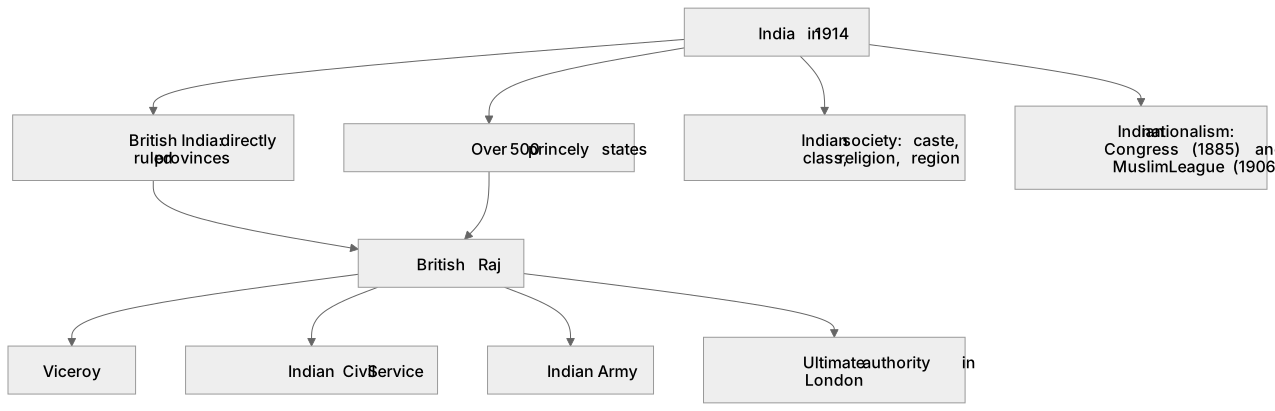
In 1914 India was not a single political unit but a patchwork of directly ruled provinces and over 500 princely states, all under the British Raj.
Checked against the Pearson Edexcel 9HI0 specification (opens in a new tab) on .
- Point 1 of 4
- 4 key terms
Study notes
From the checked teaching notes for this specification point.
The idea
In 1914 India was not a single political unit but a patchwork of directly ruled provinces and over 500 princely states, all under the British Raj. The Raj rested on the Viceroy, the Indian Civil Service and the Indian Army, with ultimate authority in London. Indian society was deeply stratified by caste, class, religion and region; Hindus formed a majority, Muslims a large minority, with Sikhs, Christians and others. Britain valued India as the 'jewel in the crown': a market for British goods, a source of raw materials and revenue, and the manpower for the Indian Army. British attitudes often combined racial superiority with a sense of duty, while Indian attitudes ranged from loyalism to growing nationalist demands. The Indian National Congress, founded in 1885, and the Muslim League, founded in 1906, pressed for greater representation and self-government.
What earns the marks
- Political geography: identify directly administered British India (e.g. Bengal, Bombay, Madras) and princely states (e.g. Hyderabad, Mysore) which accepted British paramountcy but retained internal autonomy.
- The British Raj: explain the roles of the Viceroy, the India Office in London, the Indian Civil Service and the Indian Army in maintaining control.
- Indian society and religion: describe the diversity of religions (Hinduism, Islam, Sikhism, Christianity), the caste system, and regional and linguistic divisions.
- Importance of India to Britain: assess India as a market for British exports, a source of raw materials such as cotton and tea, a field for investment, and a supplier of soldiers and revenue.
- British and Indian attitudes: contrast British beliefs in racial hierarchy and paternalism with Indian loyalism, reformism and emerging nationalism.
- Indian nationalism: outline the aims and methods of the Indian National Congress and the Muslim League by 1914, including demands for greater Indian representation in government.
Common mistakes and how to put them right
Treating India as a single uniform colony.
Put it right: Recognise the distinction between British India and the princely states, and the diversity of languages, religions and social structures.
Assuming all Indians were nationalist or all British were oppressive.
Put it right: Present a range of attitudes, including loyalism, moderate reformism and varying degrees of British paternalism and racism.
Confusing the Indian National Congress with the Muslim League.
Put it right: Note their different founding dates, membership bases and initial objectives, while acknowledging overlap in demands for representation.
Exam tips
- Use specific examples of princely states and provinces to demonstrate precise geographical knowledge.
- When discussing attitudes, refer to named individuals or groups (e.g. Viceroy, Congress leaders) to support your points.
- Link the importance of India to Britain to the wider context of British imperial strategy and economic interests.
Try the lesson
The start of the The First World War and its impact on British India, 1914–20: India in 1914: political geography; the British Raj; Indian society and religion; importance of India to Britain; British and Indian attitudes towards each other; Indian nationalism. lesson, made from checked teaching notes for this specification point.
Have a go first
In 1914, which city served as the capital of British India, where the Viceroy and the central government were based?
Listen
In 1914 India was not a single political unit but a patchwork of directly ruled provinces and over 500 princely states, all under the British Raj. The Raj rested on the Viceroy, the Indian Civil Service and the Indian Army, with ultimate authority in London. Indian society was deeply stratified by caste, class, religion and region; Hindus formed a majority, Muslims a large minority, with Sikhs, Christians and others. Britain valued India as the 'jewel in the crown': a market for British goods, a source of raw materials and revenue, and the manpower for the Indian Army. British attitudes often combined racial superiority with a sense of duty, while Indian attitudes ranged from loyalism to growing nationalist demands. The Indian National Congress, founded in 1885, and the Muslim League, founded in 1906, pressed for greater representation and self-government. A strong answer earns marks for these points. Political geography: identify directly administered British India (e.g. Bengal, Bombay, Madras) and princely states (e.g. Hyderabad, Mysore) which accepted British paramountcy but retained internal autonomy. The British Raj: explain the roles of the Viceroy, the India Office in London, the Indian Civil Service and the Indian Army in maintaining control. Indian society and religion: describe the diversity of religions (Hinduism, Islam, Sikhism, Christianity), the caste system, and regional and linguistic divisions. Importance of India to Britain: assess India as a market for British exports, a source of raw materials such as cotton and tea, a field for investment, and a supplier of soldiers and revenue. A common slip: treating India as a single uniform colony. Instead, recognise the distinction between British India and the princely states, and the diversity of languages, religions and social structures. Exam tip: Use specific examples of princely states and provinces to demonstrate precise geographical knowledge.
See it
Watch it explained
What is the one idea the video explains? Say it in a sentence.
Read the described scene instead
India in 1914 was not a single uniform colony. It was a patchwork of directly ruled provinces and over five hundred princely states under the British Raj. This lesson examines the Raj, Indian society, India's value to Britain, attitudes and nationalism by 1914. British India included directly administered provinces such as Bengal, Bombay and Madras. Princely states such as Hyderabad and Mysore accepted British paramountcy, but retained internal autonomy. So the Raj governed through both direct rule and indirect influence. The Viceroy headed the Raj in India. The India Office in London linked it to ultimate authority in London. The Indian Civil Service administered the provinces, and the Indian Army helped maintain control. Indian society was deeply stratified by caste, class, religion and region. Hindus formed a majority and Muslims a large minority, alongside Sikhs, Christians and others. Languages and regional identities also divided society. Britain valued India as the jewel in the crown. India was a market for British goods, a source of raw materials such as cotton and tea, and a field for investment. It also supplied soldiers and revenue for the empire. British attitudes often combined racial superiority with a sense of duty. Indian attitudes ranged from loyalism to reformism and growing nationalism. The Indian National Congress, founded in 1885, and the Muslim League, founded in 1906, pressed for greater representation and self-government. Avoid treating India as uniform or all Indians as nationalist.
Key words
Say what each word means before you turn the card.
Imperial control and administration
Try answering aloud or in your head before turning the card.
Social and religious diversity
Try answering aloud or in your head before turning the card.
Economic significance of India to Britain
Try answering aloud or in your head before turning the card.
Rise of Indian nationalism
Try answering aloud or in your head before turning the card.
See every definition
- Imperial control and administration
- The Raj rested on the Viceroy, the Indian Civil Service and the Indian Army, with ultimate authority in London.
- Social and religious diversity
- Indian society was deeply stratified by caste, class, religion and region, with Hindus a majority, Muslims a large minority, and Sikhs, Christians and others.
- Economic significance of India to Britain
- Britain valued India as a market for British goods, a source of raw materials and revenue, and the manpower for the Indian Army.
- Rise of Indian nationalism
- The Indian National Congress, founded in 1885, and the Muslim League, founded in 1906, pressed for greater representation and self-government.
Label the diagram
Some boxes have lost their names. Pick the right name for each number.
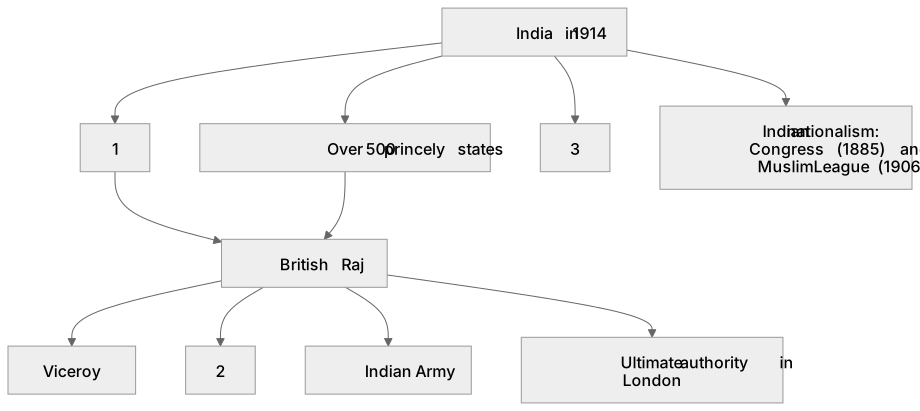
1Box 1
2Box 2
3Box 3
There is more to this lesson
The full lesson goes on to check your understanding and help you earn the marks. Create a free account to carry on, with your progress saved.
A week of Premium from your first lesson · Then the free plan continues · No card, no charge
Test your understanding of The First World War and its impact on British India, 1914–20: India in 1914: political geography; the British Raj; Indian society and religion; importance of India to Britain; British and Indian attitudes towards each other; Indian nationalism.
Active recall beats re-reading. Take an instant quiz now to test what you’ve learned and lock it into long-term memory.
A week of Premium from your first lesson · Then the free plan continues · No card, no charge