Pearson Edexcel · A-Level · History
Course version: 9HI0 · Version from Sept 2015
Growing instability, 1912–14: impact of invasion of Libya; impact of the…
Full specification wording
The liberal state, c1911–18: Growing instability, 1912–14: impact of invasion of Libya; impact of the franchise extension of 1912; growth of nationalism and socialism; resignation of Giolitti; the declaration of neutrality 1914.
Italy's Liberal state entered 1912 confident but left 1914 fragile.
Checked against the Pearson Edexcel 9HI0 specification (opens in a new tab) on .
- Point 3 of 4
- 4 key terms
Study notes
From the checked teaching notes for this specification point.
The idea
Italy's Liberal state entered 1912 confident but left 1914 fragile. The Libyan invasion (1911–12) was sold as a prestige war, yet its costs, colonial brutality and the extension of the franchise to almost all adult men in 1912 widened political participation. Nationalists demanded empire and a stronger state; socialists and Catholic deputies gained ground, while Giolitti's transformist balancing act became harder. He resigned in March 1914 after radical deputies and anti-corruption pressure, and Salandra replaced him. When war broke out in August 1914, Italy stayed out, citing the defensive nature of the Triple Alliance. Neutrality split opinion: interventionists on left and right versus neutralists. This instability exposed the weaknesses of Liberal Italy before 1915.
What earns the marks
- Explains that the Libyan war (1911–12) was presented as a route to imperial prestige and emigration relief, but its cost and the harsh occupation of Libya deepened divisions and weakened Giolitti's domestic credit.
- Assesses the 1912 franchise extension as a major step towards mass politics: it increased the electorate substantially, strengthened socialist and Catholic representation, and made transformism harder to manage.
- Traces the growth of nationalism through associations such as the ANI and the rhetoric of imperial expansion, and the growth of socialism through the PSI, trade unions and the General Confederation of Labour.
- Explains Giolitti's resignation in March 1914 as the outcome of radical and socialist opposition, corruption scandals and his loss of parliamentary control, leading to Salandra's more conservative government.
Common mistakes and how to put them right
Treating the Libyan war as a simple success.
Put it right: Balance short-term prestige against long-term instability.
Assuming the 1912 franchise extension gave all Italians the vote.
Put it right: Note that it still excluded women and younger men and retained literacy and property qualifications for some.
Confusing Giolitti's resignation with a permanent end to his influence.
Put it right: Recognise he returned as prime minister later, so 1914 marks a temporary loss of control.
Exam tips
- Link each factor to the theme of growing instability rather than narrating events in isolation.
- Use precise dates and names, such as the Treaty of Lausanne 1912, the 1912 franchise law, and Salandra's appointment in 1914.
- When discussing neutrality, distinguish the legal argument from the political debate between interventionists and neutralists.
Try the lesson
The start of the The liberal state, c1911–18: Growing instability, 1912–14: impact of invasion of Libya; impact of the franchise extension of 1912; growth of nationalism and socialism; resignation of Giolitti; the declaration of neutrality 1914. lesson, made from checked teaching notes for this specification point.
Have a go first
Which territory did Italy invade in 1911–12, a campaign that deepened the instability of the liberal state?
Listen
Italy's Liberal state entered 1912 confident but left 1914 fragile. The Libyan invasion (1911–12) was sold as a prestige war, yet its costs, colonial brutality and the extension of the franchise to almost all adult men in 1912 widened political participation. Nationalists demanded empire and a stronger state; socialists and Catholic deputies gained ground, while Giolitti's transformist balancing act became harder. He resigned in March 1914 after radical deputies and anti-corruption pressure, and Salandra replaced him. When war broke out in August 1914, Italy stayed out, citing the defensive nature of the Triple Alliance. Neutrality split opinion: interventionists on left and right versus neutralists. This instability exposed the weaknesses of Liberal Italy before 1915. A strong answer earns marks for these points. Explains that the Libyan war (1911–12) was presented as a route to imperial prestige and emigration relief, but its cost and the harsh occupation of Libya deepened divisions and weakened Giolitti's domestic credit. Assesses the 1912 franchise extension as a major step towards mass politics: it increased the electorate substantially, strengthened socialist and Catholic representation, and made transformism harder to manage. Traces the growth of nationalism through associations such as the ANI and the rhetoric of imperial expansion, and the growth of socialism through the PSI, trade unions and the General Confederation of Labour. Explains Giolitti's resignation in March 1914 as the outcome of radical and socialist opposition, corruption scandals and his loss of parliamentary control, leading to Salandra's more conservative government. A common slip: Treating the Libyan war as a simple success: the error is ignoring its financial and political costs. Instead, balance short-term prestige against long-term instability. Exam tip: Link each factor to the theme of growing instability rather than narrating events in isolation.
See it
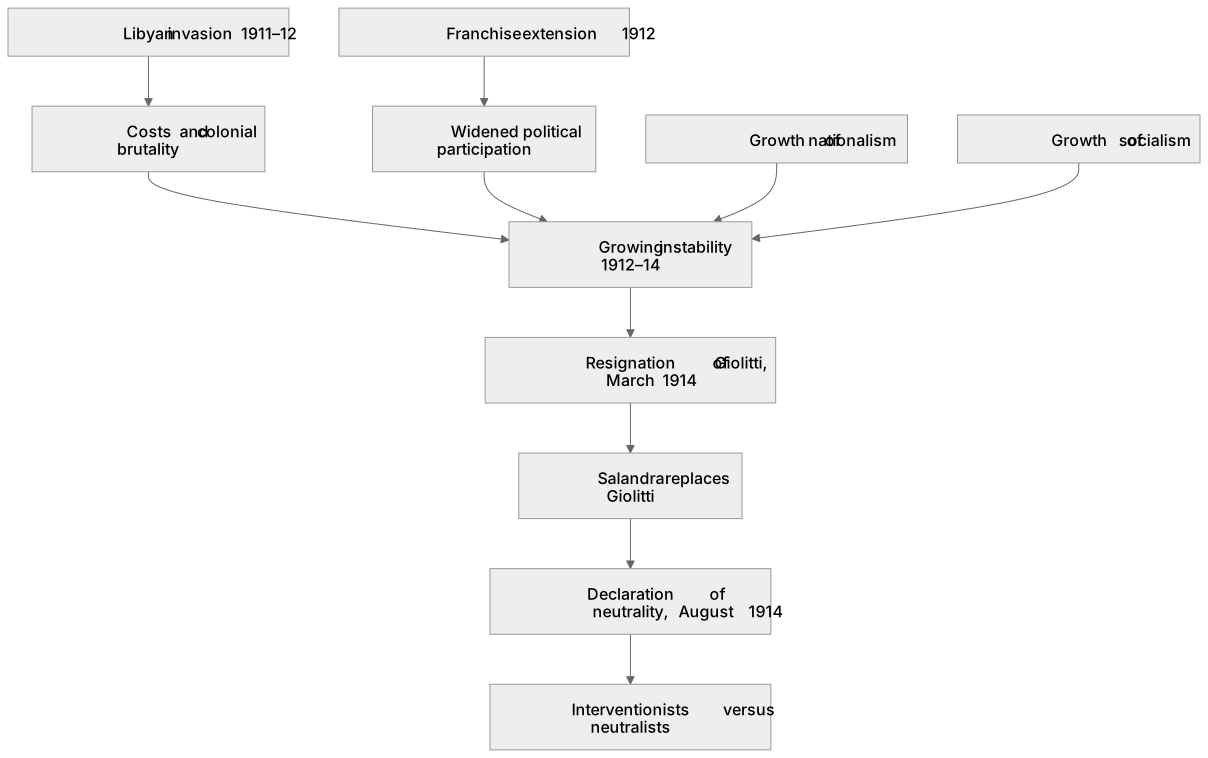
Key words
Say what each word means before you turn the card.
Mass politics and the limits of transformism
Try answering aloud or in your head before turning the card.
Nationalism, imperialism and the Libyan war
Try answering aloud or in your head before turning the card.
Socialism and organised labour
Try answering aloud or in your head before turning the card.
The crisis of the Liberal state and the neutrality debate
Try answering aloud or in your head before turning the card.
See every definition
- Mass politics and the limits of transformism
- The widening of political participation, especially through the 1912 franchise extension, which strengthened socialist and Catholic representation and made Giolitti's transformist balancing act harder to manage.
- Nationalism, imperialism and the Libyan war
- The growth of nationalism through associations such as the ANI and imperial rhetoric, alongside the Libyan invasion of 1911–12, sold as a prestige war but marked by costs and colonial brutality.
- Socialism and organised labour
- The growth of socialism through the PSI, trade unions and the General Confederation of Labour, which gained ground as political participation widened.
- The crisis of the Liberal state and the neutrality debate
- Giolitti's resignation in March 1914 after radical and socialist opposition and corruption scandals, followed by Salandra's government and the August 1914 declaration of neutrality that split interventionists and neutralists.
Label the diagram
Some boxes have lost their names. Pick the right name for each number.
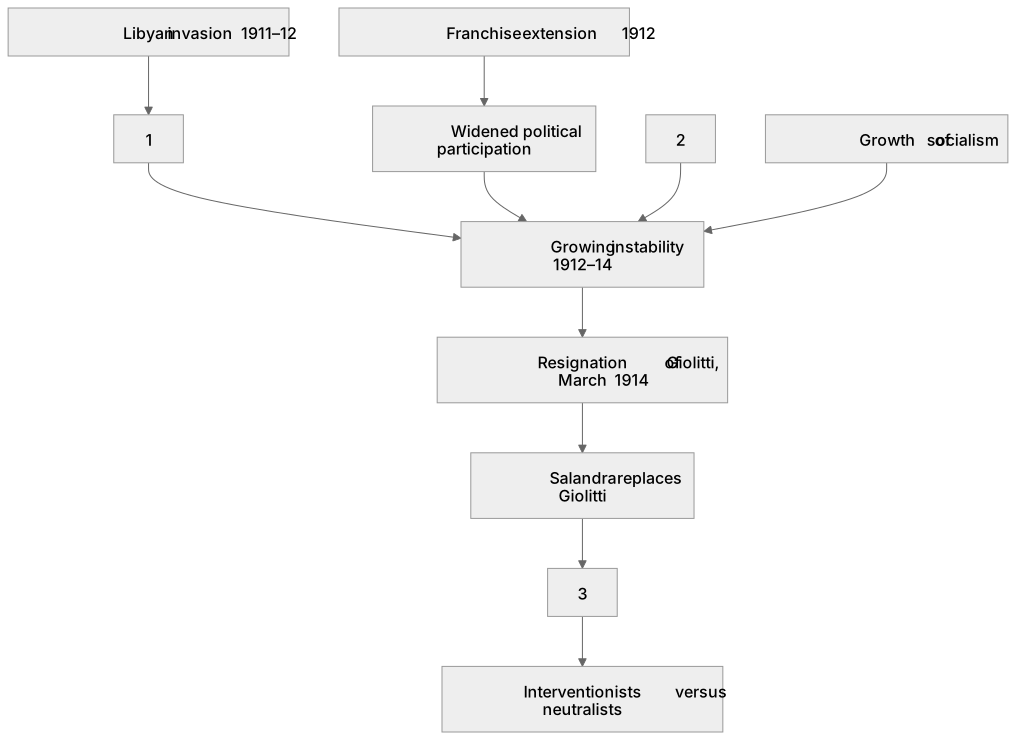
1Box 1
2Box 2
3Box 3
There is more to this lesson
The full lesson goes on to check your understanding and help you earn the marks. Create a free account to carry on, with your progress saved.
A week of Premium from your first lesson · Then the free plan continues · No card, no charge
Test your understanding of The liberal state, c1911–18: Growing instability, 1912–14: impact of invasion of Libya; impact of the franchise extension of 1912; growth of nationalism and socialism; resignation of Giolitti; the declaration of neutrality 1914.
Active recall beats re-reading. Take an instant quiz now to test what you’ve learned and lock it into long-term memory.
A week of Premium from your first lesson · Then the free plan continues · No card, no charge