Pearson Edexcel · A-Level · History
Course version: 9HI0 · Version from Sept 2015
Preconditions for ‘terror’: the significance of external threat; the…
Full specification wording
The National Convention, the Jacobins and the Terror, 1793–94: Preconditions for ‘terror’: the significance of external threat; the impact of the Vendée revolt; economic pressures; political pressures, including the Girondin purge, Federalist revolt and Marat’s death; the power of the sans-culottes and the Paris Commune.
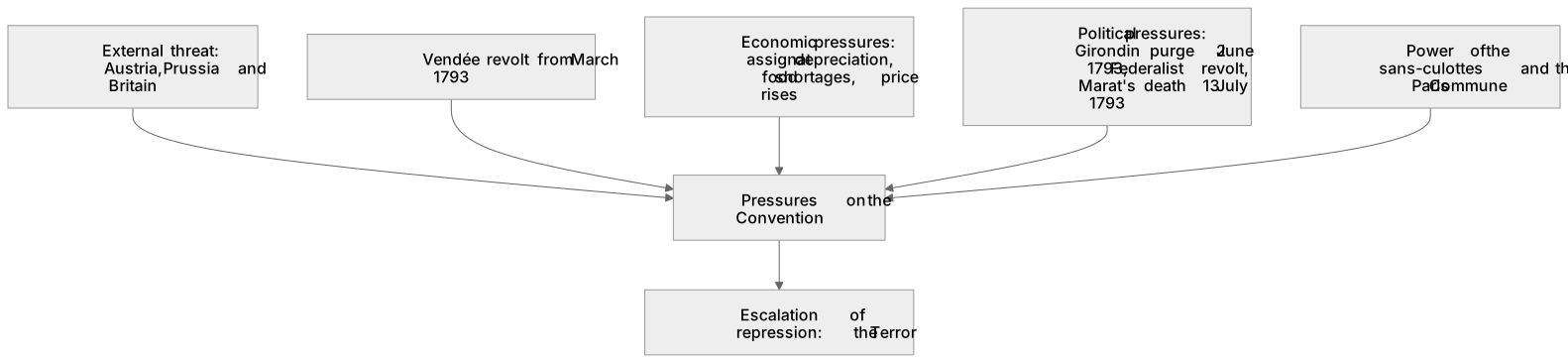
The Terror emerged from converging crises in 1793.
Checked against the Pearson Edexcel 9HI0 specification (opens in a new tab) on .
- Point 1 of 4
- 4 key terms
Study notes
From the checked teaching notes for this specification point.
The idea
The Terror emerged from converging crises in 1793. External threat: Austria, Prussia and Britain pressed France, defeats and invasion fears bred panic and demands for severity. The Vendée revolt from March 1793 tied down troops and showed internal counter-revolution. Economic pressures: assignat depreciation, food shortages and price rises fuelled popular anger. Political pressures: the Girondin purge of 2 June 1793 removed moderate voices; the Federalist revolt in provinces such as Lyon and Bordeaux challenged Paris; Marat’s assassination on 13 July 1793 made him a martyr and hardened rhetoric. The sans-culottes and Paris Commune gave popular muscle, pushing the Convention towards emergency government. Together these pressures explain why repression escalated.
What earns the marks
- Explains how external threat from Austria, Prussia and Britain created fear of invasion and internal betrayal, justifying emergency measures.
- Analyses the Vendée revolt as a counter-revolutionary uprising that stretched military resources and provoked brutal reprisals.
- Assesses economic pressures such as assignat depreciation, food shortages and inflation as drivers of popular militancy.
- Evaluates the Girondin purge of 2 June 1793 as a political turning point that removed moderate opposition to the Jacobins.
- Examines the Federalist revolt as a provincial challenge to Parisian authority that intensified suspicion of dissent.
- Explains how Marat’s death on 13 July 1793 was used to justify further repression and martyrdom of the radical cause.
- Analyses the power of the sans-culottes and the Paris Commune in pressuring the Convention towards terror.
Common mistakes and how to put them right
Treating the Terror as a single event rather than a process driven by multiple overlapping pressures.
Put it right by linking each precondition to specific decisions or escalations.
Assuming the Vendée revolt was only a peasant uprising.
Put it right by recognising its royalist, religious and anti-conscription dimensions.
Confusing the Girondin purge with the later purge of the Hébertists or Dantonists.
Put it right by dating the Girondin purge to 2 June 1793 and distinguishing its victims.
Overstating the sans-culottes as a unified revolutionary class.
Put it right by noting their diversity and specific economic grievances.
Exam tips
- Use precise dates and names to anchor each precondition, such as 2 June 1793 for the Girondin purge and 13 July 1793 for Marat’s death.
- Link each precondition to a consequence for the Convention’s authority or the escalation of repression.
- When discussing the sans-culottes, refer to specific actions such as journées or pressure on the Convention rather than general statements.
Try the lesson
The start of the The National Convention, the Jacobins and the Terror, 1793–94: Preconditions for ‘terror’: the significance of external threat; the impact of the Vendée revolt; economic pressures; political pressures, including the Girondin purge, Federalist revolt and Marat’s death; the power of the sans-culottes and the Paris Commune. lesson, made from checked teaching notes for this specification point.
Have a go first
How did the external military threat to France in 1793 act as a precondition for the Terror?
Listen
The Terror emerged from converging crises in 1793. External threat: Austria, Prussia and Britain pressed France, defeats and invasion fears bred panic and demands for severity. The Vendée revolt from March 1793 tied down troops and showed internal counter-revolution. Economic pressures: assignat depreciation, food shortages and price rises fuelled popular anger. Political pressures: the Girondin purge of 2 June 1793 removed moderate voices; the Federalist revolt in provinces such as Lyon and Bordeaux challenged Paris; Marat’s assassination on 13 July 1793 made him a martyr and hardened rhetoric. The sans-culottes and Paris Commune gave popular muscle, pushing the Convention towards emergency government. Together these pressures explain why repression escalated. A strong answer earns marks for these points. Explains how external threat from Austria, Prussia and Britain created fear of invasion and internal betrayal, justifying emergency measures. Analyses the Vendée revolt as a counter-revolutionary uprising that stretched military resources and provoked brutal reprisals. Assesses economic pressures such as assignat depreciation, food shortages and inflation as drivers of popular militancy. Evaluates the Girondin purge of 2 June 1793 as a political turning point that removed moderate opposition to the Jacobins. A common slip: Treating the Terror as a single event rather than a process driven by multiple overlapping pressures. Instead, linking each precondition to specific decisions or escalations. Exam tip: Use precise dates and names to anchor each precondition, such as 2 June 1793 for the Girondin purge and 13 July 1793 for Marat’s death.
See it
Key words
Say what each word means before you turn the card.
Revolutionary crisis and emergency government
Try answering aloud or in your head before turning the card.
Popular politics and the sans-culottes
Try answering aloud or in your head before turning the card.
Counter-revolution and internal war
Try answering aloud or in your head before turning the card.
Political factionalism and the purge of the Girondins
Try answering aloud or in your head before turning the card.
See every definition
- Revolutionary crisis and emergency government
- Converging crises in 1793, including external threat, the Vendée revolt, economic pressures and political pressures, pushed the Convention towards emergency government and escalated repression.
- Popular politics and the sans-culottes
- The sans-culottes and Paris Commune gave popular muscle, pressuring the Convention towards terror, though they were diverse and driven by specific economic grievances.
- Counter-revolution and internal war
- The Vendée revolt from March 1793 tied down troops and showed internal counter-revolution, stretching military resources and provoking brutal reprisals.
- Political factionalism and the purge of the Girondins
- The Girondin purge of 2 June 1793 removed moderate voices and moderate opposition to the Jacobins, a political turning point in the escalation of repression.
Label the diagram
Some boxes have lost their names. Pick the right name for each number.
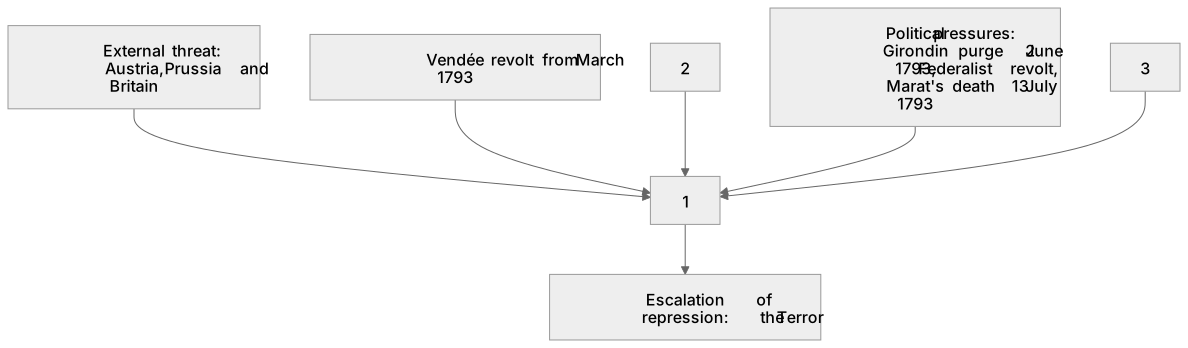
1Box 1
2Box 2
3Box 3
There is more to this lesson
The full lesson goes on to check your understanding and help you earn the marks. Create a free account to carry on, with your progress saved.
A week of Premium from your first lesson · Then the free plan continues · No card, no charge
Test your understanding of The National Convention, the Jacobins and the Terror, 1793–94: Preconditions for ‘terror’: the significance of external threat; the impact of the Vendée revolt; economic pressures; political pressures, including the Girondin purge, Federalist revolt and Marat’s death; the power of the sans-culottes and the Paris Commune.
Active recall beats re-reading. Take an instant quiz now to test what you’ve learned and lock it into long-term memory.
A week of Premium from your first lesson · Then the free plan continues · No card, no charge