Pearson Edexcel · A-Level · History
Course version: 9HI0 · Version from Sept 2015
Black American civil rights, c1917–55: life in the South and the impact of…
Full specification wording
The quest for civil rights, 1917–80: Black American civil rights, c1917–55: life in the South and the impact of northern migration, 1917–32; the impact of the New Deal, the Second World War and the Truman presidency; from legal challenge to direct action, 1917–55.
This topic explores Black American civil rights from 1917 to 1955.
Checked against the Pearson Edexcel 9HI0 specification (opens in a new tab) on .
- Point 1 of 3
- 4 key terms
Study notes
From the checked teaching notes for this specification point.
The idea
This topic explores Black American civil rights from 1917 to 1955. It begins with life in the South under Jim Crow and the impact of northern migration (1917–32), which altered demographics as many sought to escape violence. The impact of the New Deal offered economic relief but also entrenched discrimination. The Second World War and the Truman presidency advanced civil rights through executive orders, such as military desegregation, and the Double V campaign. Finally, the period saw a shift from legal challenge to direct action (1917–55), moving from NAACP court cases like Brown v. Board to grassroots protests such as the 1955 Montgomery Bus Boycott.
What earns the marks
- Describes life in the South, including Jim Crow segregation, disenfranchisement, and the push/pull factors of northern migration (1917–32).
- Assesses the mixed impact of the New Deal on Black Americans, noting both benefits and discrimination in federal programmes.
- Analyses how the Second World War and the Truman presidency advanced civil rights, including Executive Order 9981 and the 'To Secure These Rights' report.
- Traces the shift from legal challenge to direct action (1917–55), using examples such as NAACP litigation and early grassroots protests like the 1955 Montgomery Bus Boycott.
- Evaluates the extent of change by 1955, considering both progress in civil rights and persistent inequality.
Common mistakes and how to put them right
Assuming northern migration (1917–32) only had economic causes.
Put it right: Include social and political factors such as escaping violence and seeking voting rights.
Treating the New Deal as uniformly beneficial for Black Americans.
Put it right: Highlight discriminatory practices and the exclusion of many Black workers from key programmes.
Overstating the impact of Truman’s civil rights actions.
Put it right: Note that desegregation of the military was gradual and faced resistance, and that legislative change was limited.
Confusing the timeline of direct action.
Put it right: Avoid citing the 1960s mass sit-in movement for the 1917–55 period; instead, reference the 1955 Montgomery Bus Boycott or CORE's 1947 Journey of Reconciliation.
Exam tips
- Use specific examples, such as the 1919 Chicago race riot or the 1941 March on Washington Movement, to illustrate broader trends.
- When discussing the shift from legal challenge to direct action, compare early NAACP court victories with the emergence of grassroots boycotts by 1955.
Try the lesson
The start of the The quest for civil rights, 1917–80: Black American civil rights, c1917–55: life in the South and the impact of northern migration, 1917–32; the impact of the New Deal, the Second World War and the Truman presidency; from legal challenge to direct action, 1917–55. lesson, made from checked teaching notes for this specification point.
Have a go first
Which term describes the system of racial segregation and discrimination in the southern states that shaped Black American life in the early twentieth century?
Listen
This topic explores Black American civil rights from 1917 to 1955. It begins with life in the South under Jim Crow and the impact of northern migration (1917–32), which altered demographics as many sought to escape violence. The impact of the New Deal offered economic relief but also entrenched discrimination. The Second World War and the Truman presidency advanced civil rights through executive orders, such as military desegregation, and the Double V campaign. Finally, the period saw a shift from legal challenge to direct action (1917–55), moving from NAACP court cases like Brown v. Board to grassroots protests such as the 1955 Montgomery Bus Boycott. A strong answer earns marks for these points. Describes life in the South, including Jim Crow segregation, disenfranchisement, and the push/pull factors of northern migration (1917–32). Assesses the mixed impact of the New Deal on Black Americans, noting both benefits and discrimination in federal programmes. Analyses how the Second World War and the Truman presidency advanced civil rights, including Executive Order 9981 and the 'To Secure These Rights' report. Traces the shift from legal challenge to direct action (1917–55), using examples such as NAACP litigation and early grassroots protests like the 1955 Montgomery Bus Boycott. A common slip: Assuming northern migration (1917–32) only had economic causes. Instead, include social and political factors such as escaping violence and seeking voting rights. Exam tip: Use specific examples, such as the 1919 Chicago race riot or the 1941 March on Washington Movement, to illustrate broader trends.
See it
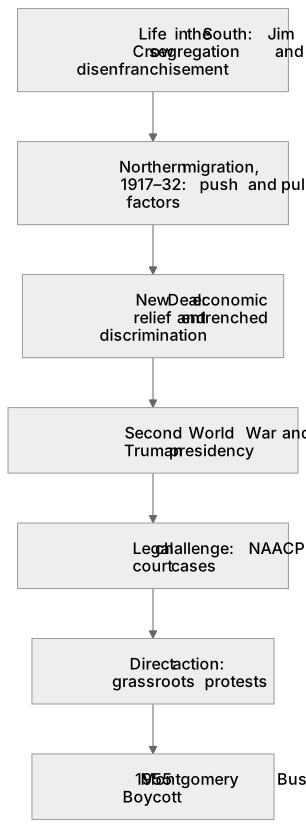
Put it in order
Put these steps in the order they happen.
- 1. 1955 Montgomery Bus Boycott
- 2. Direct action: grassroots protests
- 3. New Deal: economic relief and entrenched discrimination
- 4. Legal challenge: NAACP court cases
- 5. Life in the South: Jim Crow segregation and disenfranchisement
- 6. Northern migration, 1917–32: push and pull factors
- 7. Second World War and the Truman presidency
Key words
Say what each word means before you turn the card.
Segregation and life in the South
Try answering aloud or in your head before turning the card.
Northern migration (1917–32)
Try answering aloud or in your head before turning the card.
The impact of the New Deal, WWII and Truman
Try answering aloud or in your head before turning the card.
From legal challenge to direct action
Try answering aloud or in your head before turning the card.
See every definition
- Segregation and life in the South
- Life under Jim Crow, involving segregation and disenfranchisement, with push and pull factors prompting northern migration.
- Northern migration (1917–32)
- Movement that altered demographics as many sought to escape violence, with social and political as well as economic causes.
- The impact of the New Deal, WWII and Truman
- Economic relief that also entrenched discrimination, and civil rights advances through executive orders such as military desegregation and the Double V campaign.
- From legal challenge to direct action
- A shift from NAACP court cases like Brown v. Board to grassroots protests such as the 1955 Montgomery Bus Boycott.
Label the diagram
Some boxes have lost their names. Pick the right name for each number.
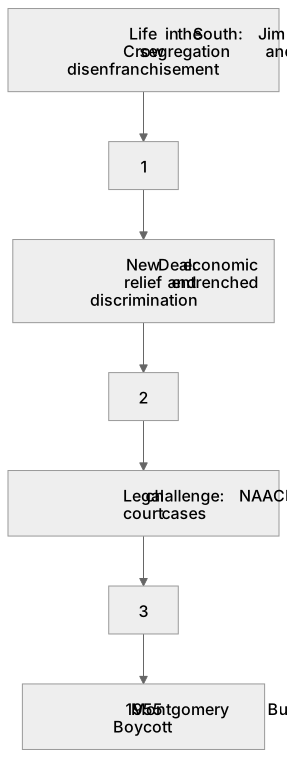
1Box 1
2Box 2
3Box 3
There is more to this lesson
The full lesson goes on to check your understanding and help you earn the marks. Create a free account to carry on, with your progress saved.
A week of Premium from your first lesson · Then the free plan continues · No card, no charge
Test your understanding of The quest for civil rights, 1917–80: Black American civil rights, c1917–55: life in the South and the impact of northern migration, 1917–32; the impact of the New Deal, the Second World War and the Truman presidency; from legal challenge to direct action, 1917–55.
Active recall beats re-reading. Take an instant quiz now to test what you’ve learned and lock it into long-term memory.
A week of Premium from your first lesson · Then the free plan continues · No card, no charge