Pearson Edexcel · A-Level · History
Course version: 9HI0 · Version from Sept 2015
Withdrawal, partition and independence, 1947–48: Mountbatten and the…
Full specification wording
The road to independence, 1942–48: Withdrawal, partition and independence, 1947–48: Mountbatten and the decision to withdraw; reasons for partition and the nationalist response; the partition plan; the Boundary Commission; independence for India and Pakistan. British withdrawal and communal violence.
In 1947, Mountbatten became Viceroy and quickly concluded that Britain must withdraw.
Checked against the Pearson Edexcel 9HI0 specification (opens in a new tab) on .
- Point 4 of 4
- 4 key terms
Study notes
From the checked teaching notes for this specification point.
The idea
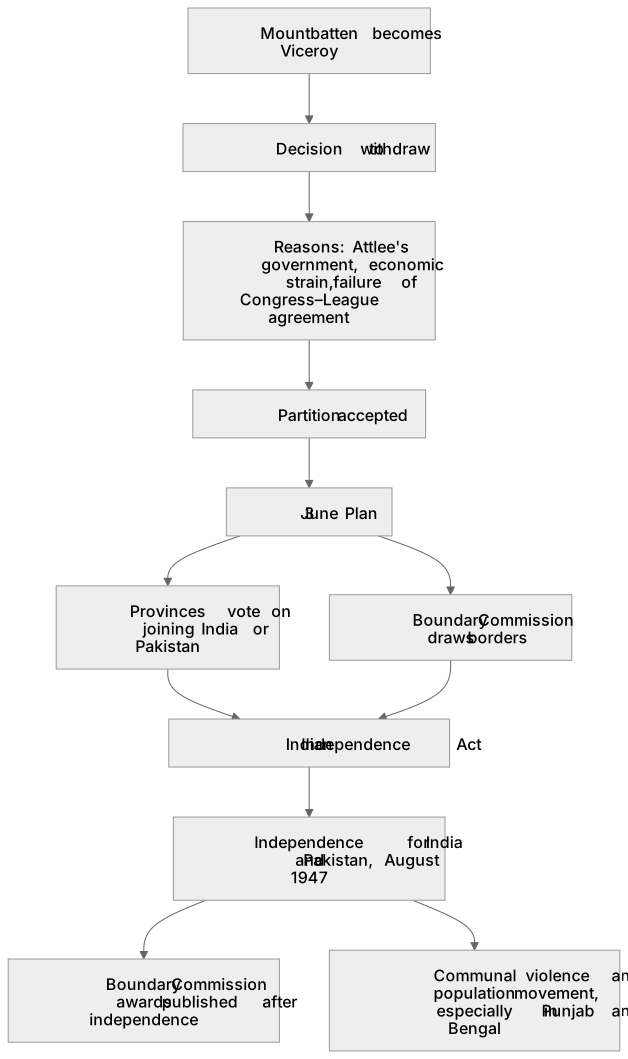
In 1947, Mountbatten became Viceroy and quickly concluded that Britain must withdraw. The decision to leave was driven by Attlee's government, economic strain, and the failure of Congress–League agreement. Partition was accepted because Congress and the League could not agree on a united India, and the League's demand for Pakistan had mass support. The 3 June Plan set out partition, with provinces voting on joining India or Pakistan and a Boundary Commission to draw borders. The Indian Independence Act made India and Pakistan independent dominions in August 1947. The Boundary Commission's awards, published after independence, caused confusion and anger. British withdrawal was followed by massive communal violence and population movement, especially in Punjab and Bengal.
What earns the marks
- Explains Mountbatten's role in accelerating withdrawal and persuading leaders to accept partition as the only practical solution.
- Analyses the reasons for partition: Congress–League deadlock, the League's Pakistan demand, and the failure of the Cabinet Mission.
- Describes the 3 June Plan and the Indian Independence Act, including the choice for provinces and the creation of two dominions.
- Explains the Boundary Commission's work under Radcliffe and why its awards were controversial, especially in Punjab and Bengal.
- Assesses the consequences: independence for India and Pakistan, British withdrawal, and widespread communal violence and migration.
Common mistakes and how to put them right
Thinking Mountbatten alone decided to withdraw.
Put it right: The Attlee government decided, and Mountbatten implemented and accelerated the timetable.
Assuming the Boundary Commission's awards were published before independence.
Put it right: They were published after 15 August 1947, adding to confusion.
Treating partition as peaceful.
Put it right: It was accompanied by severe communal violence and mass displacement, particularly in Punjab and Bengal.
Exam tips
- Use key dates: 3 June Plan 1947, Indian Independence Act July 1947, independence 14–15 August 1947.
- Explain both short-term triggers and long-term causes of partition, and link them to the decisions of 1947.
- Discuss the nationalist responses: Congress accepted partition reluctantly, the League celebrated Pakistan, and many were displaced or killed.
Try the lesson
The start of the The road to independence, 1942–48: Withdrawal, partition and independence, 1947–48: Mountbatten and the decision to withdraw; reasons for partition and the nationalist response; the partition plan; the Boundary Commission; independence for India and Pakistan. British withdrawal and communal violence. lesson, made from checked teaching notes for this specification point.
Have a go first
Who was appointed Viceroy of India in March 1947 with the task of arranging the British withdrawal?
Listen
In 1947, Mountbatten became Viceroy and quickly concluded that Britain must withdraw. The decision to leave was driven by Attlee's government, economic strain, and the failure of Congress–League agreement. Partition was accepted because Congress and the League could not agree on a united India, and the League's demand for Pakistan had mass support. The 3 June Plan set out partition, with provinces voting on joining India or Pakistan and a Boundary Commission to draw borders. The Indian Independence Act made India and Pakistan independent dominions in August 1947. The Boundary Commission's awards, published after independence, caused confusion and anger. British withdrawal was followed by massive communal violence and population movement, especially in Punjab and Bengal. A strong answer earns marks for these points. Explains Mountbatten's role in accelerating withdrawal and persuading leaders to accept partition as the only practical solution. Analyses the reasons for partition: Congress–League deadlock, the League's Pakistan demand, and the failure of the Cabinet Mission. Describes the 3 June Plan and the Indian Independence Act, including the choice for provinces and the creation of two dominions. Explains the Boundary Commission's work under Radcliffe and why its awards were controversial, especially in Punjab and Bengal. A common slip: Thinking Mountbatten alone decided to withdraw. Instead, the Attlee government decided, and Mountbatten implemented and accelerated the timetable. Exam tip: Use key dates: 3 June Plan 1947, Indian Independence Act July 1947, independence 14–15 August 1947.
See it
Key words
Say what each word means before you turn the card.
Decolonisation and British withdrawal
Try answering aloud or in your head before turning the card.
Partition and its human cost
Try answering aloud or in your head before turning the card.
Nationalism and communal identity
Try answering aloud or in your head before turning the card.
Consequences of independence
Try answering aloud or in your head before turning the card.
See every definition
- Decolonisation and British withdrawal
- Mountbatten became Viceroy and quickly concluded that Britain must withdraw, a decision driven by Attlee's government, economic strain and the failure of Congress–League agreement.
- Partition and its human cost
- Partition was accepted because Congress and the League could not agree on a united India, and it was followed by massive communal violence and population movement, especially in Punjab and Bengal.
- Nationalism and communal identity
- The League's demand for Pakistan had mass support, while Congress accepted partition reluctantly and the League celebrated Pakistan.
- Consequences of independence
- The Indian Independence Act made India and Pakistan independent dominions in August 1947, and British withdrawal was followed by massive communal violence and population movement.
Label the diagram
Some boxes have lost their names. Pick the right name for each number.
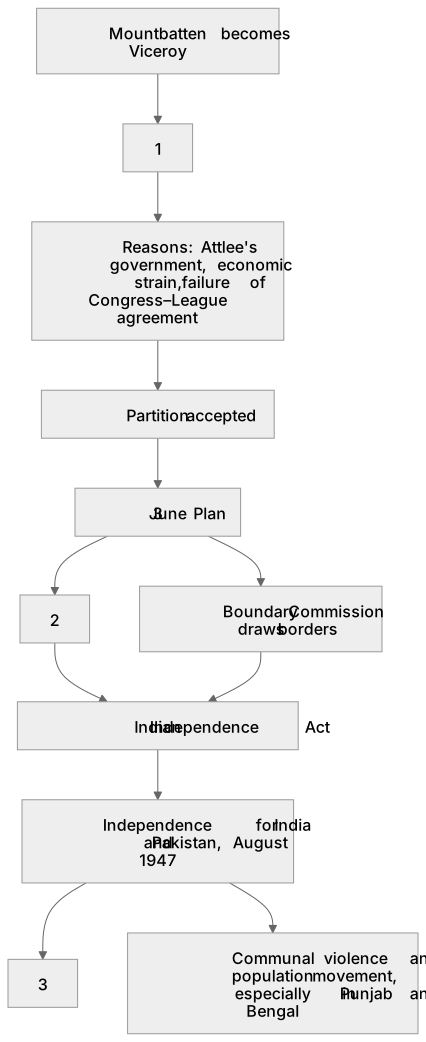
1Box 1
2Box 2
3Box 3
There is more to this lesson
The full lesson goes on to check your understanding and help you earn the marks. Create a free account to carry on, with your progress saved.
A week of Premium from your first lesson · Then the free plan continues · No card, no charge
Test your understanding of The road to independence, 1942–48: Withdrawal, partition and independence, 1947–48: Mountbatten and the decision to withdraw; reasons for partition and the nationalist response; the partition plan; the Boundary Commission; independence for India and Pakistan. British withdrawal and communal violence.
Active recall beats re-reading. Take an instant quiz now to test what you’ve learned and lock it into long-term memory.
A week of Premium from your first lesson · Then the free plan continues · No card, no charge