Pearson Edexcel · A-Level · History
Course version: 9HI0 · Version from Sept 2015
The 1905 Revolution: the impact of the Russo-Japanese war; Bloody Sunday;…
Full specification wording
The rule of Nicholas II, 1894–1905: The 1905 Revolution: the impact of the Russo-Japanese war; Bloody Sunday; the spread of revolutionary activity among peasants, workers and national minorities; the St. Petersburg Soviet.
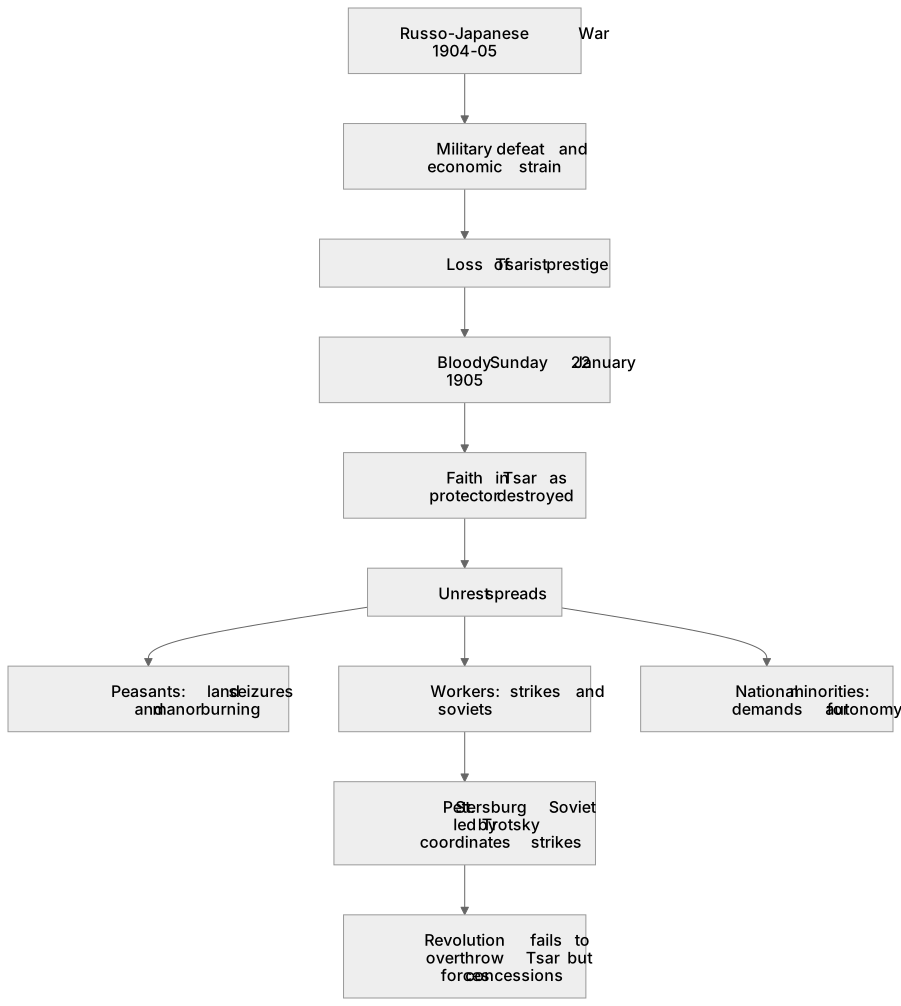
The 1905 Revolution was a wave of unrest triggered by the Russo-Japanese War (1904–05), which exposed military incompetence and economic strain.
Checked against the Pearson Edexcel 9HI0 specification (opens in a new tab) on .
- Point 3 of 4
- 4 key terms
Study notes
From the checked teaching notes for this specification point.
The idea
The 1905 Revolution was a wave of unrest triggered by the Russo-Japanese War (1904–05), which exposed military incompetence and economic strain. Defeat at Tsushima and Mukden undermined Tsarist prestige. On 22 January 1905, peaceful protesters led by Father Gapon marched to the Winter Palace with a petition; troops fired on them, killing hundreds. This 'Bloody Sunday' destroyed faith in the Tsar as 'Little Father'. Unrest spread: peasants seized land and burned manor houses; workers struck and formed soviets; national minorities (Poles, Finns, Balts, Georgians) demanded autonomy. The St. Petersburg Soviet, led by Trotsky, coordinated strikes in October 1905. Although the revolution failed to overthrow the Tsar, it forced concessions and revealed the depth of discontent.
What earns the marks
- Explain how the Russo-Japanese War (1904–05) caused military defeat, economic hardship and loss of prestige, contributing to the 1905 Revolution.
- Describe Bloody Sunday (22 January 1905) as a peaceful protest led by Father Gapon that was violently suppressed, destroying the myth of the Tsar as protector of the people.
- Analyse how revolutionary activity spread among peasants (land seizures, riots), workers (strikes, trade unions) and national minorities (demands for autonomy in Poland, Finland, Georgia).
- Assess the role of the St. Petersburg Soviet (led by Trotsky) in coordinating strikes and providing a model of organised opposition, despite its eventual suppression.
- Evaluate the extent to which the 1905 Revolution was a spontaneous outburst versus a coordinated movement, and its long-term significance for Tsarist rule.
Common mistakes and how to put them right
Confusing the Russo-Japanese War (1904–05) with the First World War as the trigger for the 1905 Revolution.
Put it right: The 1905 Revolution was directly sparked by the Russo-Japanese War and Bloody Sunday, while WWI contributed to the 1917 Revolutions.
Believing that Bloody Sunday was a violent uprising by revolutionaries.
Put it right: It was a peaceful march led by Father Gapon to present a petition to the Tsar; the violence came from the Tsar's troops.
Assuming the St. Petersburg Soviet was a permanent government.
Put it right: It was a temporary council of workers' deputies that coordinated strikes and was crushed in December 1905; it did not replace the Tsarist state.
Exam tips
- Use specific dates and names (e.g., 22 January 1905, Father Gapon, Trotsky) to demonstrate precise knowledge.
- Link each factor (war, Bloody Sunday, spread of unrest, Soviet) to the overall impact on Tsarist authority and the extent of revolution.
- When discussing the spread of revolutionary activity, give examples for each group (peasants, workers, national minorities) to show breadth.
- Evaluate the relative importance of different factors rather than just describing them; for example, argue whether Bloody Sunday or the war was more decisive.
Try the lesson
The start of the The rule of Nicholas II, 1894–1905: The 1905 Revolution: the impact of the Russo-Japanese war; Bloody Sunday; the spread of revolutionary activity among peasants, workers and national minorities; the St. Petersburg Soviet. lesson, made from checked teaching notes for this specification point.
Have a go first
Which event on 22 January 1905 is seen as the start of the 1905 Revolution?
Listen
The 1905 Revolution was a wave of unrest triggered by the Russo-Japanese War (1904–05), which exposed military incompetence and economic strain. Defeat at Tsushima and Mukden undermined Tsarist prestige. On 22 January 1905, peaceful protesters led by Father Gapon marched to the Winter Palace with a petition; troops fired on them, killing hundreds. This 'Bloody Sunday' destroyed faith in the Tsar as 'Little Father'. Unrest spread: peasants seized land and burned manor houses; workers struck and formed soviets; national minorities (Poles, Finns, Balts, Georgians) demanded autonomy. The St. Petersburg Soviet, led by Trotsky, coordinated strikes in October 1905. Although the revolution failed to overthrow the Tsar, it forced concessions and revealed the depth of discontent. A strong answer earns marks for these points. Explain how the Russo-Japanese War (1904–05) caused military defeat, economic hardship and loss of prestige, contributing to the 1905 Revolution. Describe Bloody Sunday (22 January 1905) as a peaceful protest led by Father Gapon that was violently suppressed, destroying the myth of the Tsar as protector of the people. Analyse how revolutionary activity spread among peasants (land seizures, riots), workers (strikes, trade unions) and national minorities (demands for autonomy in Poland, Finland, Georgia). Assess the role of the St. Petersburg Soviet (led by Trotsky) in coordinating strikes and providing a model of organised opposition, despite its eventual suppression. A common slip: Confusing the Russo-Japanese War (1904–05) with the First World War as the trigger for the 1905 Revolution. Instead, The 1905 Revolution was directly sparked by the Russo-Japanese War and Bloody Sunday, while WWI contributed to the 1917 Revolutions. Exam tip: Use specific dates and names (e.g., 22 January 1905, Father Gapon, Trotsky) to demonstrate precise knowledge.
See it
Key words
Say what each word means before you turn the card.
Bloody Sunday
Try answering aloud or in your head before turning the card.
St. Petersburg Soviet
Try answering aloud or in your head before turning the card.
Russo-Japanese War
Try answering aloud or in your head before turning the card.
national minorities
Try answering aloud or in your head before turning the card.
See every definition
- Bloody Sunday
- On 22 January 1905 troops fired on peaceful protesters led by Father Gapon marching to the Winter Palace with a petition, killing hundreds and destroying faith in the Tsar as 'Little Father'.
- St. Petersburg Soviet
- A council of workers' deputies led by Trotsky that coordinated strikes in October 1905 and provided a model of organised opposition, despite its eventual suppression.
- Russo-Japanese War
- The 1904–05 conflict that exposed military incompetence and economic strain, and whose defeat at Tsushima and Mukden undermined Tsarist prestige.
- national minorities
- Groups such as Poles, Finns, Balts and Georgians who demanded autonomy during the spread of unrest in the 1905 Revolution.
Label the diagram
Some boxes have lost their names. Pick the right name for each number.
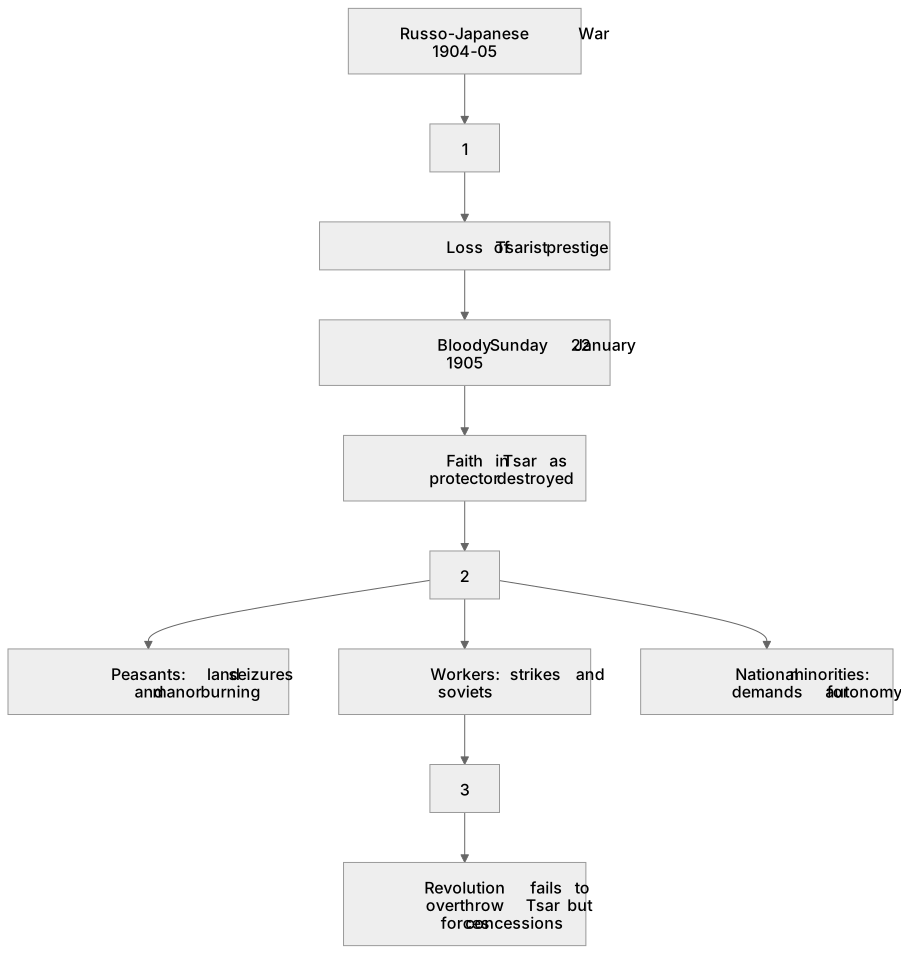
1Box 1
2Box 2
3Box 3
There is more to this lesson
The full lesson goes on to check your understanding and help you earn the marks. Create a free account to carry on, with your progress saved.
A week of Premium from your first lesson · Then the free plan continues · No card, no charge
Test your understanding of The rule of Nicholas II, 1894–1905: The 1905 Revolution: the impact of the Russo-Japanese war; Bloody Sunday; the spread of revolutionary activity among peasants, workers and national minorities; the St. Petersburg Soviet.
Active recall beats re-reading. Take an instant quiz now to test what you’ve learned and lock it into long-term memory.
A week of Premium from your first lesson · Then the free plan continues · No card, no charge