Pearson Edexcel · A-Level · History
Course version: 9HI0 · Version from Sept 2015
The importance of humanitarian campaigns and the influence of religion.
Full specification wording
What explains the abolition of the slave trade at the end of the period, c1785–1807?: The importance of humanitarian campaigns and the influence of religion.
Humanitarian campaigns and religious influence were crucial in driving the abolition of the slave trade between c1785 and c1807.
Checked against the Pearson Edexcel 9HI0 specification (opens in a new tab) on .
- Point 1 of 4
- 2 key terms
Study notes
From the checked teaching notes for this specification point.
The idea
Humanitarian campaigns and religious influence were crucial in driving the abolition of the slave trade between c1785 and c1807. Campaigners like Thomas Clarkson and William Wilberforce gathered evidence of the Middle Passage's horrors, mobilising public opinion through pamphlets, petitions, and the Society for Effecting the Abolition of the Slave Trade. Evangelical Christianity, particularly the Clapham Sect, provided moral impetus, framing slavery as a sin against God. Quakers were also instrumental, initiating early petitions and boycotts of slave-grown sugar.
What earns the marks
- Explains the methods of humanitarian campaigns, including Clarkson's evidence gathering, petitions, and the sugar boycott.
- Analyses the influence of religion, particularly the role of Quakers and Evangelical Anglicans like Wilberforce in framing abolition as a moral imperative.
- Assesses the impact of the Society for Effecting the Abolition of the Slave Trade on public opinion and parliamentary debate.
- Evaluates the relative importance of humanitarian and religious factors compared to economic changes and slave resistance.
Common mistakes and how to put them right
Attributing abolition solely to Wilberforce.
Put it right: Acknowledge the vital grassroots campaigning by Clarkson, Quakers, and women.
Ignoring the role of religion.
Put it right: Explicitly discuss how Evangelical and Quaker beliefs provided the moral framework for the campaign.
Treating humanitarianism as the only factor.
Put it right: Weigh moral campaigns against economic arguments and the context of the Haitian Revolution.
Exam tips
- Anchor arguments in specific examples, such as the 1787 formation of the Abolition Society or the 1791 sugar boycott.
- Address both humanitarian campaigns and religious influence, showing how they intertwined to mobilise public support.
Try the lesson
The start of the What explains the abolition of the slave trade at the end of the period, c1785–1807?: The importance of humanitarian campaigns and the influence of religion. lesson, made from checked teaching notes for this specification point.
Have a go first
Which religious group formed the majority of the founding committee of the Society for Effecting the Abolition of the Slave Trade in 1787?
Listen
Humanitarian campaigns and religious influence were crucial in driving the abolition of the slave trade between c1785 and c1807. Campaigners like Thomas Clarkson and William Wilberforce gathered evidence of the Middle Passage's horrors, mobilising public opinion through pamphlets, petitions, and the Society for Effecting the Abolition of the Slave Trade. Evangelical Christianity, particularly the Clapham Sect, provided moral impetus, framing slavery as a sin against God. Quakers were also instrumental, initiating early petitions and boycotts of slave-grown sugar. A strong answer earns marks for these points. Explains the methods of humanitarian campaigns, including Clarkson's evidence gathering, petitions, and the sugar boycott. Analyses the influence of religion, particularly the role of Quakers and Evangelical Anglicans like Wilberforce in framing abolition as a moral imperative. Assesses the impact of the Society for Effecting the Abolition of the Slave Trade on public opinion and parliamentary debate. Evaluates the relative importance of humanitarian and religious factors compared to economic changes and slave resistance. A common slip: Attributing abolition solely to Wilberforce. Instead, acknowledge the vital grassroots campaigning by Clarkson, Quakers, and women. Exam tip: Anchor arguments in specific examples, such as the 1787 formation of the Abolition Society or the 1791 sugar boycott.
See it
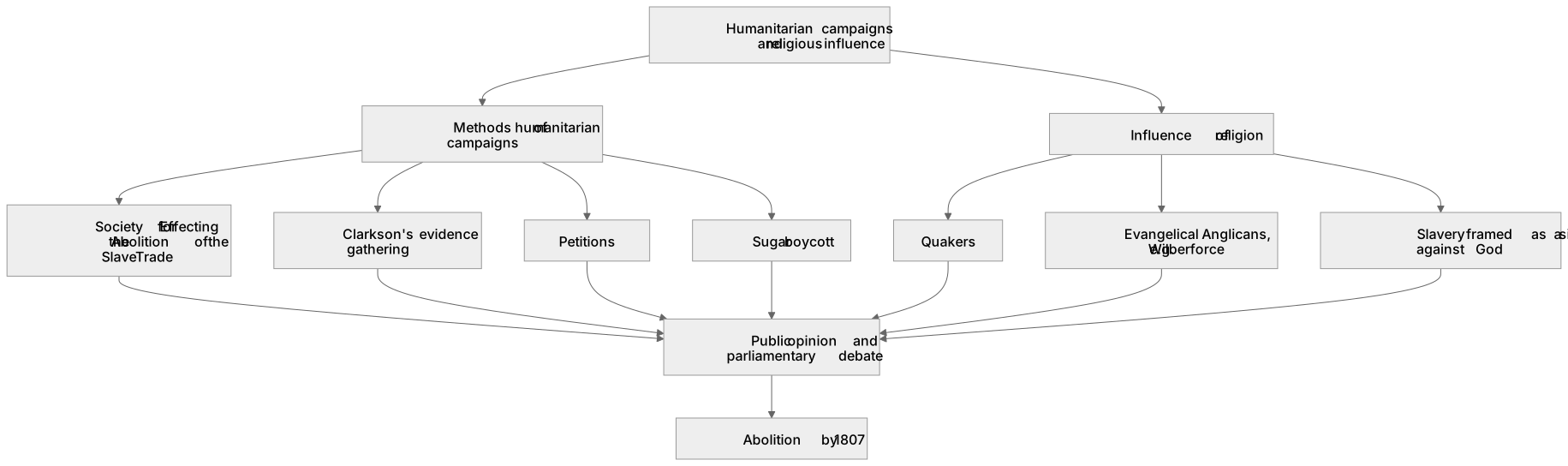
Watch it explained
Assess the importance of humanitarian campaigns and religious influence in explaining the abolition of the slave trade, c1785–1807.
Read the described scene instead
Welcome to this interactive study breakdown on the abolition of the slave trade at the end of the period, c1785–1807. This guide focuses on two central explanations: humanitarian campaigning and the influence of religion. We will examine how campaigners such as Thomas Clarkson and William Wilberforce, alongside Quakers and Evangelical Christians, gathered evidence, mobilised public opinion and pressed Parliament. We will also assess how far these moral and religious campaigns changed parliamentary attitudes, weighing their importance against economic factors and the impact of slave resistance, such as the Haitian Revolution. Let us map the core explanations. Humanitarian campaigning provided methods and momentum: Clarkson gathered evidence of the horrors of the Middle Passage, while pamphlets and petitions mobilised public opinion. Religion supplied a powerful moral framework. Evangelical Christianity, particularly the Clapham Sect, framed slavery as a sin against God, and Quakers were instrumental in initiating early petitions and boycotts of slave-grown sugar. Parliamentary politics connected this pressure to Westminster, especially through Wilberforce and the Society for Effecting the Abolition of the Slave Trade. The key exam skill is to show how these strands intertwined. Turning to our core study notes, humanitarian campaigns and religious influence were crucial in driving abolition between c1785 and 1807. Campaigners like Thomas Clarkson gathered evidence of the horrors of the Middle Passage and mobilised public opinion through pamphlets, petitions and the Society for Effecting the Abolition of the Slave Trade. Evangelical Christianity, particularly the Clapham Sect, provided moral impetus by framing slavery as a sin against God. Quakers were also instrumental, initiating early petitions and boycotts of slave-grown sugar. Evangelical Anglicans such as Wilberforce helped turn this moral imperative into parliamentary pressure. These details are the evidence you should anchor your answers in. How did moral and religious campaigning become political pressure? First, campaigners gathered evidence of the horrors of the Middle Passage, giving abolition arguments a factual and emotional force. Second, they mobilised public opinion through pamphlets and petitions. Third, Quakers and others organised boycotts of slave-grown sugar, giving ordinary people a practical way to support the cause. Fourth, the Society for Effecting the Abolition of the Slave Trade helped coordinate campaigners and connect their activity to parliamentary debate. Finally, figures such as Wilberforce pressed the issue through parliamentary politics. This sequence shows that abolition was not the work of one person alone; it depended on grassroots campaigning and organised public pressure. Let us work through an A-Level question on the importance of humanitarian campaigns and religious influence. Start with Clarkson's evidence gathering and the way campaigners mobilised public opinion through pamphlets and petitions. Then analyse the religious dimension: Quakers and Evangelical Anglicans, including the Clapham Sect and Wilberforce, framed slavery as a sin against God and made abolition a moral imperative. Next, link the Society for Effecting the Abolition of the Slave Trade to parliamentary debate. For a strong judgement, do not stop there: weigh these moral and religious factors against economic factors and the impact of slave resistance, such as the Haitian Revolution. The best answers show both the importance and the limits of humanitarian and religious explanations. Watch out for common pitfalls. First, do not attribute abolition solely to Wilberforce; acknowledge the vital grassroots campaigning by Clarkson, Quakers and women. Second, do not ignore religion; explicitly discuss how Evangelical and Quaker beliefs provided the moral framework for the campaign. Third, do not treat humanitarianism as the only factor; weigh moral campaigns against economic arguments and the context of the Haitian Revolution. For exam technique, anchor your arguments in specific examples, such as the 1787 formation of the Abolition Society or the 1791 sugar boycott. Finally, address both humanitarian campaigns and religious influence, and show how they intertwined to mobilise public support. To recap, the abolition of the slave trade by 1807 is explained in this guide through humanitarian campaigning, public mobilisation and religious influence. Clarkson's evidence gathering, pamphlets and petitions built pressure. Evangelicalism and the Quakers supplied a moral framework, while parliamentary politics and Wilberforce's role connected that pressure to debate. But a top-level answer must assess relative importance: weigh these moral and religious factors against economic changes and slave resistance, such as the Haitian Revolution. Use specific examples, including the 1787 formation of the Abolition Society and the 1791 sugar boycott, and remember that these campaigns intertwined rather than operating alone.
Key words
Say what each word means before you turn the card.
Humanitarian campaigning and public mobilisation
Try answering aloud or in your head before turning the card.
The influence of Evangelicalism and Quakers
Try answering aloud or in your head before turning the card.
See every definition
- Humanitarian campaigning and public mobilisation
- Campaigners gathered evidence of the Middle Passage's horrors and mobilised public opinion through pamphlets, petitions and the Society for Effecting the Abolition of the Slave Trade.
- The influence of Evangelicalism and Quakers
- Evangelical Christianity, particularly the Clapham Sect, provided moral impetus by framing slavery as a sin against God, while Quakers initiated early petitions and boycotts of slave-grown sugar.
Label the diagram
Some boxes have lost their names. Pick the right name for each number.
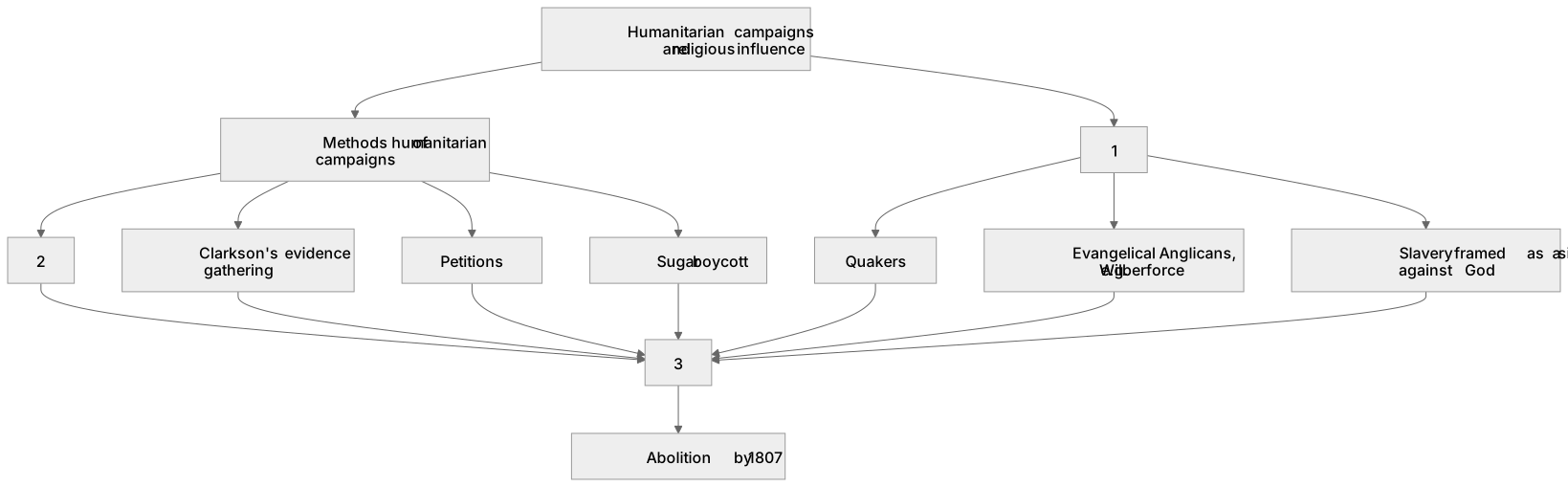
1Box 1
2Box 2
3Box 3
There is more to this lesson
The full lesson goes on to check your understanding and help you earn the marks. Create a free account to carry on, with your progress saved.
A week of Premium from your first lesson · Then the free plan continues · No card, no charge
Test your understanding of What explains the abolition of the slave trade at the end of the period, c1785–1807?: The importance of humanitarian campaigns and the influence of religion.
Active recall beats re-reading. Take an instant quiz now to test what you’ve learned and lock it into long-term memory.
A week of Premium from your first lesson · Then the free plan continues · No card, no charge