Pearson Edexcel · A-Level · History
Course version: 9HI0 · Version from Sept 2015
The significance of individuals, including Thomas Clarkson, William…
Full specification wording
What explains the abolition of the slave trade at the end of the period, c1785–1807?: The significance of individuals, including Thomas Clarkson, William Wilberforce, Olaudah Equiano.
Abolition was not one person's achievement.
Checked against the Pearson Edexcel 9HI0 specification (opens in a new tab) on .
- Point 3 of 4
- 4 key terms
Study notes
From the checked teaching notes for this specification point.
The idea
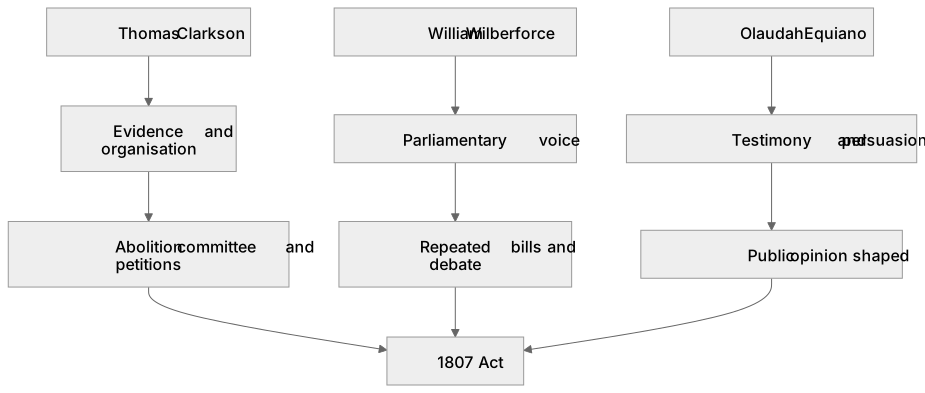
Abolition was not one person's achievement. Clarkson supplied evidence and organisation: he gathered testimony, statistics and cargo manifests, toured the country, and helped found the committee that coordinated petitions. Wilberforce supplied the parliamentary voice, repeatedly introducing bills and steering debate until the 1807 Act ended British participation in the slave trade. Equiano supplied testimony and persuasion: his narrative and speaking tours made the Middle Passage vivid to readers who would never see it. Assess significance by asking what each could do that others could not, and how their roles complemented one another.
What earns the marks
- Explains Clarkson's contribution as evidence-gathering, investigation of ships and cargoes, and nationwide organisation of the abolition campaign.
- Explains Wilberforce's contribution as sustained parliamentary leadership, repeated motions and management of the bill that became the 1807 Act.
- Explains Equiano's contribution as first-hand testimony, published narrative and public speaking that shaped opinion.
- Judges relative significance by function: evidence, legislation and persuasion were different but interdependent roles.
- Uses specific evidence, such as the 1807 Act or the work of the abolition committee, to support the judgement.
Common mistakes and how to put them right
Crediting one individual with ending the slave trade alone.
Put it right by showing how evidence, parliamentary pressure and public persuasion combined.
Treating Equiano only as a victim rather than as an active campaigner.
Put it right by discussing his narrative and speaking as deliberate political action.
Assuming Wilberforce acted without organised support.
Put it right by linking his bills to the committee, petitions and public campaigning.
Exam tips
- Anchor each individual to a distinct function before comparing their significance.
- Use precise dates and measures, such as the 1807 Act, rather than vague claims about reform.
- Reach a clear relative judgement instead of listing three separate biographies.
Try the lesson
The start of the What explains the abolition of the slave trade at the end of the period, c1785–1807?: The significance of individuals, including Thomas Clarkson, William Wilberforce, Olaudah Equiano. lesson, made from checked teaching notes for this specification point.
Have a go first
Which abolitionist provided crucial first-hand testimony of the Middle Passage by publishing a widely read autobiography in 1789?
Listen
Abolition was not one person's achievement. Clarkson supplied evidence and organisation: he gathered testimony, statistics and cargo manifests, toured the country, and helped found the committee that coordinated petitions. Wilberforce supplied the parliamentary voice, repeatedly introducing bills and steering debate until the 1807 Act ended British participation in the slave trade. Equiano supplied testimony and persuasion: his narrative and speaking tours made the Middle Passage vivid to readers who would never see it. Assess significance by asking what each could do that others could not, and how their roles complemented one another. A strong answer earns marks for these points. Explains Clarkson's contribution as evidence-gathering, investigation of ships and cargoes, and nationwide organisation of the abolition campaign. Explains Wilberforce's contribution as sustained parliamentary leadership, repeated motions and management of the bill that became the 1807 Act. Explains Equiano's contribution as first-hand testimony, published narrative and public speaking that shaped opinion. Judges relative significance by function: evidence, legislation and persuasion were different but interdependent roles. A common slip: Crediting one individual with ending the slave trade alone. Instead, showing how evidence, parliamentary pressure and public persuasion combined. Exam tip: Anchor each individual to a distinct function before comparing their significance.
See it
Watch it explained
What is the one idea the video explains? Say it in a sentence.
Read the described scene instead
Between c1785 and 1807, British abolition of the slave trade was not one person's achievement. It combined evidence, parliamentary pressure and public persuasion, with different campaigners doing different jobs. Think of the campaign as three functions. Clarkson supplied evidence and organisation. Wilberforce supplied the parliamentary voice. Equiano supplied first-hand testimony and persuasion. Their roles complemented one another rather than competing as separate biographies. Thomas Clarkson gathered testimony, statistics and cargo manifests. He toured the country and helped found the committee that coordinated petitions. This gave abolitionists a shared evidence base and a national organisation, not just a moral slogan. William Wilberforce repeatedly introduced bills and steered debate until the 1807 Act ended British participation in the slave trade. Olaudah Equiano's narrative and speaking tours made the Middle Passage vivid to readers who would never see it. Both turned campaign material into pressure. To judge relative significance, ask what each person could do that others could not. Clarkson could gather evidence; Wilberforce could introduce bills; Equiano could testify from experience. Pause briefly: which function was indispensable in 1807? The stronger answer links evidence, legislation and persuasion, then judges their interdependence. Avoid crediting one individual with ending the slave trade alone. Avoid treating Equiano only as a victim; his narrative and speaking were deliberate political action. Avoid assuming Wilberforce acted without organised support; his bills rested on the committee, petitions and public campaigning. So abolition is best explained by combining functions: Clarkson's evidence and organisation, Wilberforce's parliamentary leadership, and Equiano's testimony and persuasion, culminating in the 1807 Act. Use precise evidence and a clear relative judgement about how these roles depended on one another.
Key words
Say what each word means before you turn the card.
Abolition campaign organisation
Try answering aloud or in your head before turning the card.
Parliamentary pressure and legislation
Try answering aloud or in your head before turning the card.
First-hand testimony and public opinion
Try answering aloud or in your head before turning the card.
Relative significance of individuals
Try answering aloud or in your head before turning the card.
See every definition
- Abolition campaign organisation
- Gathering testimony, statistics and cargo manifests, touring the country and helping found the committee that coordinated petitions.
- Parliamentary pressure and legislation
- Repeatedly introducing bills and steering debate until the 1807 Act ended British participation in the slave trade.
- First-hand testimony and public opinion
- A published narrative and speaking tours that made the Middle Passage vivid to readers who would never see it.
- Relative significance of individuals
- Judged by function, asking what each could do that others could not and how their roles complemented one another.
Label the diagram
Some boxes have lost their names. Pick the right name for each number.
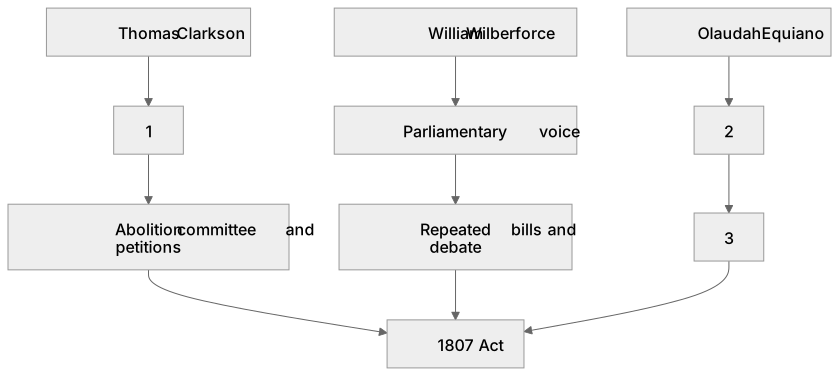
1Box 1
2Box 2
3Box 3
There is more to this lesson
The full lesson goes on to check your understanding and help you earn the marks. Create a free account to carry on, with your progress saved.
A week of Premium from your first lesson · Then the free plan continues · No card, no charge
Test your understanding of What explains the abolition of the slave trade at the end of the period, c1785–1807?: The significance of individuals, including Thomas Clarkson, William Wilberforce, Olaudah Equiano.
Active recall beats re-reading. Take an instant quiz now to test what you’ve learned and lock it into long-term memory.
A week of Premium from your first lesson · Then the free plan continues · No card, no charge