Pearson Edexcel · A-Level · History
Course version: 9HI0 · Version from Sept 2015
Innocent III’s plans for the crusade and the significance of their failure.
Full specification wording
What explains the failure of the Fourth Crusade?: Innocent III’s plans for the crusade and the significance of their failure.
Innocent III became pope in 1198 and immediately planned a new crusade.
Checked against the Pearson Edexcel 9HI0 specification (opens in a new tab) on .
- Point 1 of 4
- 4 key terms
Study notes
From the checked teaching notes for this specification point.
The idea
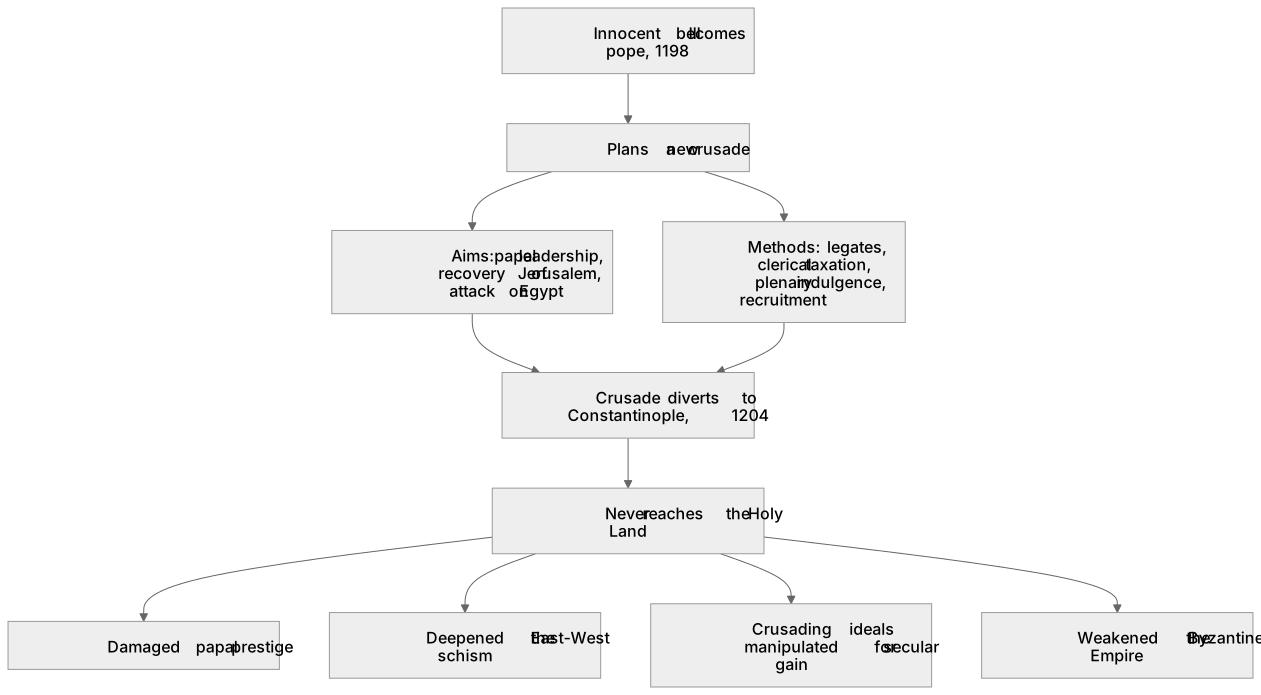
Innocent III became pope in 1198 and immediately planned a new crusade. He wanted papal leadership, not royal, to avoid the failures of the Second and Third Crusades. He sent legates to France and Germany, taxed the clergy, and proclaimed a plenary indulgence. The plan aimed to recover Jerusalem by attacking Egypt, the centre of Muslim power. However, the crusade diverted to Constantinople in 1204, never reaching the Holy Land. The failure was significant: it damaged papal prestige, deepened the East-West schism, and showed that crusading ideals could be manipulated for secular gain. It also weakened the Byzantine Empire, which later fell to the Ottomans. Thus, Innocent’s plans failed to achieve their primary goal and had unintended consequences.
What earns the marks
- Explains Innocent III’s aims: papal leadership, recovery of Jerusalem, and attack on Egypt as the strategic key.
- Details the methods: legates, clerical taxation, plenary indulgence, and recruitment across Europe.
- Analyses the diversion to Constantinople in 1204 and its causes, including Venetian and Byzantine involvement.
- Assesses the significance of failure: damage to papal authority, worsening East-West relations, and failure to recover Jerusalem.
- Evaluates the long-term impact: weakening of Byzantium and the precedent for future crusades.
Common mistakes and how to put them right
Confusing Innocent III’s crusade with the Third Crusade.
Put it right: Innocent III’s crusade is the Fourth Crusade (1202–1204), while the Third Crusade (1189–1192) was led by Richard I, Philip II, and Frederick I.
Stating that the Fourth Crusade successfully recovered Jerusalem.
Put it right: It never reached Jerusalem; instead, it sacked Constantinople in 1204.
Ignoring the role of Venice in the diversion.
Put it right: Venice’s financial and political interests were crucial in redirecting the crusade to Constantinople.
Exam tips
- Use specific evidence: name key figures like Innocent III, Boniface of Montferrat, and Doge Enrico Dandolo.
- Link the failure to broader themes: papal authority, East-West relations, and the nature of crusading.
- Avoid narrative; focus on analysis of significance and causation.
Try the lesson
The start of the What explains the failure of the Fourth Crusade?: Innocent III’s plans for the crusade and the significance of their failure. lesson, made from checked teaching notes for this specification point.
Have a go first
Which pope called the crusade that set out in 1202 and made careful plans for its leadership and financing?
Listen
Innocent III became pope in 1198 and immediately planned a new crusade. He wanted papal leadership, not royal, to avoid the failures of the Second and Third Crusades. He sent legates to France and Germany, taxed the clergy, and proclaimed a plenary indulgence. The plan aimed to recover Jerusalem by attacking Egypt, the centre of Muslim power. However, the crusade diverted to Constantinople in 1204, never reaching the Holy Land. The failure was significant: it damaged papal prestige, deepened the East-West schism, and showed that crusading ideals could be manipulated for secular gain. It also weakened the Byzantine Empire, which later fell to the Ottomans. Thus, Innocent’s plans failed to achieve their primary goal and had unintended consequences. A strong answer earns marks for these points. Explains Innocent III’s aims: papal leadership, recovery of Jerusalem, and attack on Egypt as the strategic key. Details the methods: legates, clerical taxation, plenary indulgence, and recruitment across Europe. Analyses the diversion to Constantinople in 1204 and its causes, including Venetian and Byzantine involvement. Assesses the significance of failure: damage to papal authority, worsening East-West relations, and failure to recover Jerusalem. A common slip: Confusing Innocent III’s crusade with the Third Crusade. Instead, Innocent III’s crusade is the Fourth Crusade (1202–1204), while the Third Crusade (1189–1192) was led by Richard I, Philip II, and Frederick I. Exam tip: Use specific evidence: name key figures like Innocent III, Boniface of Montferrat, and Doge Enrico Dandolo.
See it
Key words
Say what each word means before you turn the card.
Papal authority and reform
Try answering aloud or in your head before turning the card.
Crusading ideology and practice
Try answering aloud or in your head before turning the card.
East-West relations and the schism
Try answering aloud or in your head before turning the card.
Secular manipulation of religious warfare
Try answering aloud or in your head before turning the card.
See every definition
- Papal authority and reform
- Innocent III wanted papal leadership, not royal, to avoid the failures of the Second and Third Crusades, and the failure damaged papal prestige.
- Crusading ideology and practice
- The crusade showed that crusading ideals could be manipulated for secular gain, and its failure set a precedent for future crusades.
- East-West relations and the schism
- The diversion to Constantinople in 1204 deepened the East-West schism and weakened the Byzantine Empire, which later fell to the Ottomans.
- Secular manipulation of religious warfare
- The crusade was diverted to Constantinople in 1204, showing that crusading ideals could be manipulated for secular gain.
Label the diagram
Some boxes have lost their names. Pick the right name for each number.
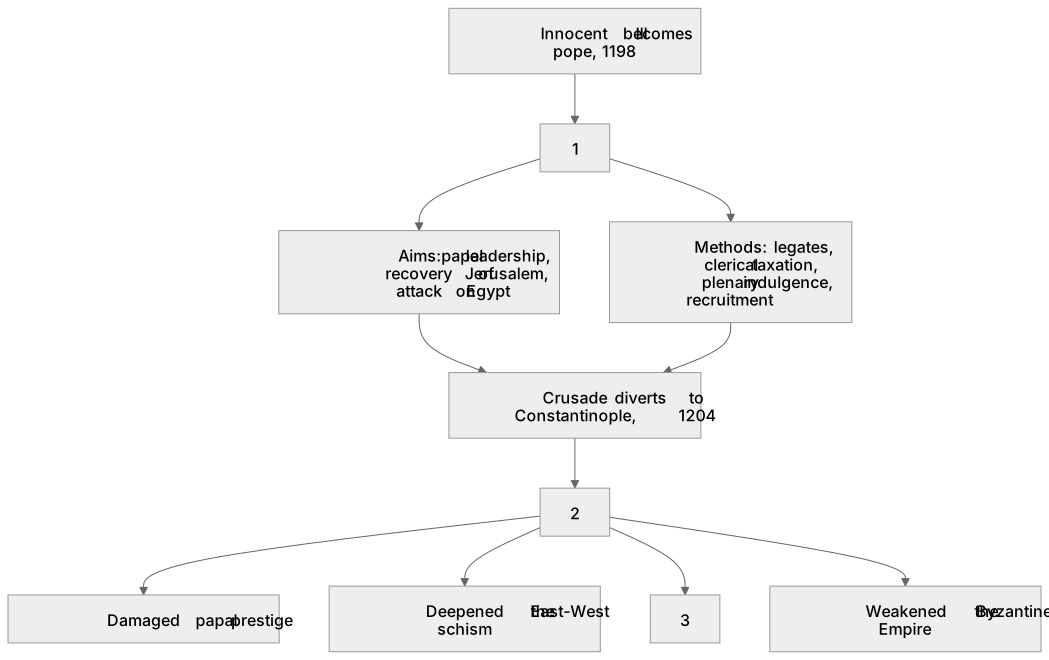
1Box 1
2Box 2
3Box 3
There is more to this lesson
The full lesson goes on to check your understanding and help you earn the marks. Create a free account to carry on, with your progress saved.
A week of Premium from your first lesson · Then the free plan continues · No card, no charge
Test your understanding of What explains the failure of the Fourth Crusade?: Innocent III’s plans for the crusade and the significance of their failure.
Active recall beats re-reading. Take an instant quiz now to test what you’ve learned and lock it into long-term memory.
A week of Premium from your first lesson · Then the free plan continues · No card, no charge