Pearson Edexcel · A-Level · History
Course version: 9HI0 · Version from Sept 2015
The significance of the failure of Prince Alexius and of the sack of…
Full specification wording
What explains the failure of the Fourth Crusade?: The significance of the failure of Prince Alexius and of the sack of Constantinople.
Prince Alexius promised the Fourth Crusade (c.1198–1204) money, troops and church union if they helped restore him.
Checked against the Pearson Edexcel 9HI0 specification (opens in a new tab) on .
- Point 4 of 4
- 3 key terms
Study notes
From the checked teaching notes for this specification point.
The idea
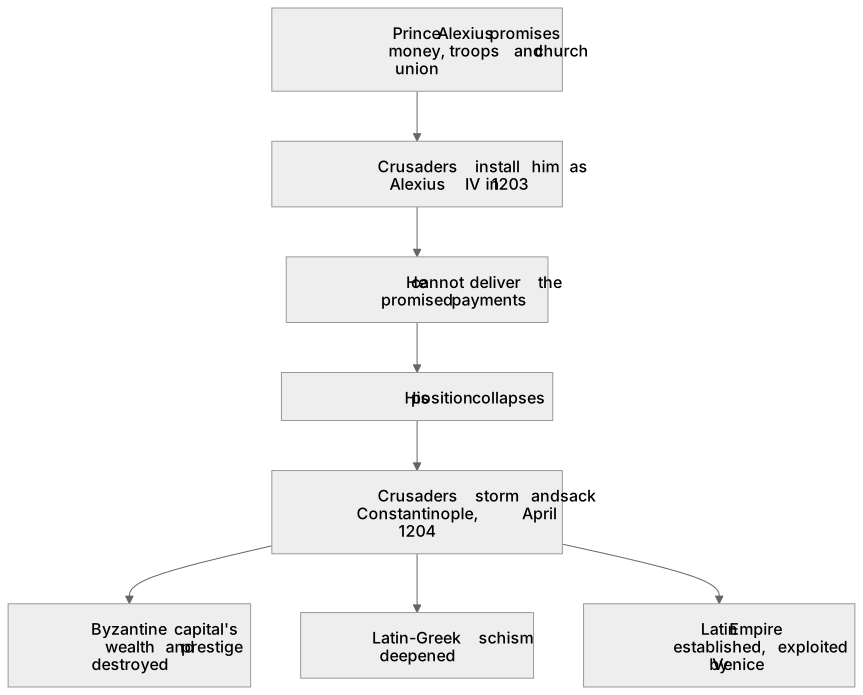
Prince Alexius promised the Fourth Crusade (c.1198–1204) money, troops and church union if they helped restore him. The crusaders installed him as Alexius IV in 1203, but he could not deliver the promised payments, and his position collapsed. In April 1204, the crusaders stormed and sacked Constantinople, inflicting massive destruction and looting. The significance is twofold: the failure of Alexius exposed the hollowness of the deal that drew the crusade to Byzantium, while the sack destroyed the Byzantine capital's wealth and prestige. It deepened the schism between Latin and Greek Christianity and established a Latin Empire that Venice exploited. Assess how far these events transformed the crusading movement and regional relations.
What earns the marks
- Explains Alexius's promise to the crusaders, including payment, military support and submission of the Greek Church, and why his inability to fulfil it undermined the expedition's original purpose.
- Describes the consequences of Alexius's failure: his overthrow, the breakdown of negotiations with the crusaders, and the decision to take Constantinople by force.
- Analyses the sack of Constantinople in 1204, including its scale, the looting of wealth and relics, and the collapse of Byzantine imperial authority.
- Reaches a judgement on which consequence was most significant and explains the reasoning.
Common mistakes and how to put them right
Treating Alexius's failure as merely personal incompetence.
Put it right by linking it to structural problems such as empty treasury and resistance from the Byzantine elite.
Describing the sack only as destruction without assessing its long-term religious and political effects.
Put it right by connecting it to the schism and the Latin Empire.
Assuming the sack ended Byzantine power immediately.
Put it right by noting that Byzantine successor states survived and eventually retook Constantinople in 1261.
Exam tips
- Keep the two parts of the question distinct: deal with the failure of Alexius and the sack of Constantinople, then draw their significance together.
- Support significance claims with named consequences, such as the Latin Empire, Venetian privileges or the 1261 recovery, rather than vague assertions.
- Ensure you accurately contextualise Prince Alexius and the 1204 sack within the specific events of the Fourth Crusade (c.1198–1204), rather than earlier crusading periods.
Try the lesson
The start of the What explains the failure of the Fourth Crusade?: The significance of the failure of Prince Alexius and of the sack of Constantinople. lesson, made from checked teaching notes for this specification point.
Have a go first
Why was the failure of Prince Alexius (Alexius IV) to fulfil his promises to the crusaders in 1203–1204 significant in causing the ultimate failure of the Fourth Crusade?
Listen
Prince Alexius promised the Fourth Crusade (c.1198–1204) money, troops and church union if they helped restore him. The crusaders installed him as Alexius IV in 1203, but he could not deliver the promised payments, and his position collapsed. In April 1204, the crusaders stormed and sacked Constantinople, inflicting massive destruction and looting. The significance is twofold: the failure of Alexius exposed the hollowness of the deal that drew the crusade to Byzantium, while the sack destroyed the Byzantine capital's wealth and prestige. It deepened the schism between Latin and Greek Christianity and established a Latin Empire that Venice exploited. Assess how far these events transformed the crusading movement and regional relations. A strong answer earns marks for these points. Explains Alexius's promise to the crusaders, including payment, military support and submission of the Greek Church, and why his inability to fulfil it undermined the expedition's original purpose. Describes the consequences of Alexius's failure: his overthrow, the breakdown of negotiations with the crusaders, and the decision to take Constantinople by force. Analyses the sack of Constantinople in 1204, including its scale, the looting of wealth and relics, and the collapse of Byzantine imperial authority. Assesses the wider significance: the deepening of the Latin-Greek schism, the creation of the Latin Empire, the boost to Venetian commercial dominance, and the weakening of Byzantium as a bulwark against Islamic expansion. A common slip: Treating Alexius's failure as merely personal incompetence. Instead, linking it to structural problems such as empty treasury and resistance from the Byzantine elite. Exam tip: Keep the two parts of the question distinct: deal with the failure of Alexius and the sack of Constantinople, then draw their significance together.
See it
Put the events in order
Put these events in the order they happened, earliest first.
- 1. Byzantine successor states retook Constantinople
- 2. The Fourth Crusade began
- 3. The crusaders stormed and sacked Constantinople
- 4. The crusaders installed Prince Alexius as Alexius IV
Key words
Say what each word means before you turn the card.
Failure of political leadership in Byzantium
Try answering aloud or in your head before turning the card.
The Fourth Crusade and the sack of Constantinople
Try answering aloud or in your head before turning the card.
The Latin-Greek schism and Latin Empire
Try answering aloud or in your head before turning the card.
See every definition
- Failure of political leadership in Byzantium
- Prince Alexius could not deliver the promised payments and his position collapsed, which exposed the hollowness of the deal that drew the crusade to Byzantium.
- The Fourth Crusade and the sack of Constantinople
- In April 1204 the crusaders stormed and sacked Constantinople, inflicting massive destruction and looting and destroying the Byzantine capital's wealth and prestige.
- The Latin-Greek schism and Latin Empire
- The sack deepened the schism between Latin and Greek Christianity and established a Latin Empire that Venice exploited.
Label the diagram
Some boxes have lost their names. Pick the right name for each number.
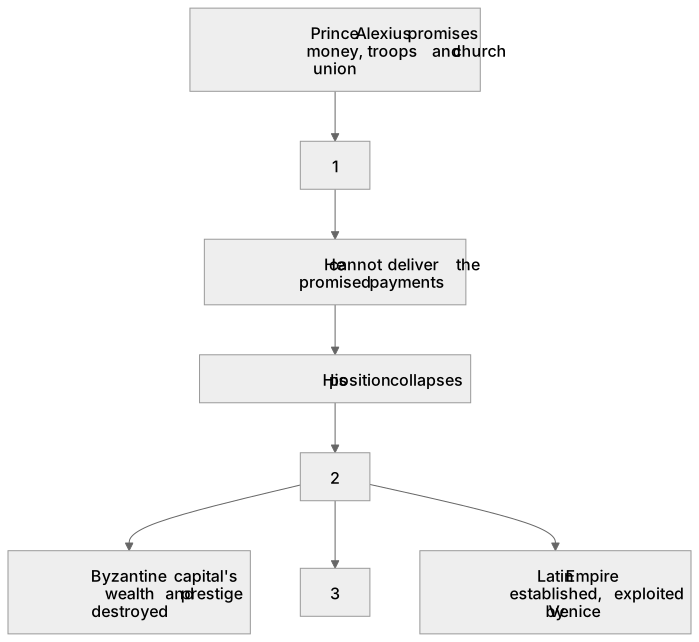
1Box 1
2Box 2
3Box 3
There is more to this lesson
The full lesson goes on to check your understanding and help you earn the marks. Create a free account to carry on, with your progress saved.
A week of Premium from your first lesson · Then the free plan continues · No card, no charge
Test your understanding of What explains the failure of the Fourth Crusade?: The significance of the failure of Prince Alexius and of the sack of Constantinople.
Active recall beats re-reading. Take an instant quiz now to test what you’ve learned and lock it into long-term memory.
A week of Premium from your first lesson · Then the free plan continues · No card, no charge