Pearson Edexcel · A-Level · History
Course version: 9HI0 · Version from Sept 2015
The effects of Gorbachev’s failure to reform the Communist Party and the…
Full specification wording
What explains the fall of the USSR, c1985–91?: The effects of Gorbachev’s failure to reform the Communist Party and the Soviet government.
Gorbachev attempted to reform the Communist Party and Soviet government through glasnost, perestroika, and democratisation.
Checked against the Pearson Edexcel 9HI0 specification (opens in a new tab) on .
- Point 2 of 4
- 4 key terms
Study notes
From the checked teaching notes for this specification point.
The idea
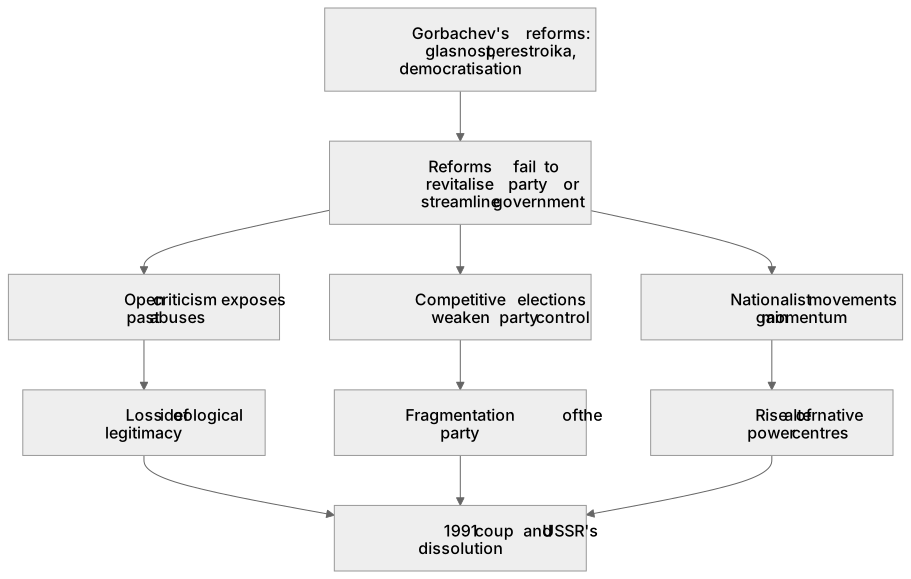
Gorbachev attempted to reform the Communist Party and Soviet government through glasnost, perestroika, and democratisation. However, these reforms failed to revitalise the party or streamline government. Instead, they unleashed forces that undermined party authority: open criticism exposed past abuses, competitive elections weakened party control, and nationalist movements gained momentum. The effects included a loss of ideological legitimacy, fragmentation of the party, and the rise of alternative power centres, culminating in the 1991 coup and the USSR’s dissolution. For example, the 1990 elections saw many party officials defeated, signalling a collapse of party dominance. Thus, Gorbachev’s failure to reform effectively accelerated the Soviet system’s disintegration.
What earns the marks
- Explains Gorbachev’s reform aims: glasnost, perestroika, democratisation, and attempts to revitalise the party.
- Analyses why these reforms failed: resistance from party conservatives, unintended consequences, and economic crisis.
- Assesses the effects: loss of party authority, rise of nationalism, political fragmentation, and the 1991 coup.
- Uses evidence such as the 1989 Congress of People’s Deputies, the 1990 elections, or the August 1991 coup.
- Evaluates the extent to which Gorbachev’s failures directly caused the collapse of the Soviet government.
Common mistakes and how to put them right
Claiming Gorbachev intended to destroy the Communist Party.
Put it right: Recognise his aim was to reform and strengthen it, but unintended consequences led to its decline.
Overlooking the role of conservative resistance within the party.
Put it right: Consider how hardliners’ opposition undermined reform efforts.
Treating the effects as only political, ignoring social and economic impacts.
Put it right: Link political reforms to economic disruption and social unrest.
Exam tips
- Focus on effects: what were the consequences of failed reforms for the party and government?
- Use specific examples of reform measures and their outcomes to illustrate your points.
- Consider short-term and long-term effects, and how they interrelate.
Try the lesson
The start of the What explains the fall of the USSR, c1985–91?: The effects of Gorbachev’s failure to reform the Communist Party and the Soviet government. lesson, made from checked teaching notes for this specification point.
Have a go first
Which of the following was a direct political effect of Gorbachev's failure to successfully reform the Communist Party?
Listen
Gorbachev attempted to reform the Communist Party and Soviet government through glasnost, perestroika, and democratisation. However, these reforms failed to revitalise the party or streamline government. Instead, they unleashed forces that undermined party authority: open criticism exposed past abuses, competitive elections weakened party control, and nationalist movements gained momentum. The effects included a loss of ideological legitimacy, fragmentation of the party, and the rise of alternative power centres, culminating in the 1991 coup and the USSR’s dissolution. For example, the 1990 elections saw many party officials defeated, signalling a collapse of party dominance. Thus, Gorbachev’s failure to reform effectively accelerated the Soviet system’s disintegration. A strong answer earns marks for these points. Explains Gorbachev’s reform aims: glasnost, perestroika, democratisation, and attempts to revitalise the party. Analyses why these reforms failed: resistance from party conservatives, unintended consequences, and economic crisis. Assesses the effects: loss of party authority, rise of nationalism, political fragmentation, and the 1991 coup. Uses evidence such as the 1989 Congress of People’s Deputies, the 1990 elections, or the August 1991 coup. A common slip: claiming Gorbachev intended to destroy the Communist Party. Instead, recognise his aim was to reform and strengthen it, but unintended consequences led to its decline. Exam tip: Focus on effects: what were the consequences of failed reforms for the party and government?
See it
Key words
Say what each word means before you turn the card.
Gorbachev’s reform programme
Try answering aloud or in your head before turning the card.
Party and government resistance
Try answering aloud or in your head before turning the card.
Unintended consequences of reform
Try answering aloud or in your head before turning the card.
Collapse of Soviet authority
Try answering aloud or in your head before turning the card.
See every definition
- Gorbachev’s reform programme
- Glasnost, perestroika and democratisation were attempts to reform the Communist Party and Soviet government and to revitalise the party.
- Party and government resistance
- Opposition from party conservatives and hardliners undermined reform efforts.
- Unintended consequences of reform
- The reforms unleashed forces that undermined party authority, including open criticism, competitive elections and nationalist movements.
- Collapse of Soviet authority
- The effects included a loss of ideological legitimacy, fragmentation of the party and the rise of alternative power centres, culminating in the 1991 coup and the USSR’s dissolution.
Label the diagram
Some boxes have lost their names. Pick the right name for each number.
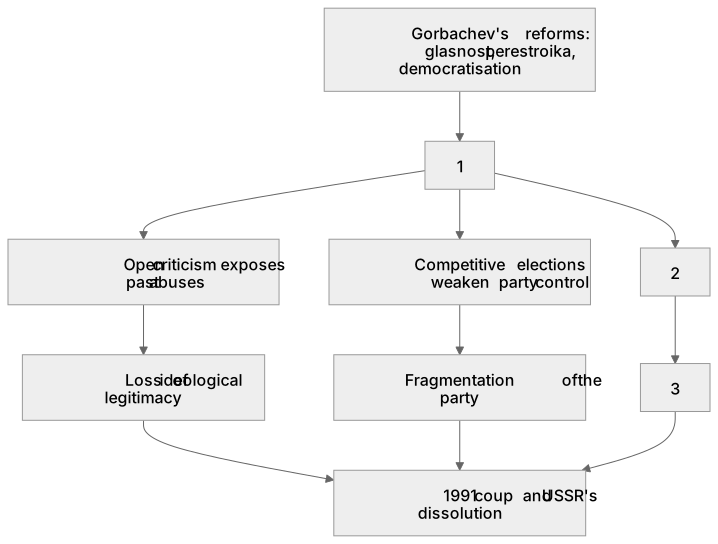
1Box 1
2Box 2
3Box 3
There is more to this lesson
The full lesson goes on to check your understanding and help you earn the marks. Create a free account to carry on, with your progress saved.
A week of Premium from your first lesson · Then the free plan continues · No card, no charge
Test your understanding of What explains the fall of the USSR, c1985–91?: The effects of Gorbachev’s failure to reform the Communist Party and the Soviet government.
Active recall beats re-reading. Take an instant quiz now to test what you’ve learned and lock it into long-term memory.
A week of Premium from your first lesson · Then the free plan continues · No card, no charge