Pearson Edexcel · A-Level · History
Course version: 9HI0 · Version from Sept 2015
The effect of Thatcherism on politics and party development.
Full specification wording
What impact did Thatcher’s governments (1979–90) have on Britain, 1979–97?: The effect of Thatcherism on politics and party development.
Thatcherism, associated with Margaret Thatcher from 1975 and especially after 1979, reshaped British politics and party development.
Checked against the Pearson Edexcel 9HI0 specification (opens in a new tab) on .
- Point 4 of 4
- 3 key terms
Study notes
From the checked teaching notes for this specification point.
The idea
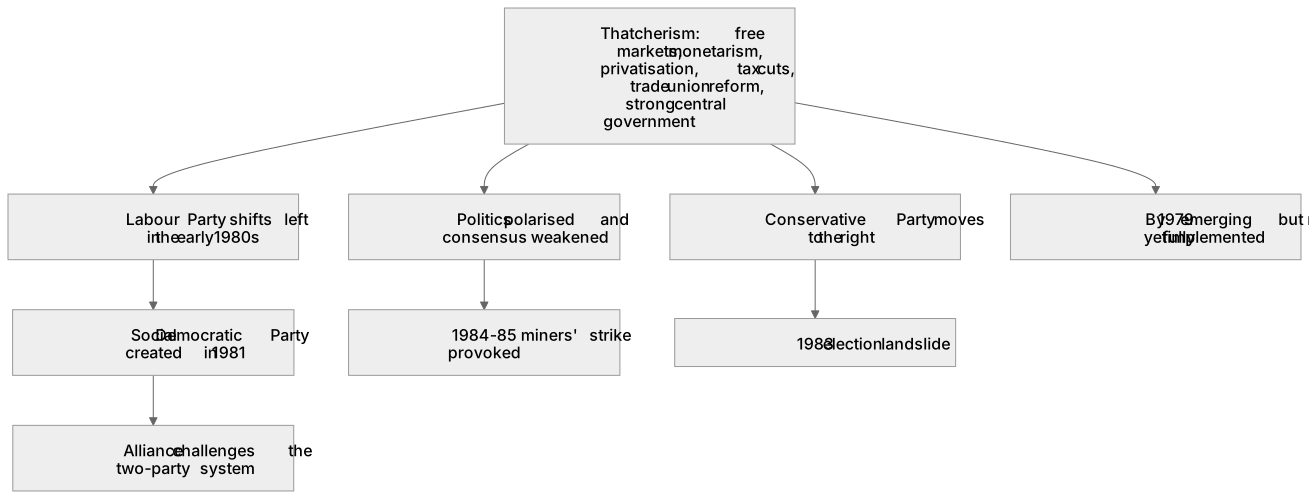
Thatcherism, associated with Margaret Thatcher from 1975 and especially after 1979, reshaped British politics and party development. Its core ideas included free markets, privatisation, monetarism, tax cuts, trade union reform, and strong central government. You must assess its effects on politics and party development, not just describe policies. Effects include the Labour Party's shift left in the early 1980s and later creation of the Social Democratic Party in 1981, the Conservatives' move to the right, and the 1983 election landslide. It also polarised politics, weakened consensus, and provoked the 1984–85 miners' strike. By 1979, Thatcherism was emerging but not yet fully implemented, so judge its early impact carefully.
What earns the marks
- Defines Thatcherism as a political and economic creed: free markets, monetarism, privatisation, tax reduction, trade union reform, and national sovereignty.
- Explains effects on the Conservative Party: shift away from post-war consensus, internal divisions over Europe and economic policy, and electoral dominance in 1979, 1983, and 1987.
- Explains effects on other parties: Labour's leftward turn under Michael Foot, the 1981 SDP split, and the Alliance's challenge to the two-party system.
- Assesses political polarisation and party development, including the decline of consensus, rise of protest politics, and changing party membership and campaigning.
- Reaches a substantiated judgement on how far Thatcherism transformed politics and party development by 1979 and beyond.
Common mistakes and how to put them right
Treating Thatcherism as only economic policy.
Put it right: Include its political and party effects, such as leadership style, centralisation, and party realignment.
Assuming Thatcherism was fully implemented by 1979.
Put it right: Distinguish early influence from later legislation after 1979, such as privatisation and union laws.
Ignoring opposition and unintended consequences.
Put it right: Include the SDP split, Labour's 1983 manifesto, and the miners' strike as evidence of contested effects.
Exam tips
- Define Thatcherism briefly, then spend most of your answer on effects, using party examples.
- Use precise dates and names, such as the 1975 Conservative leadership election, 1981 SDP formation, and 1983 general election.
- Weigh positive and negative effects, and distinguish short-term from long-term party development.
Try the lesson
The start of the What impact did Thatcher’s governments (1979–90) have on Britain, 1979–97?: The effect of Thatcherism on politics and party development. lesson, made from checked teaching notes for this specification point.
Have a go first
How did the electoral success of Thatcherism most significantly affect the development of the Labour Party by the mid-1990s?
Listen
Thatcherism, associated with Margaret Thatcher from 1975 and especially after 1979, reshaped British politics and party development. Its core ideas included free markets, privatisation, monetarism, tax cuts, trade union reform, and strong central government. You must assess its effects on politics and party development, not just describe policies. Effects include the Labour Party's shift left in the early 1980s and later creation of the Social Democratic Party in 1981, the Conservatives' move to the right, and the 1983 election landslide. It also polarised politics, weakened consensus, and provoked the 1984–85 miners' strike. By 1979, Thatcherism was emerging but not yet fully implemented, so judge its early impact carefully. A strong answer earns marks for these points. Defines Thatcherism as a political and economic creed: free markets, monetarism, privatisation, tax reduction, trade union reform, and national sovereignty. Explains effects on the Conservative Party: shift away from post-war consensus, internal divisions over Europe and economic policy, and electoral dominance in 1979, 1983, and 1987. Explains effects on other parties: Labour's leftward turn under Michael Foot, the 1981 SDP split, and the Alliance's challenge to the two-party system. Assesses political polarisation and party development, including the decline of consensus, rise of protest politics, and changing party membership and campaigning. A common slip: treating Thatcherism as only economic policy. Instead, include its political and party effects, such as leadership style, centralisation, and party realignment. Exam tip: Define Thatcherism briefly, then spend most of your answer on effects, using party examples.
See it
Put the events in order
Put these events in the order they happened, earliest first.
- 1. Thatcher's governments begin and Thatcherism emerges
- 2. Margaret Thatcher becomes associated with Thatcherism
- 3. The miners' strike is provoked
- 4. The Social Democratic Party is created
- 5. The election landslide
Key words
Say what each word means before you turn the card.
Free-market economics and privatisation
Try answering aloud or in your head before turning the card.
Party realignment and the end of consensus
Try answering aloud or in your head before turning the card.
Electoral dominance and opposition
Try answering aloud or in your head before turning the card.
See every definition
- Free-market economics and privatisation
- Core ideas of Thatcherism that included free markets and privatisation, alongside monetarism, tax cuts and trade union reform.
- Party realignment and the end of consensus
- Thatcherism shifted the Conservatives to the right and weakened consensus, while Labour moved left and the SDP was created in 1981.
- Electoral dominance and opposition
- Thatcherism brought the Conservatives electoral dominance in 1979, 1983 and 1987, while polarising politics and provoking opposition.
Label the diagram
Some boxes have lost their names. Pick the right name for each number.
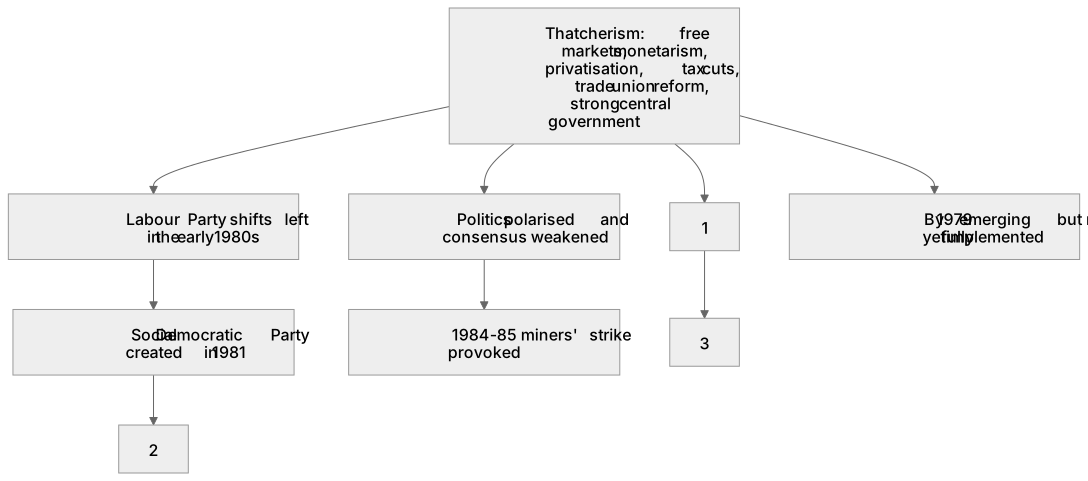
1Box 1
2Box 2
3Box 3
There is more to this lesson
The full lesson goes on to check your understanding and help you earn the marks. Create a free account to carry on, with your progress saved.
A week of Premium from your first lesson · Then the free plan continues · No card, no charge
Test your understanding of What impact did Thatcher’s governments (1979–90) have on Britain, 1979–97?: The effect of Thatcherism on politics and party development.
Active recall beats re-reading. Take an instant quiz now to test what you’ve learned and lock it into long-term memory.
A week of Premium from your first lesson · Then the free plan continues · No card, no charge