Pearson Edexcel · GCSE · History
Course version: 1HI0 · Version from Sept 2016
The historic environment - 1 Whitechapel, c1870–c1900: crime, policing and…
Full specification wording
Option 10: The historic environment - 1 Whitechapel, c1870–c1900: crime, policing and the inner city: The organisation of policing in Whitechapel. The role of the ‘beat constable’. The work of H division and the difficulties of policing the slum area of Whitechapel, the rookeries, alleys and courts. Problems of policing caused by crime and antisocial behaviour: alcohol, prostitution, protection rackets, gangs, violent demonstrations and attacks on Jewish people.
Policing Whitechapel fell to H Division, relying on the 'beat constable' patrolling set routes to deter crime.
Checked against the Pearson Edexcel 1HI0 specification (opens in a new tab) on .
- Point 3 of 5
- 4 key terms
Study notes
From the checked teaching notes for this specification point.
The idea
Policing Whitechapel fell to H Division, relying on the 'beat constable' patrolling set routes to deter crime. Policing this slum was exceptionally difficult due to the maze-like geography of rookeries, narrow alleys, and unlit courts, providing easy escape routes. H Division faced severe problems from widespread crime and antisocial behaviour. Alcohol abuse fuelled violence, while poverty drove many to prostitution. Organised crime, including protection rackets and gangs, challenged the police. Additionally, officers had to manage violent political demonstrations and protect the growing Jewish community from targeted antisemitic attacks, severely stretching their limited resources in a highly volatile and hostile urban environment.
What earns the marks
- Detail the organisation of H Division and the specific duties of the beat constable in maintaining a visible presence.
- Explain how the physical environment of Whitechapel (rookeries, alleys, courts) hindered effective policing.
- Identify the link between alcohol, prostitution, and the high levels of antisocial behaviour in the area.
- Describe the impact of organised crime, such as gangs and protection rackets, on the local community and police workload.
- Analyse the police response to wider social unrest, including violent demonstrations and antisemitic attacks on Jewish people.
Common mistakes and how to put them right
Believing the police were entirely ineffective or absent.
Put it right: Note that H Division had a strong presence and beat constables worked hard, but they were overwhelmed by the environment and social conditions.
Confusing rookeries with standard housing.
Put it right: Define rookeries specifically as densely populated, slum housing areas characterised by dirt, disease, and complex layouts that aided criminals.
Overlooking the role of alcohol.
Put it right: Emphasise that cheap alcohol was a primary driver of violence and antisocial behaviour, making the beat constable's job significantly more dangerous.
Exam tips
- Link the physical environment (alleys and courts) directly to the difficulties of catching criminals to show a deep understanding of the historic environment.
- Use specific examples of the challenges faced by H Division, such as managing the tensions between different immigrant groups.
- When evaluating police effectiveness, balance their organisational structure against the overwhelming social problems they faced.
Try the lesson
The start of the Option 10: The historic environment - 1 Whitechapel, c1870–c1900: crime, policing and the inner city: The organisation of policing in Whitechapel. The role of the ‘beat constable’. The work of H division and the difficulties of policing the slum area of Whitechapel, the rookeries, alleys and courts. Problems of policing caused by crime and antisocial behaviour: alcohol, prostitution, protection rackets, gangs, violent demonstrations and attacks on Jewish people. lesson, made from checked teaching notes for this specification point.
Have a go first
Which division of the Metropolitan Police was primarily responsible for policing the Whitechapel area in the late nineteenth century?
Listen
Policing Whitechapel fell to H Division, relying on the 'beat constable' patrolling set routes to deter crime. Policing this slum was exceptionally difficult due to the maze-like geography of rookeries, narrow alleys, and unlit courts, providing easy escape routes. H Division faced severe problems from widespread crime and antisocial behaviour. Alcohol abuse fuelled violence, while poverty drove many to prostitution. Organised crime, including protection rackets and gangs, challenged the police. Additionally, officers had to manage violent political demonstrations and protect the growing Jewish community from targeted antisemitic attacks, severely stretching their limited resources in a highly volatile and hostile urban environment. A strong answer earns marks for these points. Detail the organisation of H Division and the specific duties of the beat constable in maintaining a visible presence. Explain how the physical environment of Whitechapel (rookeries, alleys, courts) hindered effective policing. Identify the link between alcohol, prostitution, and the high levels of antisocial behaviour in the area. Describe the impact of organised crime, such as gangs and protection rackets, on the local community and police workload. A common slip: Believing the police were entirely ineffective or absent. Instead, Note that H Division had a strong presence and beat constables worked hard, but they were overwhelmed by the environment and social conditions. Exam tip: Link the physical environment (alleys and courts) directly to the difficulties of catching criminals to show a deep understanding of the historic environment.
See it
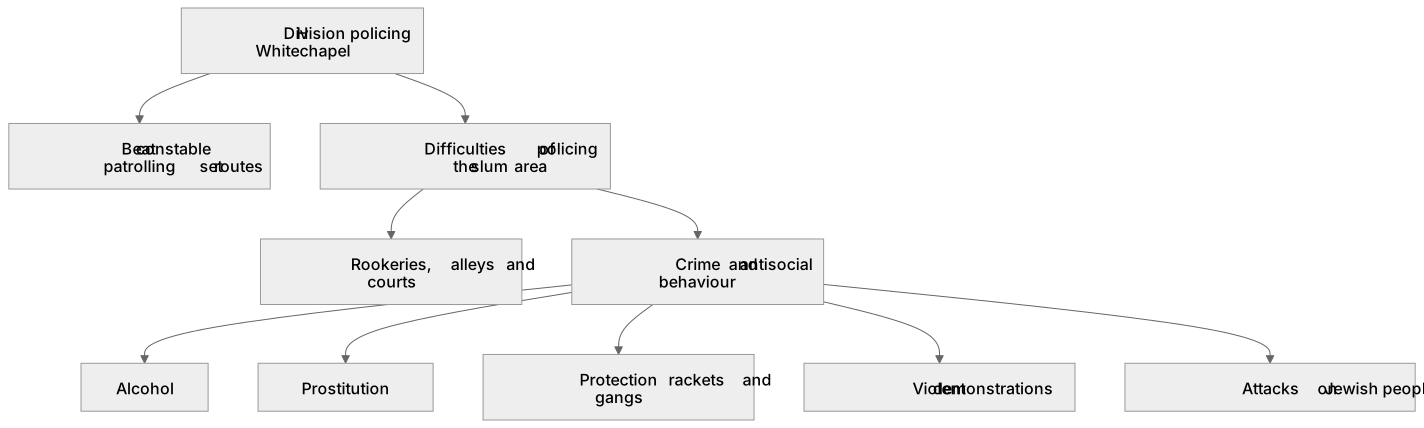
Key words
Say what each word means before you turn the card.
Beat constable
Try answering aloud or in your head before turning the card.
Rookeries
Try answering aloud or in your head before turning the card.
Protection rackets
Try answering aloud or in your head before turning the card.
H Division
Try answering aloud or in your head before turning the card.
See every definition
- Beat constable
- An officer who patrolled set routes to maintain a visible presence and deter crime.
- Rookeries
- Densely populated slum housing areas characterised by dirt, disease, and complex layouts that aided criminals.
- Protection rackets
- A form of organised crime that, alongside gangs, challenged the police and added to their workload.
- H Division
- The police division to which the policing of Whitechapel fell, relying on the beat constable.
Label the diagram
Some boxes have lost their names. Pick the right name for each number.
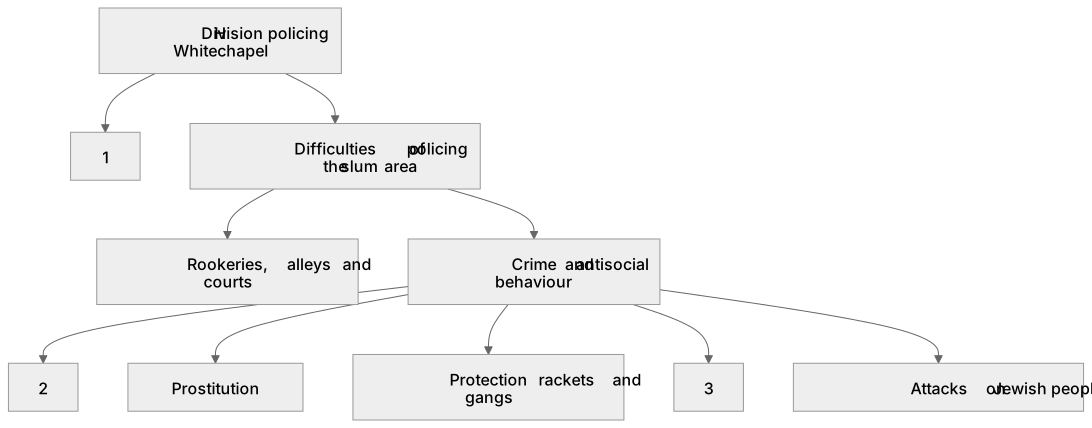
1Box 1
2Box 2
3Box 3
There is more to this lesson
The full lesson goes on to check your understanding and help you earn the marks. Create a free account to carry on, with your progress saved.
A week of Premium from your first lesson · Then the free plan continues · No card, no charge
Test your understanding of Option 10: The historic environment - 1 Whitechapel, c1870–c1900: crime, policing and the inner city: The organisation of policing in Whitechapel. The role of the ‘beat constable’. The work of H division and the difficulties of policing the slum area of Whitechapel, the rookeries, alleys and courts. Problems of policing caused by crime and antisocial behaviour: alcohol, prostitution, protection rackets, gangs, violent demonstrations and attacks on Jewish people.
Active recall beats re-reading. Take an instant quiz now to test what you’ve learned and lock it into long-term memory.
A week of Premium from your first lesson · Then the free plan continues · No card, no charge