Pearson Edexcel · GCSE · History
Course version: 1HI0 · Version from Sept 2016
The historic environment - 2 Knowledge, selection and use of sources for…
Full specification wording
Option 10: The historic environment - 2 Knowledge, selection and use of sources for historical enquiries: Knowledge of national sources relevant to the period and issue, e.g. national newspapers, records of crimes and police investigations, Old Bailey records of trials and Punch cartoons.
National sources provide a broader perspective on Whitechapel, reflecting how the area was viewed by the rest of the country.
Checked against the Pearson Edexcel 1HI0 specification (opens in a new tab) on .
- Point 2 of 5
- 4 key terms
Study notes
From the checked teaching notes for this specification point.
The idea
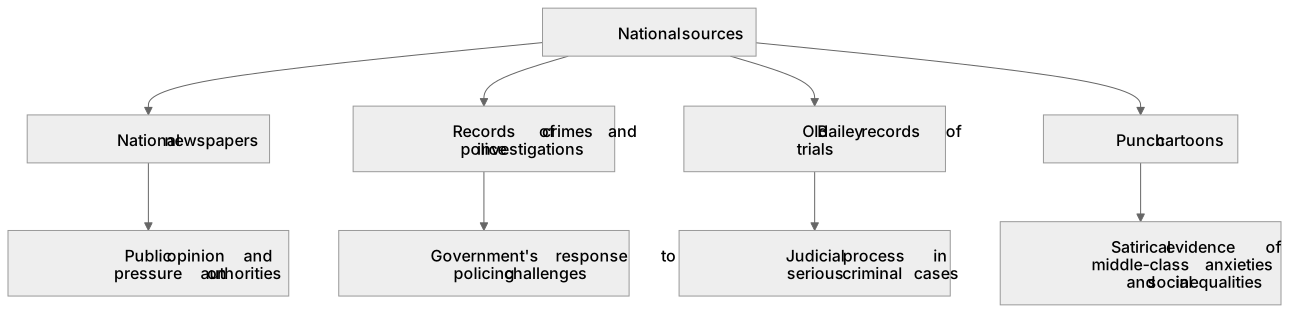
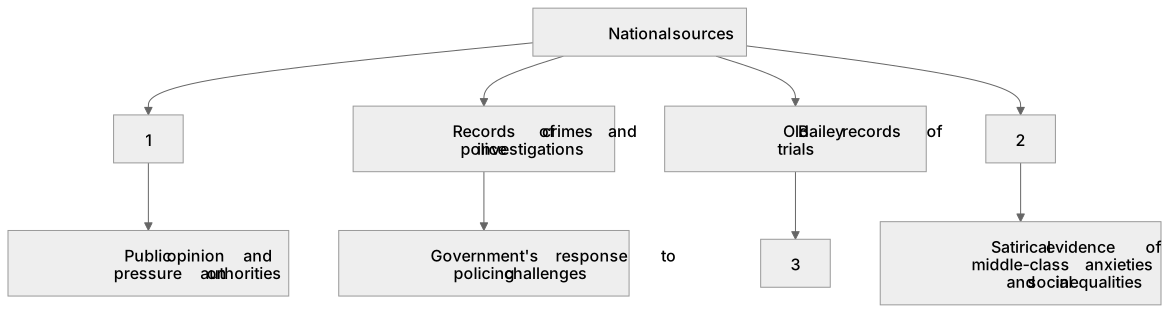
National sources provide a broader perspective on Whitechapel, reflecting how the area was viewed by the rest of the country. National newspapers, such as The Times, offer insight into public opinion and the pressure placed on authorities during events like the Ripper murders. Records of crimes and high-level police investigations, including Home Office files, reveal the government's response to policing challenges. Old Bailey records of trials provide detailed transcripts of serious criminal cases, shedding light on the judicial process. Furthermore, Punch cartoons serve as valuable satirical evidence, illustrating middle-class anxieties, criticising police incompetence, and highlighting the severe social inequalities of the period.
What earns the marks
- Identify national sources such as national newspapers, Home Office records, Old Bailey transcripts, and Punch cartoons.
- Explain how national newspapers shaped and reflected wider public opinion regarding events in Whitechapel.
- Use records of crimes and police investigations to understand the national government's involvement in local policing.
- Analyse Old Bailey records to extract detailed information about serious crimes and the legal system.
- Interpret Punch cartoons to understand satirical critiques of the police and societal attitudes towards the poor.
Common mistakes and how to put them right
Treating Punch cartoons as factual representations of events.
Put it right: Analyse cartoons as satirical commentary reflecting specific viewpoints, usually those of the middle or upper classes, rather than literal truth.
Assuming national newspapers had accurate information about local Whitechapel events.
Put it right: Acknowledge that national papers often relied on sensationalism or second-hand reports, which could distort the reality of local issues.
Confusing local police station logs with national police investigation records.
Put it right: Distinguish between day-to-day local H Division records and higher-level Metropolitan Police or Home Office files.
Exam tips
- Use Punch cartoons to discuss public attitudes and criticism of the Metropolitan Police, especially the Commissioner.
- When discussing national newspapers, mention their role in creating a climate of fear or pressuring the government.
- Reference Old Bailey records when evaluating sources related to the outcomes of serious criminal investigations.
Try the lesson
The start of the Option 10: The historic environment - 2 Knowledge, selection and use of sources for historical enquiries: Knowledge of national sources relevant to the period and issue, e.g. national newspapers, records of crimes and police investigations, Old Bailey records of trials and Punch cartoons. lesson, made from checked teaching notes for this specification point.
Have a go first
Which of the following is an example of a national source that could be used to investigate attitudes towards the police in the late nineteenth century?
Listen
National sources provide a broader perspective on Whitechapel, reflecting how the area was viewed by the rest of the country. National newspapers, such as The Times, offer insight into public opinion and the pressure placed on authorities during events like the Ripper murders. Records of crimes and high-level police investigations, including Home Office files, reveal the government's response to policing challenges. Old Bailey records of trials provide detailed transcripts of serious criminal cases, shedding light on the judicial process. Furthermore, Punch cartoons serve as valuable satirical evidence, illustrating middle-class anxieties, criticising police incompetence, and highlighting the severe social inequalities of the period. A strong answer earns marks for these points. Identify national sources such as national newspapers, Home Office records, Old Bailey transcripts, and Punch cartoons. Explain how national newspapers shaped and reflected wider public opinion regarding events in Whitechapel. Use records of crimes and police investigations to understand the national government's involvement in local policing. Analyse Old Bailey records to extract detailed information about serious crimes and the legal system. A common slip: Treating Punch cartoons as factual representations of events. Instead, Analyse cartoons as satirical commentary reflecting specific viewpoints, usually those of the middle or upper classes, rather than literal truth. Exam tip: Use Punch cartoons to discuss public attitudes and criticism of the Metropolitan Police, especially the Commissioner.
See it
Key words
Say what each word means before you turn the card.
Public opinion and the press
Try answering aloud or in your head before turning the card.
Government and law enforcement
Try answering aloud or in your head before turning the card.
Social class and attitudes
Try answering aloud or in your head before turning the card.
Satire and visual evidence
Try answering aloud or in your head before turning the card.
See every definition
- Public opinion and the press
- National newspapers offer insight into public opinion and the pressure placed on authorities during events like the Ripper murders.
- Government and law enforcement
- Records of crimes and high-level police investigations, including Home Office files, reveal the government's response to policing challenges.
- Social class and attitudes
- Punch cartoons illustrate middle-class anxieties and highlight the severe social inequalities of the period.
- Satire and visual evidence
- Punch cartoons serve as valuable satirical evidence, criticising police incompetence and societal attitudes towards the poor.
Label the diagram
Some boxes have lost their names. Pick the right name for each number.
1Box 1
2Box 2
3Box 3
There is more to this lesson
The full lesson goes on to check your understanding and help you earn the marks. Create a free account to carry on, with your progress saved.
A week of Premium from your first lesson · Then the free plan continues · No card, no charge
Test your understanding of Option 10: The historic environment - 2 Knowledge, selection and use of sources for historical enquiries: Knowledge of national sources relevant to the period and issue, e.g. national newspapers, records of crimes and police investigations, Old Bailey records of trials and Punch cartoons.
Active recall beats re-reading. Take an instant quiz now to test what you’ve learned and lock it into long-term memory.
A week of Premium from your first lesson · Then the free plan continues · No card, no charge