Pearson Edexcel · GCSE · History
Course version: 1HI0 · Version from Sept 2016
C1250–c1500: Medicine in medieval England - 2 Approaches to prevention and…
Full specification wording
Option 11: c1250–c1500: Medicine in medieval England - 2 Approaches to prevention and treatment: Approaches to prevention and treatment, and their connection with ideas about disease and illness: religious actions, bloodletting and purging, purifying the air.
Medieval approaches to prevention and treatment were directly connected to ideas about the causes of disease.
Checked against the Pearson Edexcel 1HI0 specification (opens in a new tab) on .
- Point 1 of 2
- 4 key terms
Study notes
From the checked teaching notes for this specification point.
The idea
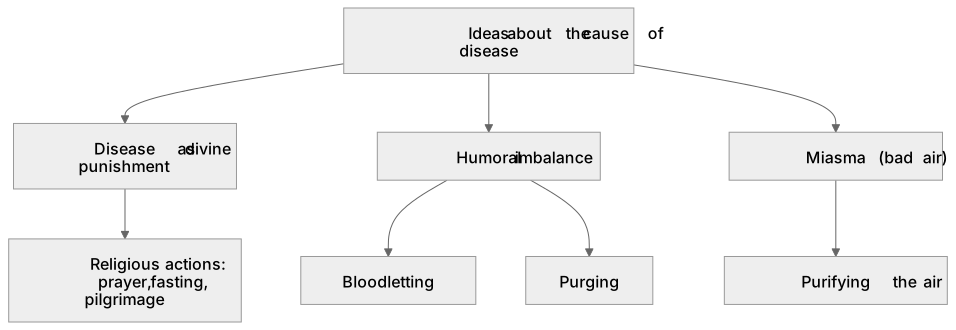
Medieval approaches to prevention and treatment were directly connected to ideas about the causes of disease. Because illness was often viewed as divine punishment, religious actions like praying, fasting, and going on pilgrimage were common treatments and preventions. To address humoral imbalances, physicians prescribed bloodletting (phlebotomy) and purging (using emetics or laxatives) to remove excess humours and restore health. Furthermore, because miasma (bad air) was believed to cause disease, purifying the air was a key preventative measure. This involved carrying sweet-smelling posies, burning herbs, or ringing bells to keep the air moving. Each method logically followed the accepted supernatural or rational explanations of the era.
What earns the marks
- Link religious actions (prayer, fasting, pilgrimage) directly to the belief that disease was a punishment from God.
- Explain bloodletting and purging as practical treatments designed to rebalance the Four Humours.
- Describe methods of purifying the air (e.g., burning herbs, carrying pomanders) as a response to the miasma theory.
- Demonstrate how treatments were a logical consequence of the prevailing ideas about the causes of illness.
- Identify that patients often used a combination of religious and rational treatments simultaneously.
Common mistakes and how to put them right
Describing treatments without linking them to the underlying cause of disease.
Put it right: Connect the treatment (e.g., bloodletting) to the specific theory it addressed (e.g., humoral imbalance).
Assuming bloodletting was a random or purely harmful practice.
Put it right: Explain that it was a highly rational treatment based on the accepted medical theory of the Four Humours.
Confusing prevention with treatment.
Put it right: Clearly distinguish between actions taken to stop illness occurring (e.g., purifying air) and those taken to cure it (e.g., purging).
Exam tips
- Use specific examples of religious actions, such as flagellation during the Black Death, to illustrate prevention.
- When discussing bloodletting, mention the different methods used, such as cupping, leeches, or cutting a vein.
- Emphasise the logical connection between the cause (miasma) and the prevention (purifying the air).
Try the lesson
The start of the Option 11: c1250–c1500: Medicine in medieval England - 2 Approaches to prevention and treatment: Approaches to prevention and treatment, and their connection with ideas about disease and illness: religious actions, bloodletting and purging, purifying the air. lesson, made from checked teaching notes for this specification point.
Have a go first
Which of the following was a common religious action taken to prevent or treat disease in medieval England?
Listen
Medieval approaches to prevention and treatment were directly connected to ideas about the causes of disease. Because illness was often viewed as divine punishment, religious actions like praying, fasting, and going on pilgrimage were common treatments and preventions. To address humoral imbalances, physicians prescribed bloodletting (phlebotomy) and purging (using emetics or laxatives) to remove excess humours and restore health. Furthermore, because miasma (bad air) was believed to cause disease, purifying the air was a key preventative measure. This involved carrying sweet-smelling posies, burning herbs, or ringing bells to keep the air moving. Each method logically followed the accepted supernatural or rational explanations of the era. A strong answer earns marks for these points. Link religious actions (prayer, fasting, pilgrimage) directly to the belief that disease was a punishment from God. Explain bloodletting and purging as practical treatments designed to rebalance the Four Humours. Describe methods of purifying the air (e.g., burning herbs, carrying pomanders) as a response to the miasma theory. Demonstrate how treatments were a logical consequence of the prevailing ideas about the causes of illness. A common slip: Describing treatments without linking them to the underlying cause of disease. Instead, connect the treatment (e.g., bloodletting) to the specific theory it addressed (e.g., humoral imbalance). Exam tip: Use specific examples of religious actions, such as flagellation during the Black Death, to illustrate prevention.
See it
Key words
Say what each word means before you turn the card.
Religious actions
Try answering aloud or in your head before turning the card.
Bloodletting
Try answering aloud or in your head before turning the card.
Purging
Try answering aloud or in your head before turning the card.
Purifying the air
Try answering aloud or in your head before turning the card.
See every definition
- Religious actions
- Praying, fasting and going on pilgrimage, used as treatments and preventions because illness was often viewed as divine punishment.
- Bloodletting
- A treatment in which blood was removed to rebalance the Four Humours, also called phlebotomy.
- Purging
- A treatment using emetics or laxatives to remove excess humours and restore health.
- Purifying the air
- A preventative measure against miasma, involving carrying sweet-smelling posies, burning herbs or ringing bells to keep the air moving.
Label the diagram
Some boxes have lost their names. Pick the right name for each number.
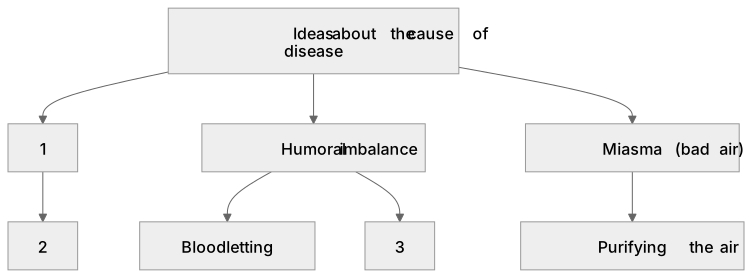
1Box 1
2Box 2
3Box 3
There is more to this lesson
The full lesson goes on to check your understanding and help you earn the marks. Create a free account to carry on, with your progress saved.
A week of Premium from your first lesson · Then the free plan continues · No card, no charge
Test your understanding of Option 11: c1250–c1500: Medicine in medieval England - 2 Approaches to prevention and treatment: Approaches to prevention and treatment, and their connection with ideas about disease and illness: religious actions, bloodletting and purging, purifying the air.
Active recall beats re-reading. Take an instant quiz now to test what you’ve learned and lock it into long-term memory.
A week of Premium from your first lesson · Then the free plan continues · No card, no charge