Pearson Edexcel · GCSE · History
Course version: 1HI0 · Version from Sept 2016
C1500–c1700: The Medical Renaissance in England - 1 Ideas about the cause…
Full specification wording
Option 11: c1500–c1700: The Medical Renaissance in England - 1 Ideas about the cause of disease and illness: Continuity and change in explanations of the cause of disease and illness. A scientific approach, including the work of Thomas Sydenham in improving diagnosis. The influence of the printing press and the work of the Royal Society on the transmission of ideas.
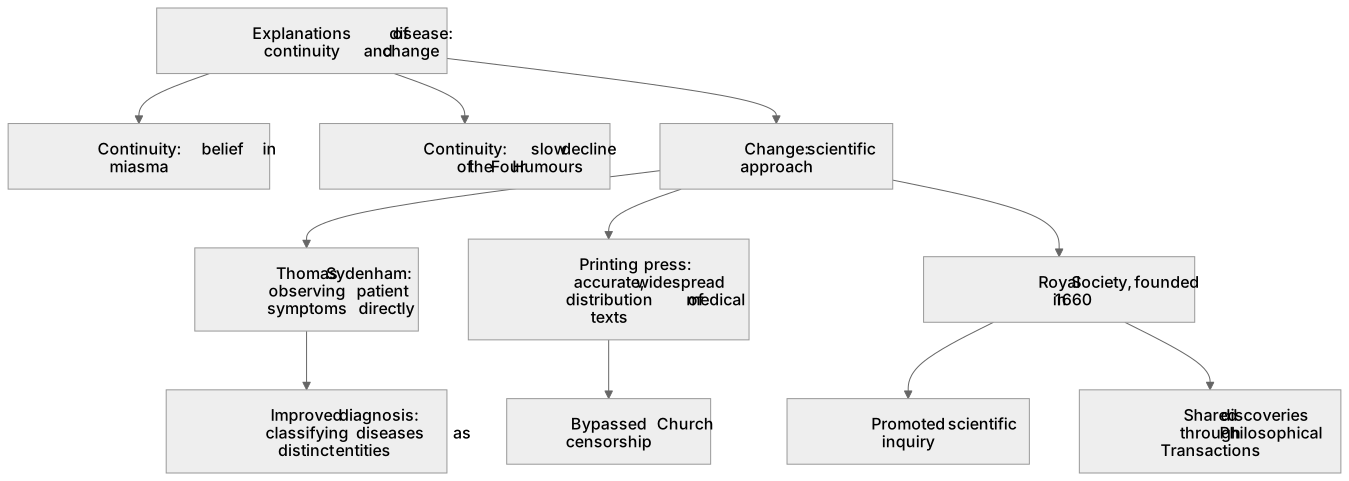
During the Medical Renaissance, explanations for disease saw both continuity, such as the lingering belief in miasma, and significant change towards a scientific approach.
Checked against the Pearson Edexcel 1HI0 specification (opens in a new tab) on .
Study notes
From the checked teaching notes for this specification point.
The idea
During the Medical Renaissance, explanations for disease saw both continuity, such as the lingering belief in miasma, and significant change towards a scientific approach. Thomas Sydenham, the 'English Hippocrates', revolutionised diagnosis by observing patient symptoms directly rather than relying on theoretical texts, classifying diseases like scarlet fever as distinct entities. The transmission of these new ideas was accelerated by the printing press, which allowed accurate, widespread distribution of medical texts without Church interference. Furthermore, the Royal Society, founded in 1660, promoted scientific inquiry and shared discoveries through its journal, Philosophical Transactions, fostering a collaborative medical community.
What earns the marks
- Identify continuities in disease explanation, such as the persistence of miasma theory and the slow decline of the Four Humours.
- Explain Thomas Sydenham's contribution to medicine, focusing on his emphasis on clinical observation and the classification of specific diseases.
- Analyse the impact of the printing press on medicine, specifically how it bypassed Church censorship and standardised medical knowledge.
- Evaluate the role of the Royal Society in promoting the scientific method and facilitating the exchange of ideas through publication.
Common mistakes and how to put them right
Stating that the Four Humours theory disappeared completely during this period.
Put it right: Clarify that while challenged by new scientific approaches, traditional ideas like the Four Humours and miasma remained popular among the general public and many physicians.
Confusing Sydenham's work with discovering the causes of disease.
Put it right: Emphasise that Sydenham improved diagnosis and symptom observation, but he did not discover germs or the true biological causes of illness.
Underestimating the printing press's role in challenging authority.
Put it right: Explain that the printing press was crucial because it removed the Church's control over which medical texts were copied and distributed.
Exam tips
- Use Thomas Sydenham as a key example of the shift from theoretical medicine (Galen) to practical, observational medicine.
- When discussing the Royal Society, mention their motto 'Nullius in verba' (Take nobody's word for it) to illustrate the new focus on scientific proof.
- Contrast the rapid spread of ideas via the printing press with the slow, error-prone process of hand-copying manuscripts in the medieval period.
Try the lesson
The start of the Option 11: c1500–c1700: The Medical Renaissance in England - 1 Ideas about the cause of disease and illness: Continuity and change in explanations of the cause of disease and illness. A scientific approach, including the work of Thomas Sydenham in improving diagnosis. The influence of the printing press and the work of the Royal Society on the transmission of ideas. lesson, made from checked teaching notes for this specification point.
Have a go first
Which institution, founded in 1660 and granted a royal charter in 1662, played a key role in the transmission of new scientific ideas about medicine in England?
Listen
During the Medical Renaissance, explanations for disease saw both continuity, such as the lingering belief in miasma, and significant change towards a scientific approach. Thomas Sydenham, the 'English Hippocrates', revolutionised diagnosis by observing patient symptoms directly rather than relying on theoretical texts, classifying diseases like scarlet fever as distinct entities. The transmission of these new ideas was accelerated by the printing press, which allowed accurate, widespread distribution of medical texts without Church interference. Furthermore, the Royal Society, founded in 1660, promoted scientific inquiry and shared discoveries through its journal, Philosophical Transactions, fostering a collaborative medical community. A strong answer earns marks for these points. Identify continuities in disease explanation, such as the persistence of miasma theory and the slow decline of the Four Humours. Explain Thomas Sydenham's contribution to medicine, focusing on his emphasis on clinical observation and the classification of specific diseases. Analyse the impact of the printing press on medicine, specifically how it bypassed Church censorship and standardised medical knowledge. Evaluate the role of the Royal Society in promoting the scientific method and facilitating the exchange of ideas through publication. A common slip: Stating that the Four Humours theory disappeared completely during this period. Instead, Clarify that while challenged by new scientific approaches, traditional ideas like the Four Humours and miasma remained popular among the general public and many physicians. Exam tip: Use Thomas Sydenham as a key example of the shift from theoretical medicine (Galen) to practical, observational medicine.
See it
Label the diagram
Some boxes have lost their names. Pick the right name for each number.
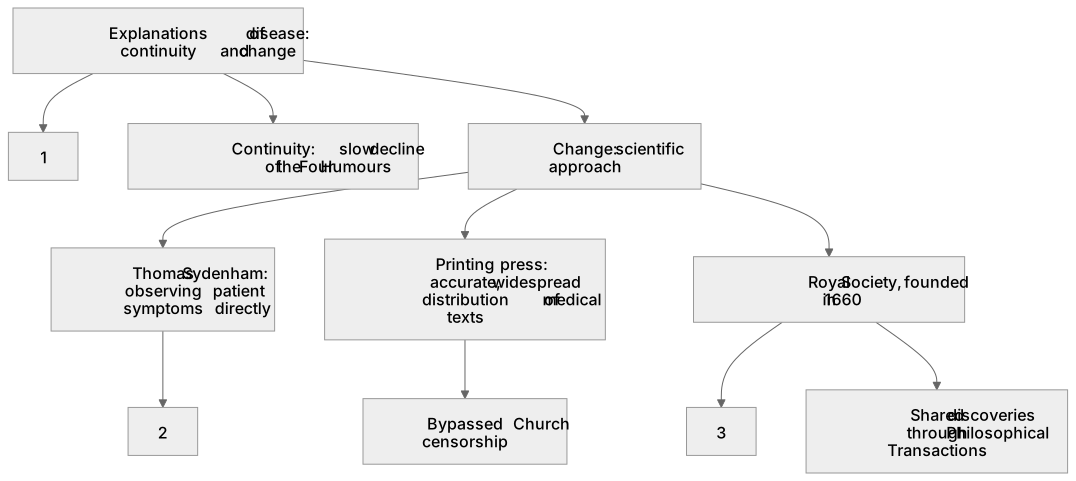
1Box 1
2Box 2
3Box 3
There is more to this lesson
The full lesson goes on to check your understanding and help you earn the marks. Create a free account to carry on, with your progress saved.
A week of Premium from your first lesson · Then the free plan continues · No card, no charge
Test your understanding of Option 11: c1500–c1700: The Medical Renaissance in England - 1 Ideas about the cause of disease and illness: Continuity and change in explanations of the cause of disease and illness. A scientific approach, including the work of Thomas Sydenham in improving diagnosis. The influence of the printing press and the work of the Royal Society on the transmission of ideas.
Active recall beats re-reading. Take an instant quiz now to test what you’ve learned and lock it into long-term memory.
A week of Premium from your first lesson · Then the free plan continues · No card, no charge