Pearson Edexcel · GCSE · History
Course version: 1HI0 · Version from Sept 2016
C1500–c1700: The Medical Renaissance in England - 2 Approaches to…
Full specification wording
Option 11: c1500–c1700: The Medical Renaissance in England - 2 Approaches to prevention and treatment: Improvements in medical training and the influence in England of the work of Vesalius.
During the Medical Renaissance, medical training improved as human dissection became legal and more common, allowing students to observe anatomy directly rather than relying solely on ancient texts.
Checked against the Pearson Edexcel 1HI0 specification (opens in a new tab) on .
- Point 2 of 2
- 3 key terms
Study notes
From the checked teaching notes for this specification point.
The idea
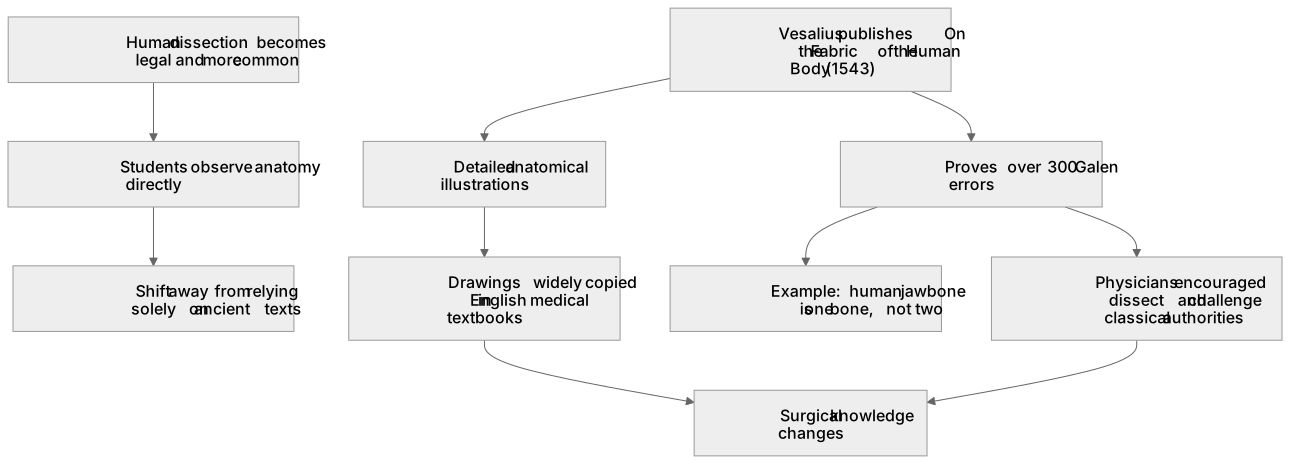
During the Medical Renaissance, medical training improved as human dissection became legal and more common, allowing students to observe anatomy directly rather than relying solely on ancient texts. Andreas Vesalius was pivotal in this shift; his 1543 book, On the Fabric of the Human Body, featured highly detailed anatomical illustrations. Vesalius proved that Galen had made over 300 errors, such as the human jawbone being one bone, not two. In England, Vesalius's work heavily influenced medical training, encouraging physicians to perform their own dissections and challenge classical authorities. His detailed anatomical drawings were widely copied in English medical textbooks, fundamentally changing surgical knowledge.
What earns the marks
- Explain how medical training shifted from reading classical texts to incorporating practical human dissection and anatomical observation.
- Describe the significance of Vesalius's publication, On the Fabric of the Human Body, and its detailed, accurate illustrations.
- Identify that Vesalius challenged Galen's authority by proving specific anatomical errors, such as the structure of the human jawbone and the septum of the heart.
- Evaluate the influence of Vesalius in England, noting how his work encouraged English physicians to dissect and investigate for themselves.
Common mistakes and how to put them right
Claiming Vesalius discovered new cures or treatments.
Put it right: Clarify that Vesalius improved anatomical knowledge and medical training, but this did not immediately lead to new treatments or cures for diseases.
Stating that Vesalius's ideas were instantly accepted by everyone.
Put it right: Explain that many traditional physicians heavily criticised Vesalius for challenging Galen, arguing that the human body must have changed since Galen's time.
Confusing Vesalius with Harvey or Sydenham.
Put it right: Ensure Vesalius is specifically linked to anatomy and dissection, whereas Harvey is linked to blood circulation and Sydenham to diagnosis.
Exam tips
- Memorise at least one specific error Vesalius corrected (e.g., the human jawbone is one bone, not two, or the breastbone has three parts, not seven) to use as concrete evidence.
- Emphasise the role of the printing press in spreading Vesalius's detailed anatomical drawings to medical students in England.
- When discussing his impact, note that while he didn't improve treatments directly, he laid the essential groundwork for future surgical and medical advancements.
Try the lesson
The start of the Option 11: c1500–c1700: The Medical Renaissance in England - 2 Approaches to prevention and treatment: Improvements in medical training and the influence in England of the work of Vesalius. lesson, made from checked teaching notes for this specification point.
Have a go first
Which famous book, published by Andreas Vesalius in 1543, significantly improved medical knowledge of human anatomy?
Listen
During the Medical Renaissance, medical training improved as human dissection became legal and more common, allowing students to observe anatomy directly rather than relying solely on ancient texts. Andreas Vesalius was pivotal in this shift; his 1543 book, On the Fabric of the Human Body, featured highly detailed anatomical illustrations. Vesalius proved that Galen had made over 300 errors, such as the human jawbone being one bone, not two. In England, Vesalius's work heavily influenced medical training, encouraging physicians to perform their own dissections and challenge classical authorities. His detailed anatomical drawings were widely copied in English medical textbooks, fundamentally changing surgical knowledge. A strong answer earns marks for these points. Explain how medical training shifted from reading classical texts to incorporating practical human dissection and anatomical observation. Describe the significance of Vesalius's publication, On the Fabric of the Human Body, and its detailed, accurate illustrations. Identify that Vesalius challenged Galen's authority by proving specific anatomical errors, such as the structure of the human jawbone and the septum of the heart. Evaluate the influence of Vesalius in England, noting how his work encouraged English physicians to dissect and investigate for themselves. A common slip: Claiming Vesalius discovered new cures or treatments. Instead, Clarify that Vesalius improved anatomical knowledge and medical training, but this did not immediately lead to new treatments or cures for diseases. Exam tip: Memorise at least one specific error Vesalius corrected (e.g., the human jawbone is one bone, not two, or the breastbone has three parts, not seven) to use as concrete evidence.
See it
Key words
Say what each word means before you turn the card.
Anatomy and dissection
Try answering aloud or in your head before turning the card.
Challenging authority
Try answering aloud or in your head before turning the card.
Medical education
Try answering aloud or in your head before turning the card.
See every definition
- Anatomy and dissection
- Human dissection became legal and more common, allowing students to observe anatomy directly rather than relying solely on ancient texts.
- Challenging authority
- Vesalius proved that Galen had made over 300 errors, encouraging physicians to challenge classical authorities.
- Medical education
- In England, Vesalius's work heavily influenced medical training, encouraging physicians to perform their own dissections.
Label the diagram
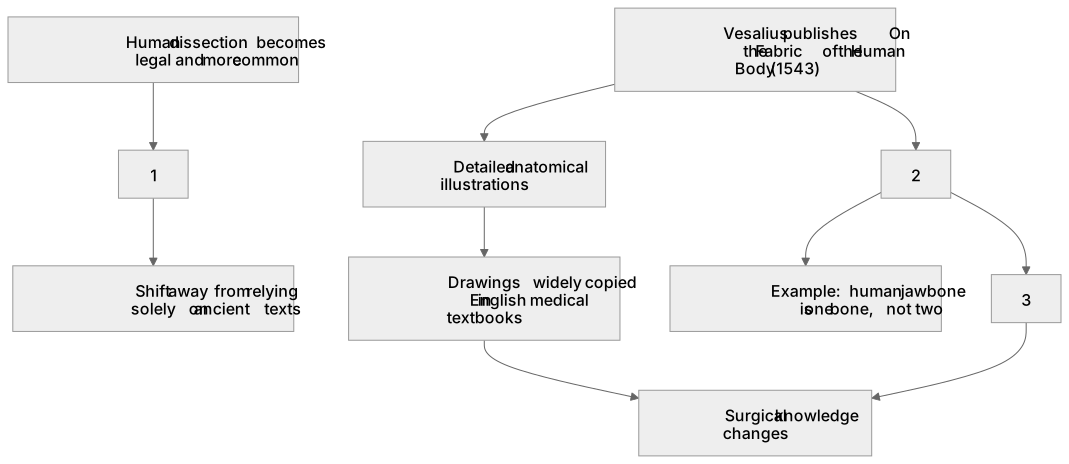
Some boxes have lost their names. Pick the right name for each number.
1Box 1
2Box 2
3Box 3
There is more to this lesson
The full lesson goes on to check your understanding and help you earn the marks. Create a free account to carry on, with your progress saved.
A week of Premium from your first lesson · Then the free plan continues · No card, no charge
Test your understanding of Option 11: c1500–c1700: The Medical Renaissance in England - 2 Approaches to prevention and treatment: Improvements in medical training and the influence in England of the work of Vesalius.
Active recall beats re-reading. Take an instant quiz now to test what you’ve learned and lock it into long-term memory.
A week of Premium from your first lesson · Then the free plan continues · No card, no charge