Pearson Edexcel · GCSE · History
Course version: 1HI0 · Version from Sept 2016
C1700–c1900: Medicine in eighteenth- and nineteenth-century Britain - 2…
Full specification wording
Option 11: c1700–c1900: Medicine in eighteenth- and nineteenth-century Britain - 2 Approaches to prevention and treatment: New approaches to prevention: the development and use of vaccinations and the Public Health Act (1875).
The 18th and 19th centuries introduced new approaches to disease prevention, shifting to government intervention.
Checked against the Pearson Edexcel 1HI0 specification (opens in a new tab) on .
- Point 2 of 2
- 4 key terms
Study notes
From the checked teaching notes for this specification point.
The idea
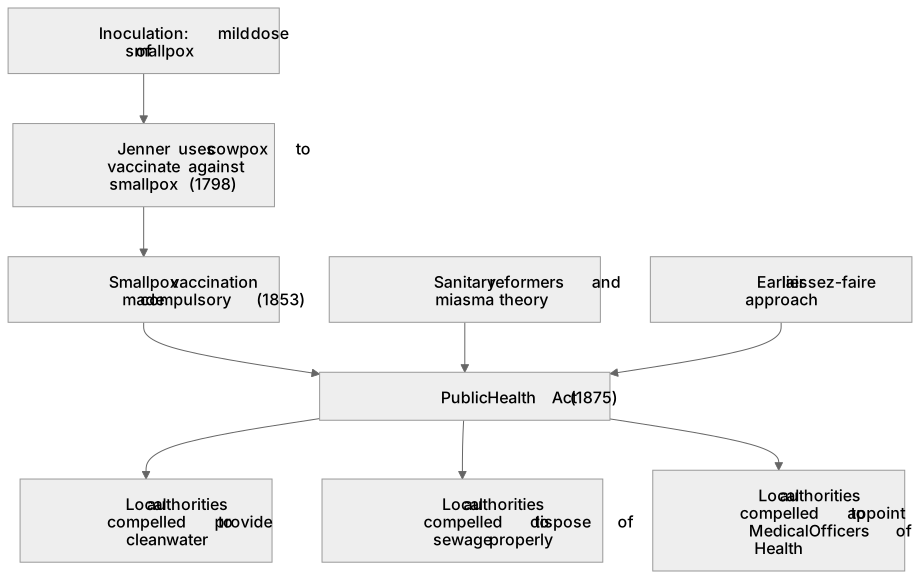
The 18th and 19th centuries introduced new approaches to disease prevention, shifting to government intervention. Edward Jenner’s development of the smallpox vaccination in 1798 marked a turning point, replacing the dangerous practice of inoculation. The government made smallpox vaccination compulsory in 1853, enforcing public health measures. This changing attitude culminated in the Public Health Act of 1875. Unlike the permissive 1848 Act, the 1875 legislation compelled local authorities to provide clean water, dispose of sewage properly, and appoint Medical Officers of Health. Driven by sanitary reformers and miasma theory rather than Germ Theory, this act ended laissez-faire attitudes, significantly improving living conditions and preventing disease.
What earns the marks
- Explain Edward Jenner's method of using cowpox to vaccinate against smallpox.
- Describe the government's role in promoting and eventually mandating the smallpox vaccination.
- Identify the key compulsory provisions of the 1875 Public Health Act, such as clean water and sewage disposal.
- Contrast the 1875 Public Health Act with earlier, laissez-faire approaches to public health.
Common mistakes and how to put them right
Confusing inoculation with vaccination.
Put it right: Specify that inoculation used a mild dose of smallpox, whereas Jenner's vaccination used cowpox, which was much safer.
Stating that Jenner knew why his vaccine worked.
Put it right: Clarify that Jenner observed the link between cowpox and smallpox but could not explain it scientifically, as Germ Theory did not yet exist.
Claiming the 1875 Public Health Act was based on Germ Theory.
Put it right: Emphasise that the Act was driven by sanitary reform and the miasma theory, which advocated cleaning up filth to prevent disease, rather than an understanding of germs.
Exam tips
- Highlight the shift from laissez-faire government attitudes to compulsory intervention when discussing the 1875 Act.
- Mention the opposition to Jenner's vaccine to show an understanding of the complexities of medical progress.
- Use the 1875 Public Health Act as a prime example of how miasma-based sanitary reforms led to effective prevention, even before Germ Theory was widely accepted.
Try the lesson
The start of the Option 11: c1700–c1900: Medicine in eighteenth- and nineteenth-century Britain - 2 Approaches to prevention and treatment: New approaches to prevention: the development and use of vaccinations and the Public Health Act (1875). lesson, made from checked teaching notes for this specification point.
Have a go first
What observation led Edward Jenner to develop the first vaccination against smallpox in 1796?
Listen
The 18th and 19th centuries introduced new approaches to disease prevention, shifting to government intervention. Edward Jenner’s development of the smallpox vaccination in 1798 marked a turning point, replacing the dangerous practice of inoculation. The government made smallpox vaccination compulsory in 1853, enforcing public health measures. This changing attitude culminated in the Public Health Act of 1875. Unlike the permissive 1848 Act, the 1875 legislation compelled local authorities to provide clean water, dispose of sewage properly, and appoint Medical Officers of Health. Driven by sanitary reformers and miasma theory rather than Germ Theory, this act ended laissez-faire attitudes, significantly improving living conditions and preventing disease. A strong answer earns marks for these points. Explain Edward Jenner's method of using cowpox to vaccinate against smallpox. Describe the government's role in promoting and eventually mandating the smallpox vaccination. Identify the key compulsory provisions of the 1875 Public Health Act, such as clean water and sewage disposal. Contrast the 1875 Public Health Act with earlier, laissez-faire approaches to public health. A common slip: Confusing inoculation with vaccination. Instead, Specify that inoculation used a mild dose of smallpox, whereas Jenner's vaccination used cowpox, which was much safer. Exam tip: Highlight the shift from laissez-faire government attitudes to compulsory intervention when discussing the 1875 Act.
See it
Put the events in order
Put these events in the order they happened, earliest first.
- 1. Jenner developed the smallpox vaccination using cowpox
- 2. Public Health Act compelled local authorities to improve public health
- 3. Government made smallpox vaccination compulsory
Key words
Say what each word means before you turn the card.
Government Intervention
Try answering aloud or in your head before turning the card.
Public Health
Try answering aloud or in your head before turning the card.
Prevention of Disease
Try answering aloud or in your head before turning the card.
Vaccination
Try answering aloud or in your head before turning the card.
See every definition
- Government Intervention
- The shift away from laissez-faire attitudes towards compulsory measures, such as making smallpox vaccination compulsory in 1853 and compelling local authorities to act under the 1875 Act.
- Public Health
- The area in which the 1875 Act compelled local authorities to provide clean water, dispose of sewage properly and appoint Medical Officers of Health.
- Prevention of Disease
- New approaches such as the development and use of vaccinations and the Public Health Act, which improved living conditions and prevented disease.
- Vaccination
- Edward Jenner's development of the smallpox vaccination in 1798, which used cowpox and replaced the dangerous practice of inoculation.
Label the diagram
Some boxes have lost their names. Pick the right name for each number.
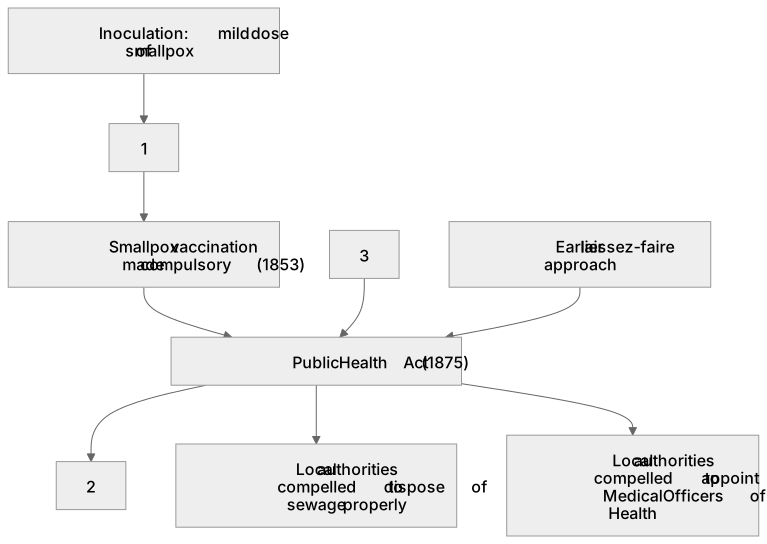
1Box 1
2Box 2
3Box 3
There is more to this lesson
The full lesson goes on to check your understanding and help you earn the marks. Create a free account to carry on, with your progress saved.
A week of Premium from your first lesson · Then the free plan continues · No card, no charge
Test your understanding of Option 11: c1700–c1900: Medicine in eighteenth- and nineteenth-century Britain - 2 Approaches to prevention and treatment: New approaches to prevention: the development and use of vaccinations and the Public Health Act (1875).
Active recall beats re-reading. Take an instant quiz now to test what you’ve learned and lock it into long-term memory.
A week of Premium from your first lesson · Then the free plan continues · No card, no charge