Pearson Edexcel · GCSE · History
Course version: 1HI0 · Version from Sept 2016
C1700–c1900: Medicine in eighteenth- and nineteenth-century Britain - 3…
Full specification wording
Option 11: c1700–c1900: Medicine in eighteenth- and nineteenth-century Britain - 3 Case studies ● Key individual: Jenner and the development of vaccination.: Fighting Cholera in London (1854); attempts to prevent its spread; the significance of Snow and the Broad Street pump.
John Snow's investigation into the 1854 cholera epidemic in Soho, London, marked a turning point in public health.
Checked against the Pearson Edexcel 1HI0 specification (opens in a new tab) on .
Study notes
From the checked teaching notes for this specification point.
The idea
John Snow's investigation into the 1854 cholera epidemic in Soho, London, marked a turning point in public health. Before Snow, cholera was widely believed to be spread by miasma, leading to ineffective prevention attempts like burning tar or cleaning streets. Snow mapped the cholera deaths and noticed a cluster around the Broad Street water pump. By removing the pump handle, he prevented further spread, proving cholera was waterborne. His work was highly significant as it provided practical evidence against the miasma theory, although it took time for his ideas to be fully accepted until Pasteur's Germ Theory provided the scientific explanation. Snow's methods laid the foundation for modern epidemiology.
What earns the marks
- Identify the prevailing belief in miasma during the 1854 cholera outbreak and the ineffective methods used to combat it.
- Describe John Snow's methodology of mapping cholera deaths to identify the Broad Street pump as the source.
- Explain the immediate impact of removing the pump handle in halting the localised epidemic.
- Evaluate the long-term significance of Snow's work in proving cholera was waterborne and influencing public health.
Common mistakes and how to put them right
Stating that John Snow discovered the cholera bacteria.
Put it right by explaining that he proved how it spread, but the bacteria was identified later by Koch.
Claiming that Snow's findings were immediately accepted by the government.
Put it right by noting that the government and many doctors continued to believe in miasma until the Germ Theory was established.
Confusing John Snow with Edwin Chadwick.
Put it right by distinguishing Snow's practical epidemiological work on cholera from Chadwick's broader sanitary reports.
Exam tips
- Use the specific example of the Broad Street pump to demonstrate Snow's practical approach to disease prevention.
- Discuss the limitations of Snow's impact, noting that without the Germ Theory, he could not explain why the water caused illness.
Try the lesson
The start of the Option 11: c1700–c1900: Medicine in eighteenth- and nineteenth-century Britain - 3 Case studies ● Key individual: Jenner and the development of vaccination.: Fighting Cholera in London (1854); attempts to prevent its spread; the significance of Snow and the Broad Street pump. lesson, made from checked teaching notes for this specification point.
Have a go first
What action did John Snow take in 1854 to stop the spread of cholera in Soho, London?
Listen
John Snow's investigation into the 1854 cholera epidemic in Soho, London, marked a turning point in public health. Before Snow, cholera was widely believed to be spread by miasma, leading to ineffective prevention attempts like burning tar or cleaning streets. Snow mapped the cholera deaths and noticed a cluster around the Broad Street water pump. By removing the pump handle, he prevented further spread, proving cholera was waterborne. His work was highly significant as it provided practical evidence against the miasma theory, although it took time for his ideas to be fully accepted until Pasteur's Germ Theory provided the scientific explanation. Snow's methods laid the foundation for modern epidemiology. A strong answer earns marks for these points. Identify the prevailing belief in miasma during the 1854 cholera outbreak and the ineffective methods used to combat it. Describe John Snow's methodology of mapping cholera deaths to identify the Broad Street pump as the source. Explain the immediate impact of removing the pump handle in halting the localised epidemic. Evaluate the long-term significance of Snow's work in proving cholera was waterborne and influencing public health. A common slip: Stating that John Snow discovered the cholera bacteria. Instead, explaining that he proved how it spread, but the bacteria was identified later by Koch. Exam tip: Use the specific example of the Broad Street pump to demonstrate Snow's practical approach to disease prevention.
See it

Label the diagram
Some boxes have lost their names. Pick the right name for each number.
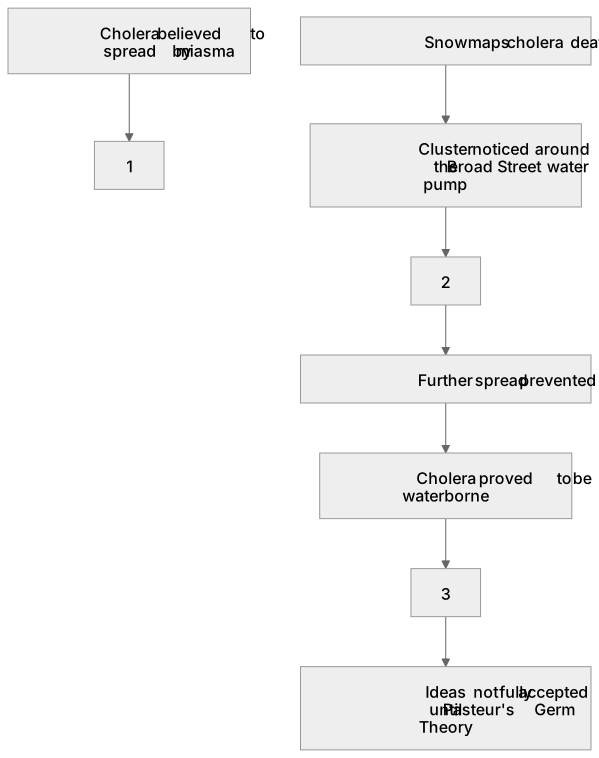
1Box 1
2Box 2
3Box 3
There is more to this lesson
The full lesson goes on to check your understanding and help you earn the marks. Create a free account to carry on, with your progress saved.
A week of Premium from your first lesson · Then the free plan continues · No card, no charge
Test your understanding of Option 11: c1700–c1900: Medicine in eighteenth- and nineteenth-century Britain - 3 Case studies ● Key individual: Jenner and the development of vaccination.: Fighting Cholera in London (1854); attempts to prevent its spread; the significance of Snow and the Broad Street pump.
Active recall beats re-reading. Take an instant quiz now to test what you’ve learned and lock it into long-term memory.
A week of Premium from your first lesson · Then the free plan continues · No card, no charge