Pearson Edexcel · GCSE · History
Course version: 1HI0 · Version from Sept 2016
The historic environment - 1 The British sector of the Western Front,…
Full specification wording
Option 11: The historic environment - 1 The British sector of the Western Front, 1914–18: injuries, treatment and the trenches: Conditions requiring medical treatment on the Western Front, including the problems of ill health arising from the trench environment. The nature of wounds from rifles and explosives. The problem of shrapnel, wound infection and increased numbers of head injuries. The effects of gas attacks.
The Western Front produced unprecedented medical challenges.
Checked against the Pearson Edexcel 1HI0 specification (opens in a new tab) on .
- Point 2 of 5
- 4 key terms
Study notes
From the checked teaching notes for this specification point.
The idea
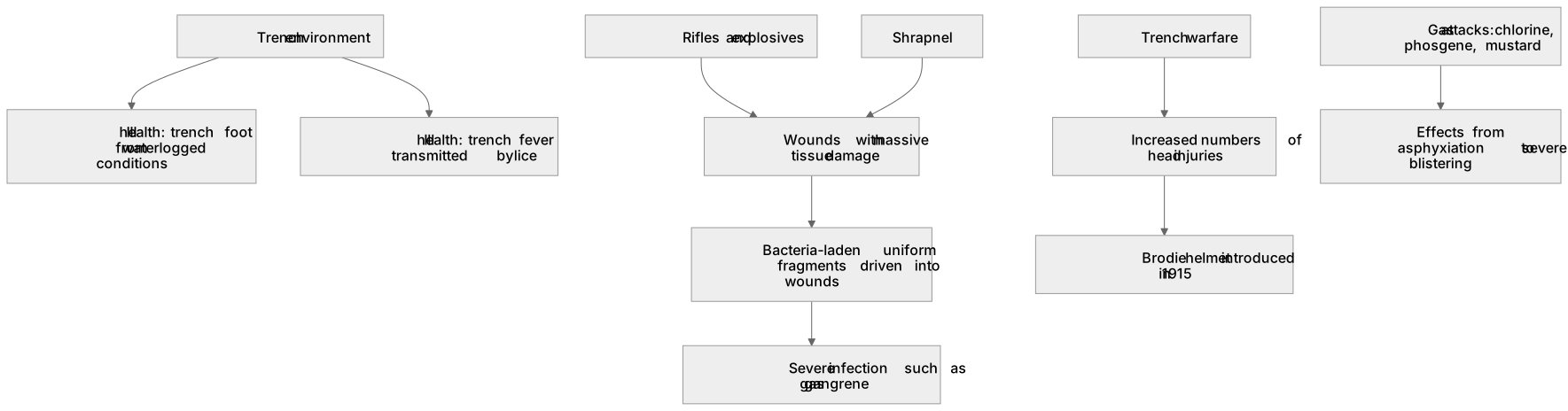
The Western Front produced unprecedented medical challenges. The trench environment caused severe ill health, notably trench foot from waterlogged conditions, and trench fever transmitted by lice. Combat inflicted devastating injuries; high-explosive artillery and shrapnel caused massive tissue damage and drove bacteria-laden uniform fragments into wounds, leading to severe infections like gas gangrene. Trench warfare resulted in increased numbers of head injuries, prompting the introduction of the Brodie helmet in 1915. Additionally, the deployment of chemical weapons, including chlorine, phosgene, and mustard gas, caused terrifying effects ranging from asphyxiation to severe blistering, requiring new medical responses and treatments.
What earns the marks
- Describe illnesses caused by the trench environment, such as trench foot and trench fever.
- Explain the nature of wounds caused by high-explosive artillery, shrapnel, and rifle fire.
- Detail the causes of wound infection, specifically the introduction of bacteria from the heavily fertilised French soil.
- Explain the reasons for the high rate of head injuries and the medical effects of different poison gases (chlorine, phosgene, mustard).
Common mistakes and how to put them right
Stating that gas attacks were the biggest killer.
Put it right by noting that artillery and shrapnel caused the vast majority of casualties and deaths.
Confusing trench foot with trench fever.
Put it right: Trench foot is caused by cold, wet conditions, while trench fever is transmitted by lice.
Assuming antibiotics were available.
Put it right: Clarify that penicillin was not available during WWI, making wound infections like gas gangrene extremely deadly.
Exam tips
- Be specific about the types of gas used (chlorine, phosgene, mustard) and their distinct medical effects on the body.
- Link the problem of wound infection directly to the environment, specifically the bacteria in the heavily manured soil of the battlefields.
- When discussing head injuries, mention the introduction of the Brodie helmet as a preventative measure that changed the nature of the injuries treated.
Try the lesson
The start of the Option 11: The historic environment - 1 The British sector of the Western Front, 1914–18: injuries, treatment and the trenches: Conditions requiring medical treatment on the Western Front, including the problems of ill health arising from the trench environment. The nature of wounds from rifles and explosives. The problem of shrapnel, wound infection and increased numbers of head injuries. The effects of gas attacks. lesson, made from checked teaching notes for this specification point.
Have a go first
Which medical condition was directly caused by standing in cold, waterlogged trenches for long periods on the Western Front?
Listen
The Western Front produced unprecedented medical challenges. The trench environment caused severe ill health, notably trench foot from waterlogged conditions, and trench fever transmitted by lice. Combat inflicted devastating injuries; high-explosive artillery and shrapnel caused massive tissue damage and drove bacteria-laden uniform fragments into wounds, leading to severe infections like gas gangrene. Trench warfare resulted in increased numbers of head injuries, prompting the introduction of the Brodie helmet in 1915. Additionally, the deployment of chemical weapons, including chlorine, phosgene, and mustard gas, caused terrifying effects ranging from asphyxiation to severe blistering, requiring new medical responses and treatments. A strong answer earns marks for these points. Describe illnesses caused by the trench environment, such as trench foot and trench fever. Explain the nature of wounds caused by high-explosive artillery, shrapnel, and rifle fire. Detail the causes of wound infection, specifically the introduction of bacteria from the heavily fertilised French soil. Explain the reasons for the high rate of head injuries and the medical effects of different poison gases (chlorine, phosgene, mustard). A common slip: Stating that gas attacks were the biggest killer. Instead, noting that artillery and shrapnel caused the vast majority of casualties and deaths. Exam tip: Be specific about the types of gas used (chlorine, phosgene, mustard) and their distinct medical effects on the body.
See it
Key words
Say what each word means before you turn the card.
Environmental health hazards
Try answering aloud or in your head before turning the card.
Weapons technology and injury
Try answering aloud or in your head before turning the card.
Infection and disease
Try answering aloud or in your head before turning the card.
Chemical warfare
Try answering aloud or in your head before turning the card.
See every definition
- Environmental health hazards
- Ill health arising from the trench environment, such as trench foot from waterlogged conditions and trench fever transmitted by lice.
- Weapons technology and injury
- Devastating injuries inflicted by high-explosive artillery, shrapnel and rifle fire, which caused massive tissue damage.
- Infection and disease
- Severe infections such as gas gangrene, caused when bacteria-laden uniform fragments were driven into wounds.
- Chemical warfare
- The deployment of chemical weapons, including chlorine, phosgene and mustard gas, causing effects ranging from asphyxiation to severe blistering.
Label the diagram
Some boxes have lost their names. Pick the right name for each number.
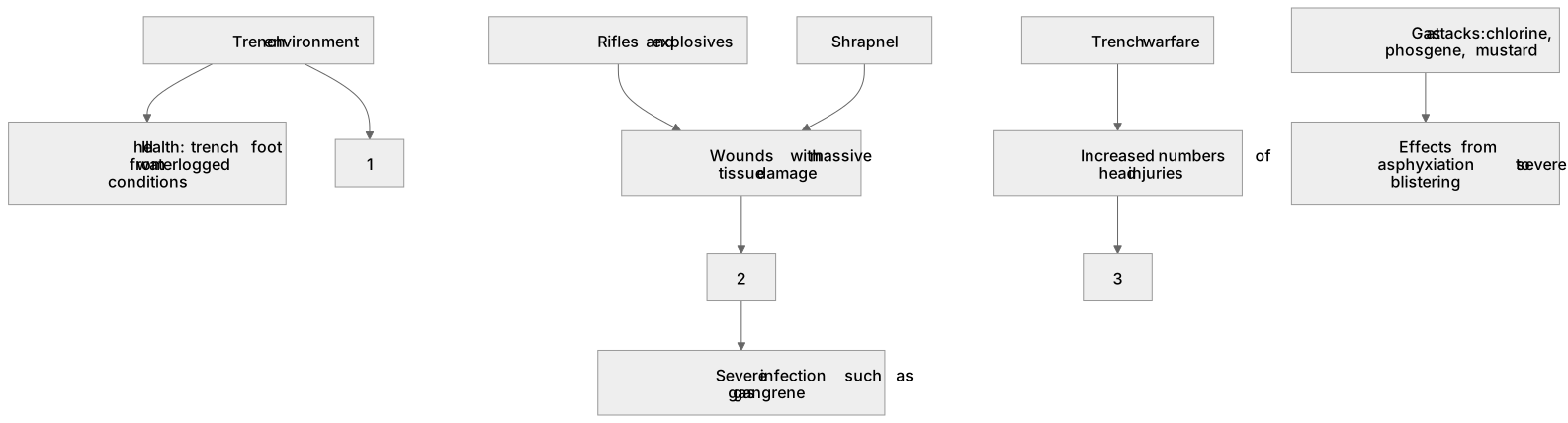
1Box 1
2Box 2
3Box 3
There is more to this lesson
The full lesson goes on to check your understanding and help you earn the marks. Create a free account to carry on, with your progress saved.
A week of Premium from your first lesson · Then the free plan continues · No card, no charge
Test your understanding of Option 11: The historic environment - 1 The British sector of the Western Front, 1914–18: injuries, treatment and the trenches: Conditions requiring medical treatment on the Western Front, including the problems of ill health arising from the trench environment. The nature of wounds from rifles and explosives. The problem of shrapnel, wound infection and increased numbers of head injuries. The effects of gas attacks.
Active recall beats re-reading. Take an instant quiz now to test what you’ve learned and lock it into long-term memory.
A week of Premium from your first lesson · Then the free plan continues · No card, no charge