Pearson Edexcel · GCSE · History
Course version: 1HI0 · Version from Sept 2016
C1250–c1500: Medieval warfare and English society - 3 Case studies ● The…
Full specification wording
Option 12: c1250–c1500: Medieval warfare and English society - 3 Case studies ● The Battle of Falkirk (1298): reasons for its outcome; the roles of William Wallace and Edward I.: The Battle of Agincourt (1415): reasons for its outcome; the role of Henry V.
The Battle of Agincourt (1415) resulted in a decisive English victory despite being heavily outnumbered.
Checked against the Pearson Edexcel 1HI0 specification (opens in a new tab) on .
- 3 key terms
Study notes
From the checked teaching notes for this specification point.
The idea
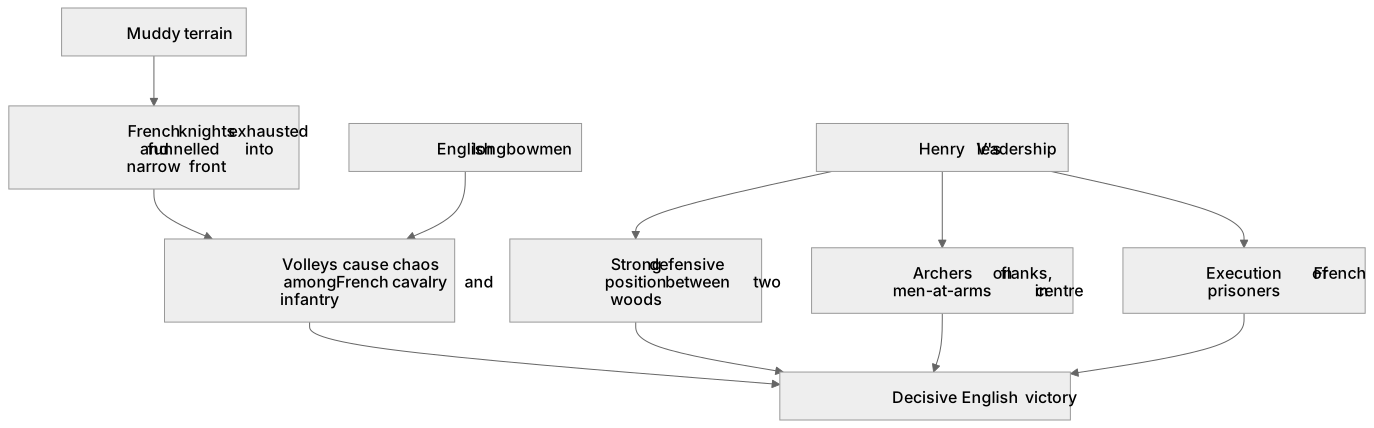
The Battle of Agincourt (1415) resulted in a decisive English victory despite being heavily outnumbered. The outcome was shaped by several factors, notably the muddy terrain which exhausted the heavily armoured French knights and funnelled them into a narrow front. English longbowmen played a crucial role, firing volleys into the advancing French cavalry and infantry, causing chaos. Henry V’s leadership was pivotal; he chose a strong defensive position between two woods, inspired his troops, and made the ruthless tactical decision to execute French prisoners to prevent a rear attack. His strategic deployment of archers on the flanks and men-at-arms in the centre maximised his army's defensive capabilities against the French.
What earns the marks
- Explain how the muddy terrain hindered the French cavalry and infantry, causing exhaustion and crowd crushes.
- Describe the impact of the English longbowmen in disrupting the French advance and inflicting heavy casualties.
- Analyse Henry V's tactical deployment, including securing his flanks with woodland and placing stakes to protect archers.
- Evaluate Henry V's leadership qualities, such as his motivational skills and the controversial decision to execute prisoners.
Common mistakes and how to put them right
Claiming the English won solely because they had more men.
Put it right: The English were actually heavily outnumbered by the French.
Stating that longbows easily pierced all French plate armour.
Put it right: The arrows primarily caused chaos, wounded horses, and hit less protected areas.
Ignoring the role of terrain.
Put it right: The muddy field and narrow battlefield were just as critical as the longbow in securing the victory.
Exam tips
- When discussing reasons for the outcome, link different factors together, such as how the mud made the French easier targets for the longbowmen.
- Use specific details about Henry V's leadership, like his decision to fight on a narrow front, to demonstrate strong subject knowledge.
Try the lesson
The start of the Option 12: c1250–c1500: Medieval warfare and English society - 3 Case studies ● The Battle of Falkirk (1298): reasons for its outcome; the roles of William Wallace and Edward I.: The Battle of Agincourt (1415): reasons for its outcome; the role of Henry V. lesson, made from checked teaching notes for this specification point.
Have a go first
Which feature of the battlefield at Agincourt significantly disadvantaged the French army?
Listen
The Battle of Agincourt (1415) resulted in a decisive English victory despite being heavily outnumbered. The outcome was shaped by several factors, notably the muddy terrain which exhausted the heavily armoured French knights and funnelled them into a narrow front. English longbowmen played a crucial role, firing volleys into the advancing French cavalry and infantry, causing chaos. Henry V’s leadership was pivotal; he chose a strong defensive position between two woods, inspired his troops, and made the ruthless tactical decision to execute French prisoners to prevent a rear attack. His strategic deployment of archers on the flanks and men-at-arms in the centre maximised his army's defensive capabilities against the French. A strong answer earns marks for these points. Explain how the muddy terrain hindered the French cavalry and infantry, causing exhaustion and crowd crushes. Describe the impact of the English longbowmen in disrupting the French advance and inflicting heavy casualties. Analyse Henry V's tactical deployment, including securing his flanks with woodland and placing stakes to protect archers. Evaluate Henry V's leadership qualities, such as his motivational skills and the controversial decision to execute prisoners. Exam tip: When discussing reasons for the outcome, link different factors together, such as how the mud made the French easier targets for the longbowmen.
See it
Key words
Say what each word means before you turn the card.
Leadership and command
Try answering aloud or in your head before turning the card.
Tactics and strategy
Try answering aloud or in your head before turning the card.
The impact of terrain on warfare
Try answering aloud or in your head before turning the card.
See every definition
- Leadership and command
- Henry V’s leadership was pivotal: he chose a strong defensive position between two woods, inspired his troops, and made the ruthless tactical decision to execute French prisoners to prevent a rear attack.
- Tactics and strategy
- His strategic deployment of archers on the flanks and men-at-arms in the centre maximised his army's defensive capabilities against the French.
- The impact of terrain on warfare
- The muddy terrain exhausted the heavily armoured French knights and funnelled them into a narrow front.
Label the diagram
Some boxes have lost their names. Pick the right name for each number.
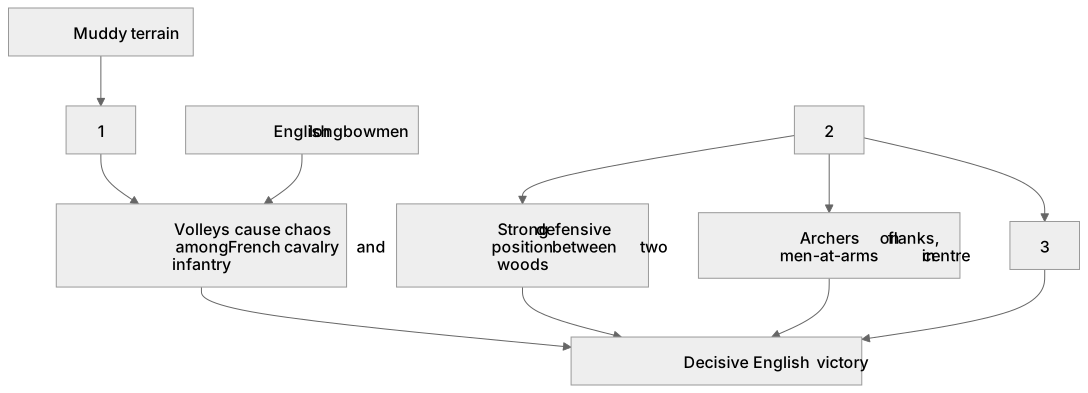
1Box 1
2Box 2
3Box 3
There is more to this lesson
The full lesson goes on to check your understanding and help you earn the marks. Create a free account to carry on, with your progress saved.
A week of Premium from your first lesson · Then the free plan continues · No card, no charge
Test your understanding of Option 12: c1250–c1500: Medieval warfare and English society - 3 Case studies ● The Battle of Falkirk (1298): reasons for its outcome; the roles of William Wallace and Edward I.: The Battle of Agincourt (1415): reasons for its outcome; the role of Henry V.
Active recall beats re-reading. Take an instant quiz now to test what you’ve learned and lock it into long-term memory.
A week of Premium from your first lesson · Then the free plan continues · No card, no charge