Pearson Edexcel · GCSE · History
Course version: 1HI0 · Version from Sept 2016
C1500–c1700: Warfare and English society in the early modern period:…
Full specification wording
Option 12: c1500–c1700: Warfare and English society in the early modern period: Continuity and change in the composition of the army in the sixteenth and seventeenth centuries, including the role of the musketeer, pikemen, dragoons and the cavalry. The development of a standing army.
During the sixteenth and seventeenth centuries, English armies experienced significant continuity and change.
Checked against the Pearson Edexcel 1HI0 specification (opens in a new tab) on .
- 3 key terms
Study notes
From the checked teaching notes for this specification point.
The idea
During the sixteenth and seventeenth centuries, English armies experienced significant continuity and change. While cavalry remained important, its role shifted from heavily armoured knights to lighter, firearm-equipped units like dragoons (mounted infantry). Infantry composition transformed dramatically, moving away from traditional longbowmen towards a combination of musketeers and pikemen. Pikemen provided essential defence against cavalry charges, while musketeers delivered volley fire. Over time, the ratio of musketeers to pikemen increased as firearms improved. A major structural change was the development of a standing army, replacing temporary feudal levies and militia with permanent, professional forces, notably the New Model Army.
What earns the marks
- Identify the shift in infantry composition from longbows and bills to muskets and pikes.
- Explain the complementary roles of musketeers (ranged firepower) and pikemen (defence against cavalry).
- Describe the changing role of cavalry, including the introduction of dragoons who rode to battle but fought on foot.
- Analyse the shift from ad-hoc militia and feudal levies to the establishment of a permanent, professional standing army.
Common mistakes and how to put them right
Confusing dragoons with traditional cavalry.
Put it right: Dragoons were mounted infantry who used horses for mobility but dismounted to fight.
Assuming the longbow disappeared overnight.
Put it right: The transition to muskets was gradual and longbows were still used in the sixteenth century.
Believing standing armies existed throughout the medieval period.
Put it right: Permanent, professional standing armies only truly developed in England during the seventeenth century.
Exam tips
- Use the phrase 'pike and musket' to describe the standard infantry formation of this era, highlighting how they worked together.
- When discussing continuity, mention that cavalry remained a decisive shock force on the battlefield, even as their equipment changed.
- Clearly define what a 'standing army' is (a permanent, professional force) when explaining its development.
Try the lesson
The start of the Option 12: c1500–c1700: Warfare and English society in the early modern period: Continuity and change in the composition of the army in the sixteenth and seventeenth centuries, including the role of the musketeer, pikemen, dragoons and the cavalry. The development of a standing army. lesson, made from checked teaching notes for this specification point.
Have a go first
What was the primary role of dragoons in seventeenth-century armies?
Listen
During the sixteenth and seventeenth centuries, English armies experienced significant continuity and change. While cavalry remained important, its role shifted from heavily armoured knights to lighter, firearm-equipped units like dragoons (mounted infantry). Infantry composition transformed dramatically, moving away from traditional longbowmen towards a combination of musketeers and pikemen. Pikemen provided essential defence against cavalry charges, while musketeers delivered volley fire. Over time, the ratio of musketeers to pikemen increased as firearms improved. A major structural change was the development of a standing army, replacing temporary feudal levies and militia with permanent, professional forces, notably the New Model Army. A strong answer earns marks for these points. Identify the shift in infantry composition from longbows and bills to muskets and pikes. Explain the complementary roles of musketeers (ranged firepower) and pikemen (defence against cavalry). Describe the changing role of cavalry, including the introduction of dragoons who rode to battle but fought on foot. Analyse the shift from ad-hoc militia and feudal levies to the establishment of a permanent, professional standing army. Exam tip: Use the phrase 'pike and musket' to describe the standard infantry formation of this era, highlighting how they worked together.
See it
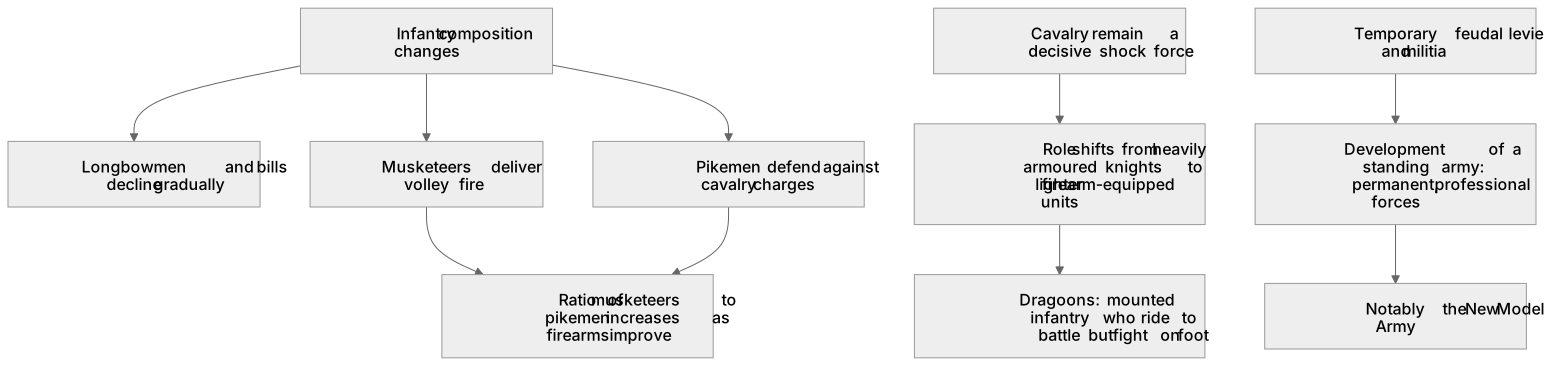
Key words
Say what each word means before you turn the card.
Dragoons
Try answering aloud or in your head before turning the card.
Standing army
Try answering aloud or in your head before turning the card.
Pikemen
Try answering aloud or in your head before turning the card.
See every definition
- Dragoons
- Mounted infantry who rode to battle but fought on foot, forming lighter, firearm-equipped units.
- Standing army
- A permanent, professional force that replaced temporary feudal levies and militia, notably the New Model Army.
- Pikemen
- Infantry who provided essential defence against cavalry charges, working alongside musketeers who delivered volley fire.
Label the diagram
Some boxes have lost their names. Pick the right name for each number.
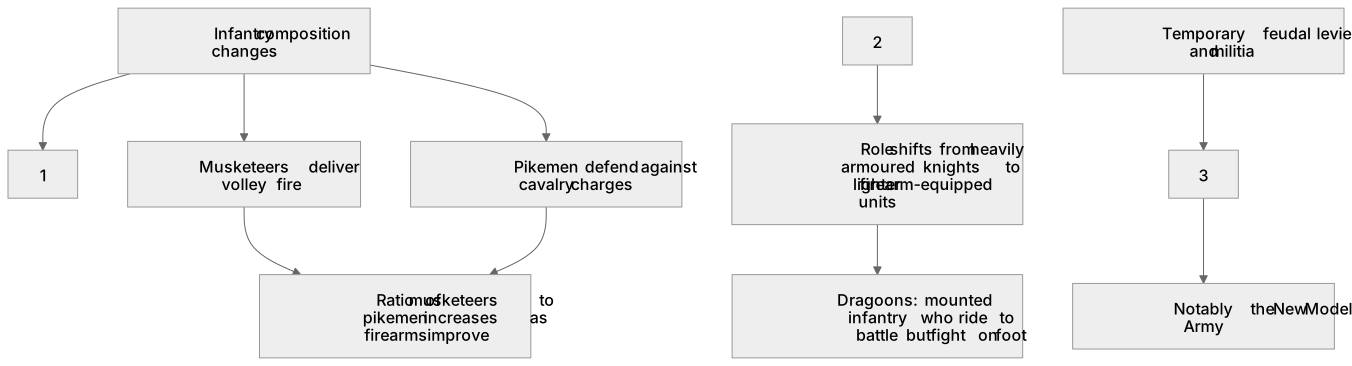
1Box 1
2Box 2
3Box 3
There is more to this lesson
The full lesson goes on to check your understanding and help you earn the marks. Create a free account to carry on, with your progress saved.
A week of Premium from your first lesson · Then the free plan continues · No card, no charge
Test your understanding of Option 12: c1500–c1700: Warfare and English society in the early modern period: Continuity and change in the composition of the army in the sixteenth and seventeenth centuries, including the role of the musketeer, pikemen, dragoons and the cavalry. The development of a standing army.
Active recall beats re-reading. Take an instant quiz now to test what you’ve learned and lock it into long-term memory.
A week of Premium from your first lesson · Then the free plan continues · No card, no charge