Pearson Edexcel · GCSE · History
Course version: 1HI0 · Version from Sept 2016
C1700–c1900: Warfare and British society in the eighteenth and nineteenth…
Full specification wording
Option 12: c1700–c1900: Warfare and British society in the eighteenth and nineteenth centuries - 1 The nature of warfare: Impact on warfare of changes in weaponry, including the use of rifles and bullets, and the development of field guns and heavy artillery. The impact on warfare of industrialisation, including steam- powered transport and the mass production of weapons.
Industrialisation fundamentally transformed warfare between 1700 and 1900.
Checked against the Pearson Edexcel 1HI0 specification (opens in a new tab) on .
- Point 1 of 2
- 3 key terms
Study notes
From the checked teaching notes for this specification point.
The idea
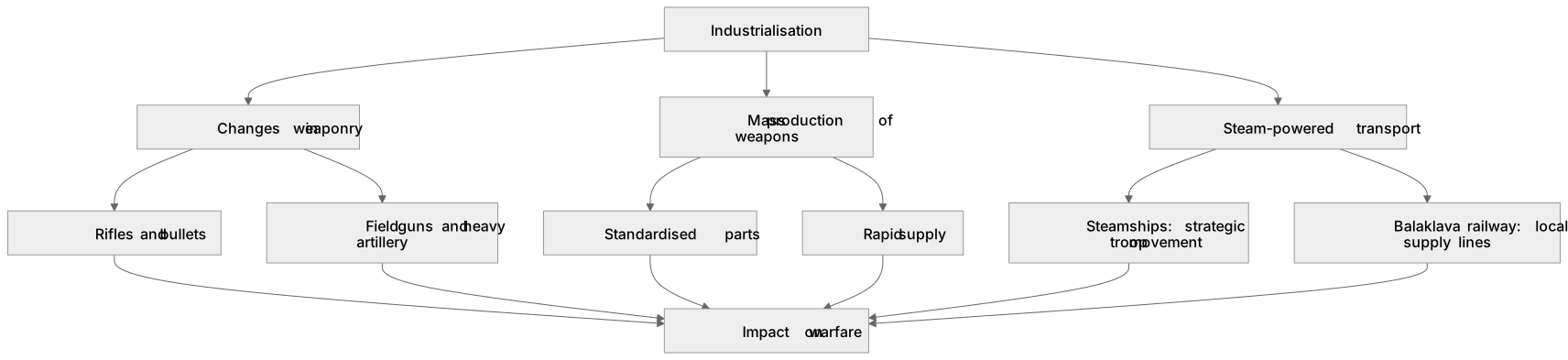
Industrialisation fundamentally transformed warfare between 1700 and 1900. Changes in weaponry, such as the shift to rifled barrels and the conical Minié bullet, vastly increased infantry range and accuracy. Concurrently, metallurgy improvements led to breech-loading field guns and heavy artillery, devastating traditional formations. Industrialisation enabled the mass production of these weapons, ensuring standardised parts and rapid supply. Furthermore, steam-powered transport revolutionised logistics and mobility. During the Crimean War, steamships provided strategic troop movement across vast distances, while the short Balaklava railway significantly improved local supply lines, sustaining troops during the siege of Sevastopol.
What earns the marks
- Explain how rifling and the Minié bullet increased the lethal range and accuracy of infantry firearms.
- Describe the development of breech-loading field guns and heavy artillery, and their impact on battlefield tactics.
- Analyse how the mass production of weapons allowed for larger, better-equipped armies and standardised ammunition.
- Evaluate the role of steam-powered transport, noting that steamships enabled strategic troop deployment while railways like the one at Balaklava improved local logistics.
Common mistakes and how to put them right
Confusing the impact of the musket with the rifle.
Put it right: Clearly distinguish that rifles had grooved barrels for spin, providing much greater range and accuracy than smoothbore muskets.
Overstating the role of the Balaklava railway.
Put it right: The Balaklava railway was a short logistics line for supplies, not a strategic network for rapid troop deployment; steamships handled strategic movement.
Assuming mass production only affected the quantity of weapons.
Put it right: Highlight that mass production also brought standardisation, making repairs and ammunition supply much more efficient.
Exam tips
- Link the development of the rifle directly to the decline of traditional cavalry charges and tight infantry formations.
- When discussing industrialisation, explicitly mention both the manufacturing of weapons (mass production) and the movement of armies and supplies (steam power).
Try the lesson
The start of the Option 12: c1700–c1900: Warfare and British society in the eighteenth and nineteenth centuries - 1 The nature of warfare: Impact on warfare of changes in weaponry, including the use of rifles and bullets, and the development of field guns and heavy artillery. The impact on warfare of industrialisation, including steam- powered transport and the mass production of weapons. lesson, made from checked teaching notes for this specification point.
Have a go first
How did the introduction of steam-powered railways significantly change warfare in the nineteenth century?
Listen
Industrialisation fundamentally transformed warfare between 1700 and 1900. Changes in weaponry, such as the shift to rifled barrels and the conical Minié bullet, vastly increased infantry range and accuracy. Concurrently, metallurgy improvements led to breech-loading field guns and heavy artillery, devastating traditional formations. Industrialisation enabled the mass production of these weapons, ensuring standardised parts and rapid supply. Furthermore, steam-powered transport revolutionised logistics and mobility. During the Crimean War, steamships provided strategic troop movement across vast distances, while the short Balaklava railway significantly improved local supply lines, sustaining troops during the siege of Sevastopol. A strong answer earns marks for these points. Explain how rifling and the Minié bullet increased the lethal range and accuracy of infantry firearms. Describe the development of breech-loading field guns and heavy artillery, and their impact on battlefield tactics. Analyse how the mass production of weapons allowed for larger, better-equipped armies and standardised ammunition. Evaluate the role of steam-powered transport, noting that steamships enabled strategic troop deployment while railways like the one at Balaklava improved local logistics. A common slip: Confusing the impact of the musket with the rifle. Instead, Clearly distinguish that rifles had grooved barrels for spin, providing much greater range and accuracy than smoothbore muskets. Exam tip: Link the development of the rifle directly to the decline of traditional cavalry charges and tight infantry formations.
See it
Key words
Say what each word means before you turn the card.
Industrialisation
Try answering aloud or in your head before turning the card.
Technological advancement
Try answering aloud or in your head before turning the card.
Logistics and supply
Try answering aloud or in your head before turning the card.
See every definition
- Industrialisation
- The process that enabled the mass production of weapons, ensuring standardised parts and rapid supply, and that brought steam-powered transport.
- Technological advancement
- Changes in weaponry, including the use of rifles and bullets and the development of field guns and heavy artillery.
- Logistics and supply
- The movement of armies and supplies, revolutionised by steam-powered transport, with steamships for strategic troop movement and railways improving local supply lines.
Label the diagram
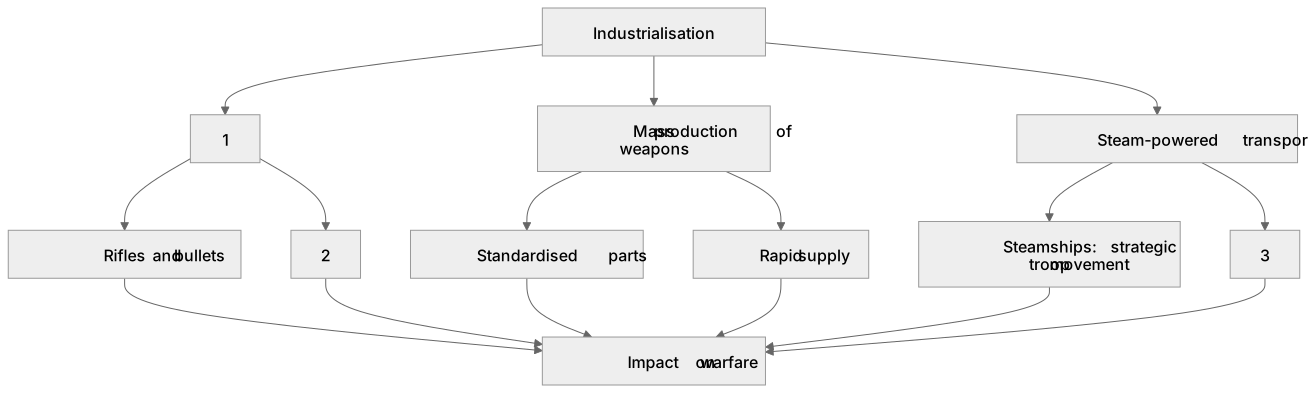
Some boxes have lost their names. Pick the right name for each number.
1Box 1
2Box 2
3Box 3
There is more to this lesson
The full lesson goes on to check your understanding and help you earn the marks. Create a free account to carry on, with your progress saved.
A week of Premium from your first lesson · Then the free plan continues · No card, no charge
Test your understanding of Option 12: c1700–c1900: Warfare and British society in the eighteenth and nineteenth centuries - 1 The nature of warfare: Impact on warfare of changes in weaponry, including the use of rifles and bullets, and the development of field guns and heavy artillery. The impact on warfare of industrialisation, including steam- powered transport and the mass production of weapons.
Active recall beats re-reading. Take an instant quiz now to test what you’ve learned and lock it into long-term memory.
A week of Premium from your first lesson · Then the free plan continues · No card, no charge