Pearson Edexcel · GCSE · History
Course version: 1HI0 · Version from Sept 2016
C1700–c1900: Warfare and British society in the eighteenth and nineteenth…
Full specification wording
Option 12: c1700–c1900: Warfare and British society in the eighteenth and nineteenth centuries - 2 The experience of war: The impact of war on civilians, including recruitment and requisitioning. The impact on popular attitudes of the growth of newspaper reporting and photography in the nineteenth century, exemplified in the Crimean and Boer Wars.
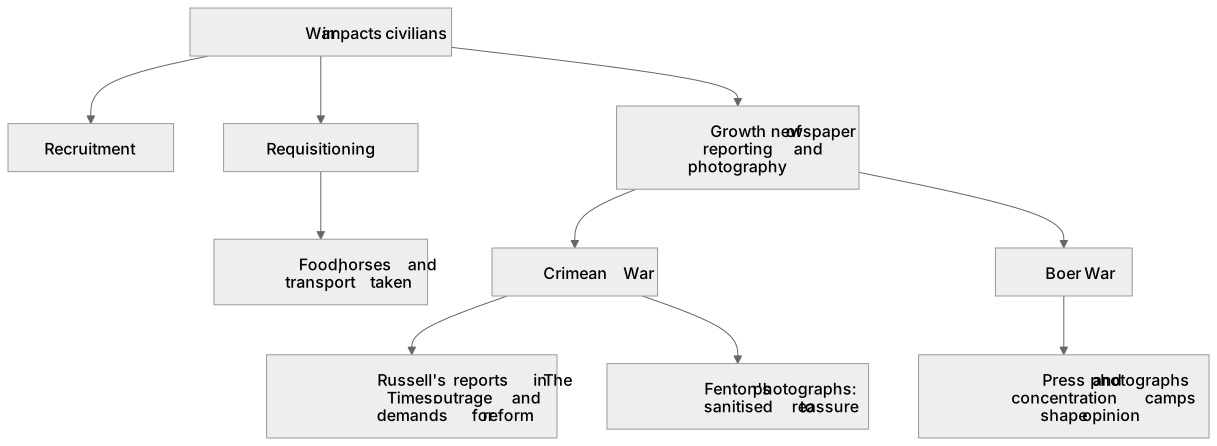
Warfare increasingly impacted civilians through intense recruitment drives and the requisitioning of supplies and transport.
Checked against the Pearson Edexcel 1HI0 specification (opens in a new tab) on .
- 3 key terms
Study notes
From the checked teaching notes for this specification point.
The idea
Warfare increasingly impacted civilians through intense recruitment drives and the requisitioning of supplies and transport. The growth of newspaper reporting and photography profoundly shifted popular attitudes towards war. During the Crimean War, William Howard Russell's vivid reports for *The Times* exposed harsh realities and logistical failures, sparking public outrage and demands for reform. Conversely, Roger Fenton's pioneering photographs were largely sanitised to avoid upsetting the public. During the Boer War, widespread press coverage and photographic evidence of concentration camps shaped public opinion, highlighting the human cost of conflict and increasing civilian engagement with military affairs.
What earns the marks
- Explain how requisitioning affected civilian life by removing essential goods, horses, and transport for military use.
- Describe the methods and impact of recruitment on local communities, including the loss of agricultural and industrial labour.
- Analyse how William Howard Russell's journalism during the Crimean War altered public perception by exposing military incompetence.
- Evaluate the role of early photography, noting that Fenton's Crimean images were sanitised, whereas Boer War photos exposed civilian suffering.
Common mistakes and how to put them right
Claiming that photography showed active combat in the Crimean War.
Put it right: Early cameras required long exposure times, so photographs depicted posed scenes and aftermaths, not live action.
Stating Fenton's photographs sparked outrage over logistical failures.
Put it right: Fenton's images were sanitised and intended to reassure the public, whereas Russell's written reports drove the outrage.
Assuming requisitioning only involved weapons.
Put it right: Requisitioning primarily involved taking civilian food, horses, and transport vehicles to supply the army.
Exam tips
- Use specific examples of journalists (like William Howard Russell) when discussing the impact of the press on public opinion.
- When evaluating change, contrast the limited civilian knowledge of war in the 1700s with the immediate, visual impact of reporting by the time of the Boer War.
Try the lesson
The start of the Option 12: c1700–c1900: Warfare and British society in the eighteenth and nineteenth centuries - 2 The experience of war: The impact of war on civilians, including recruitment and requisitioning. The impact on popular attitudes of the growth of newspaper reporting and photography in the nineteenth century, exemplified in the Crimean and Boer Wars. lesson, made from checked teaching notes for this specification point.
Have a go first
Which nineteenth-century development had a major impact on popular attitudes towards the Crimean War by bringing unprecedented visual evidence of the conflict to the British public?
Listen
Warfare increasingly impacted civilians through intense recruitment drives and the requisitioning of supplies and transport. The growth of newspaper reporting and photography profoundly shifted popular attitudes towards war. During the Crimean War, William Howard Russell's vivid reports for The Times exposed harsh realities and logistical failures, sparking public outrage and demands for reform. Conversely, Roger Fenton's pioneering photographs were largely sanitised to avoid upsetting the public. During the Boer War, widespread press coverage and photographic evidence of concentration camps shaped public opinion, highlighting the human cost of conflict and increasing civilian engagement with military affairs. A strong answer earns marks for these points. Explain how requisitioning affected civilian life by removing essential goods, horses, and transport for military use. Describe the methods and impact of recruitment on local communities, including the loss of agricultural and industrial labour. Analyse how William Howard Russell's journalism during the Crimean War altered public perception by exposing military incompetence. Evaluate the role of early photography, noting that Fenton's Crimean images were sanitised, whereas Boer War photos exposed civilian suffering. A common slip: Claiming that photography showed active combat in the Crimean War. Instead, early cameras required long exposure times, so photographs depicted posed scenes and aftermaths, not live action. Exam tip: Use specific examples of journalists (like William Howard Russell) when discussing the impact of the press on public opinion.
See it
Key words
Say what each word means before you turn the card.
Civilian experience
Try answering aloud or in your head before turning the card.
Media and communication
Try answering aloud or in your head before turning the card.
Public opinion
Try answering aloud or in your head before turning the card.
See every definition
- Civilian experience
- Warfare increasingly impacted civilians through intense recruitment drives and the requisitioning of supplies and transport.
- Media and communication
- The growth of newspaper reporting and photography profoundly shifted popular attitudes towards war.
- Public opinion
- Widespread press coverage and photographic evidence of concentration camps shaped popular attitudes, highlighting the human cost of conflict and increasing civilian engagement with military affairs.
Label the diagram
Some boxes have lost their names. Pick the right name for each number.
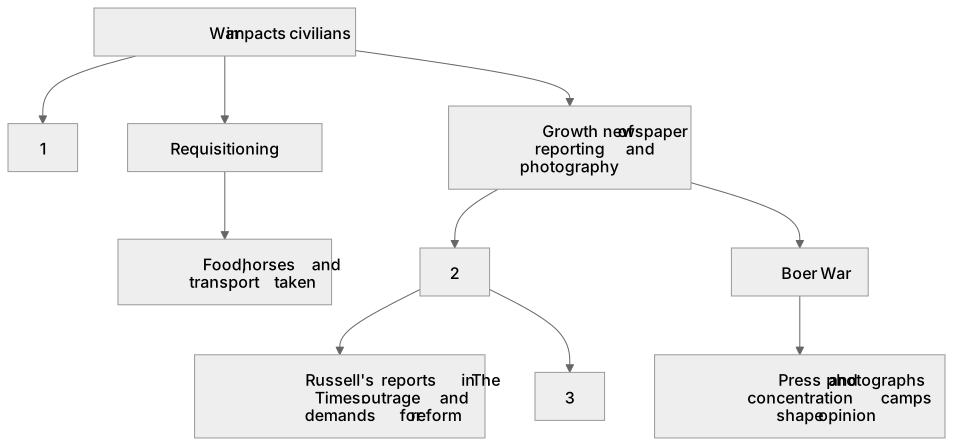
1Box 1
2Box 2
3Box 3
There is more to this lesson
The full lesson goes on to check your understanding and help you earn the marks. Create a free account to carry on, with your progress saved.
A week of Premium from your first lesson · Then the free plan continues · No card, no charge
Test your understanding of Option 12: c1700–c1900: Warfare and British society in the eighteenth and nineteenth centuries - 2 The experience of war: The impact of war on civilians, including recruitment and requisitioning. The impact on popular attitudes of the growth of newspaper reporting and photography in the nineteenth century, exemplified in the Crimean and Boer Wars.
Active recall beats re-reading. Take an instant quiz now to test what you’ve learned and lock it into long-term memory.
A week of Premium from your first lesson · Then the free plan continues · No card, no charge