Pearson Edexcel · GCSE · History
Course version: 1HI0 · Version from Sept 2016
C1900–present: Warfare and British society in the modern era - 1 The…
Full specification wording
Option 12: c1900–present: Warfare and British society in the modern era - 1 The nature of warfare: The recruitment and training of combatants, including the introduction of conscription, national service, the recruitment of women and the development of a professional army.
The 20th century saw a shift from volunteer forces to mass conscription and eventually a highly trained professional army.
Checked against the Pearson Edexcel 1HI0 specification (opens in a new tab) on .
- Point 2 of 2
- 4 key terms
Study notes
From the checked teaching notes for this specification point.
The idea
The 20th century saw a shift from volunteer forces to mass conscription and eventually a highly trained professional army. During the First World War, the Military Service Act 1916 introduced conscription to replace heavy losses. National Service continued post-1945 until 1960, requiring peacetime military service. The recruitment of women expanded significantly, from auxiliary roles like the WAAC in WWI to full integration into combat roles in the modern professional army. Training evolved from basic drill and rifle practice to complex, specialised preparation for high-tech warfare, reflecting the transition to a smaller, highly skilled professional force.
What earns the marks
- Explain the shift from volunteer armies to conscription in 1916 due to the unprecedented scale of casualties in the First World War.
- Describe the role of National Service (1947-1960) in maintaining a large peacetime military force during the early Cold War.
- Detail the progression of women's recruitment from auxiliary corps (e.g., WAAC, ATS) to full integration in the modern professional army.
- Analyse how the development of a professional army post-1960 necessitated highly specialised training for advanced weaponry and tactics.
Common mistakes and how to put them right
Confusing conscription with National Service.
Put it right: Conscription was wartime compulsory service, whereas National Service was peacetime compulsory service post-WWII.
Assuming women fought in combat roles during WWI and WWII.
Put it right: Women served in vital auxiliary and support roles, with combat roles opening much later.
Believing the British Army was always a mass conscripted force.
Put it right: It was historically a small volunteer force, only using conscription during the World Wars and National Service era.
Exam tips
- Use specific dates, such as 1916 for the introduction of conscription, to anchor your explanations of recruitment changes.
- When discussing the professional army, link the reduction in size to the increased reliance on high-tech weaponry and specialised training.
- Compare the recruitment methods of WWI (Pals Battalions, then conscription) with the modern reliance on career soldiers.
Try the lesson
The start of the Option 12: c1900–present: Warfare and British society in the modern era - 1 The nature of warfare: The recruitment and training of combatants, including the introduction of conscription, national service, the recruitment of women and the development of a professional army. lesson, made from checked teaching notes for this specification point.
Have a go first
In which year did the British government first introduce conscription for men during the First World War?
Listen
The 20th century saw a shift from volunteer forces to mass conscription and eventually a highly trained professional army. During the First World War, the Military Service Act 1916 introduced conscription to replace heavy losses. National Service continued post-1945 until 1960, requiring peacetime military service. The recruitment of women expanded significantly, from auxiliary roles like the WAAC in WWI to full integration into combat roles in the modern professional army. Training evolved from basic drill and rifle practice to complex, specialised preparation for high-tech warfare, reflecting the transition to a smaller, highly skilled professional force. A strong answer earns marks for these points. Explain the shift from volunteer armies to conscription in 1916 due to the unprecedented scale of casualties in the First World War. Describe the role of National Service (1947-1960) in maintaining a large peacetime military force during the early Cold War. Detail the progression of women's recruitment from auxiliary corps (e.g., WAAC, ATS) to full integration in the modern professional army. Analyse how the development of a professional army post-1960 necessitated highly specialised training for advanced weaponry and tactics. Exam tip: Use specific dates, such as 1916 for the introduction of conscription, to anchor your explanations of recruitment changes.
See it
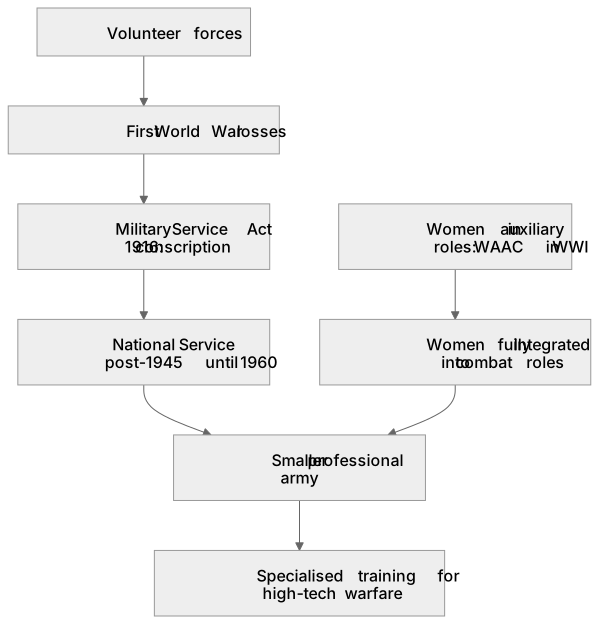
Put the events in order
Put these events in the order they happened, earliest first.
- 1. Military Service Act introduced conscription to replace heavy losses
- 2. National Service ended and professional army developed
- 3. National Service began, requiring peacetime military service
Key words
Say what each word means before you turn the card.
Conscription
Try answering aloud or in your head before turning the card.
National Service
Try answering aloud or in your head before turning the card.
Professional army
Try answering aloud or in your head before turning the card.
Auxiliary roles
Try answering aloud or in your head before turning the card.
See every definition
- Conscription
- Compulsory military service introduced during wartime, such as by the Military Service Act 1916 to replace heavy losses.
- National Service
- Peacetime compulsory military service that continued post-1945 until 1960, requiring peacetime military service.
- Professional army
- A smaller, highly skilled force that replaced mass conscription and required complex, specialised preparation for high-tech warfare.
- Auxiliary roles
- Support roles in which women served, such as the WAAC in WWI, before full integration into combat roles in the modern professional army.
Label the diagram
Some boxes have lost their names. Pick the right name for each number.
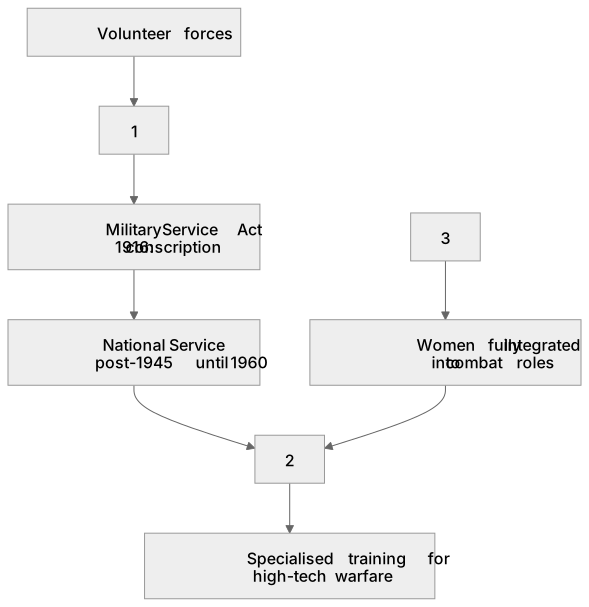
1Box 1
2Box 2
3Box 3
There is more to this lesson
The full lesson goes on to check your understanding and help you earn the marks. Create a free account to carry on, with your progress saved.
A week of Premium from your first lesson · Then the free plan continues · No card, no charge
Test your understanding of Option 12: c1900–present: Warfare and British society in the modern era - 1 The nature of warfare: The recruitment and training of combatants, including the introduction of conscription, national service, the recruitment of women and the development of a professional army.
Active recall beats re-reading. Take an instant quiz now to test what you’ve learned and lock it into long-term memory.
A week of Premium from your first lesson · Then the free plan continues · No card, no charge