Pearson Edexcel · GCSE · History
Course version: 1HI0 · Version from Sept 2016
C1900–present: Warfare and British society in the modern era - 3 Case…
Full specification wording
Option 12: c1900–present: Warfare and British society in the modern era - 3 Case studies ● The Western Front during the First World War and the Battle of the Somme (1916): the nature of trench warfare and war of attrition; reasons for the outcome of the Somme; role of General Haig.: The Iraq War (2003): reasons for its outcome; use of high-tech weaponry and surveillance techniques.
The 20th and 21st centuries saw dramatic shifts in warfare, exemplified by the Iraq War (2003).
Checked against the Pearson Edexcel 1HI0 specification (opens in a new tab) on .
Study notes
From the checked teaching notes for this specification point.
The idea
The 20th and 21st centuries saw dramatic shifts in warfare, exemplified by the Iraq War (2003). The rapid outcome of the initial invasion was driven by the Coalition's overwhelming use of high-tech weaponry, including precision-guided munitions, stealth aircraft, and cruise missiles. Advanced surveillance techniques, such as drones and satellite imagery, provided unprecedented battlefield intelligence, allowing for 'Shock and Awe' tactics that quickly dismantled Iraqi defences. However, the subsequent asymmetric warfare and insurgency highlighted the limitations of high-tech weaponry in securing long-term peace, contrasting sharply with the static war of attrition seen on the Western Front.
What earns the marks
- Explain how 'Shock and Awe' tactics and overwhelming air superiority contributed to the rapid defeat of the Iraqi conventional military in 2003.
- Describe the use of high-tech weaponry, such as precision-guided smart bombs and cruise missiles, in targeting Iraqi infrastructure and command centres.
- Detail the role of advanced surveillance techniques, including unmanned aerial vehicles (UAVs) and satellites, in providing real-time intelligence.
- Evaluate the limitations of high-tech weaponry during the subsequent insurgency phase, where conventional military dominance struggled against guerrilla tactics.
Common mistakes and how to put them right
Attributing the entire outcome of the Iraq War solely to technology.
Put it right: The initial conventional victory was swift, but the prolonged insurgency showed technology's limits in nation-building.
Confusing the 2003 Iraq War with the 1991 Gulf War.
Put it right: Ensure examples of weaponry and surveillance are specific to the 2003 conflict, such as the widespread use of drones.
Assuming high-tech weaponry eliminated civilian casualties.
Put it right: Despite precision guidance, collateral damage remained a significant issue and influenced the conflict's outcome.
Exam tips
- Use specific terms like 'precision-guided munitions' and 'UAVs' rather than generic phrases like 'modern bombs' or 'spy planes'.
- Contrast the rapid conventional victory achieved through high-tech means with the difficulties faced during the subsequent asymmetric insurgency.
- Link surveillance capabilities directly to the speed of the Coalition's advance, explaining how real-time data reduced the 'fog of war'.
Try the lesson
The start of the Option 12: c1900–present: Warfare and British society in the modern era - 3 Case studies ● The Western Front during the First World War and the Battle of the Somme (1916): the nature of trench warfare and war of attrition; reasons for the outcome of the Somme; role of General Haig.: The Iraq War (2003): reasons for its outcome; use of high-tech weaponry and surveillance techniques. lesson, made from checked teaching notes for this specification point.
Have a go first
Which type of high-tech weaponry was extensively used by coalition forces to target specific locations during the 2003 Iraq War?
Listen
The 20th and 21st centuries saw dramatic shifts in warfare, exemplified by the Iraq War (2003). The rapid outcome of the initial invasion was driven by the Coalition's overwhelming use of high-tech weaponry, including precision-guided munitions, stealth aircraft, and cruise missiles. Advanced surveillance techniques, such as drones and satellite imagery, provided unprecedented battlefield intelligence, allowing for 'Shock and Awe' tactics that quickly dismantled Iraqi defences. However, the subsequent asymmetric warfare and insurgency highlighted the limitations of high-tech weaponry in securing long-term peace, contrasting sharply with the static war of attrition seen on the Western Front. A strong answer earns marks for these points. Explain how 'Shock and Awe' tactics and overwhelming air superiority contributed to the rapid defeat of the Iraqi conventional military in 2003. Describe the use of high-tech weaponry, such as precision-guided smart bombs and cruise missiles, in targeting Iraqi infrastructure and command centres. Detail the role of advanced surveillance techniques, including unmanned aerial vehicles (UAVs) and satellites, in providing real-time intelligence. Evaluate the limitations of high-tech weaponry during the subsequent insurgency phase, where conventional military dominance struggled against guerrilla tactics. Exam tip: Use specific terms like 'precision-guided munitions' and 'UAVs' rather than generic phrases like 'modern bombs' or 'spy planes'.
See it
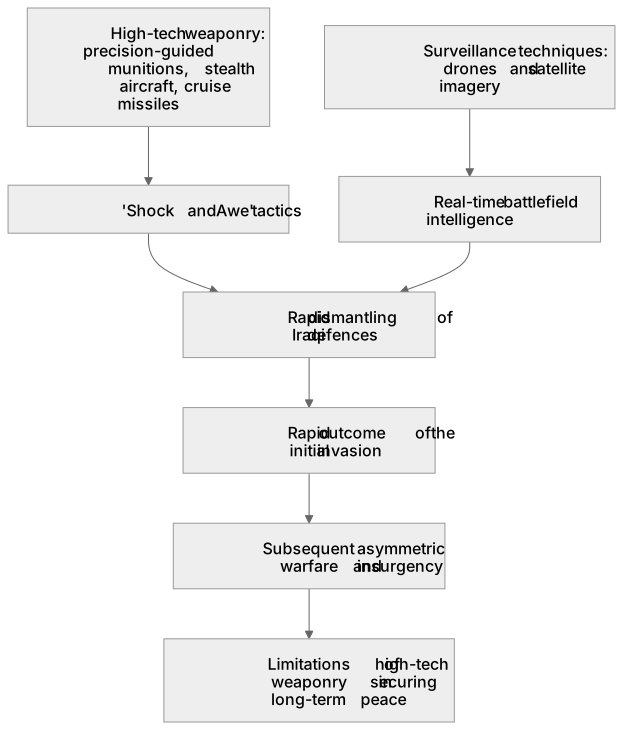
Label the diagram
Some boxes have lost their names. Pick the right name for each number.
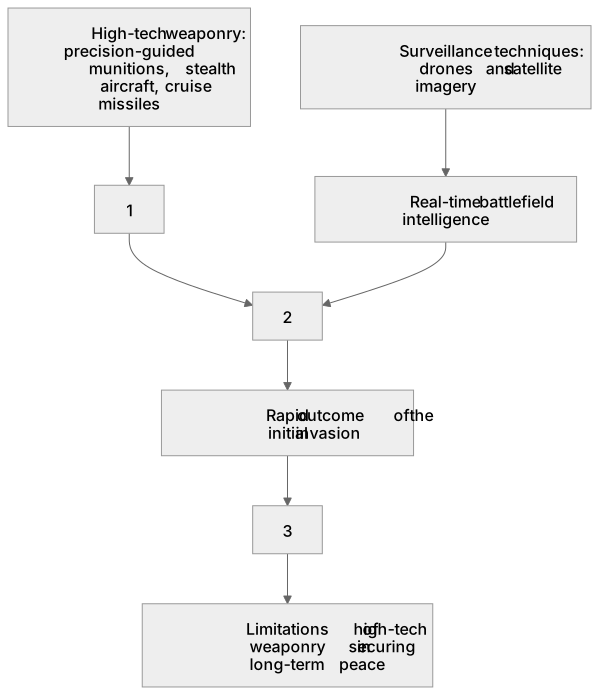
1Box 1
2Box 2
3Box 3
There is more to this lesson
The full lesson goes on to check your understanding and help you earn the marks. Create a free account to carry on, with your progress saved.
A week of Premium from your first lesson · Then the free plan continues · No card, no charge
Test your understanding of Option 12: c1900–present: Warfare and British society in the modern era - 3 Case studies ● The Western Front during the First World War and the Battle of the Somme (1916): the nature of trench warfare and war of attrition; reasons for the outcome of the Somme; role of General Haig.: The Iraq War (2003): reasons for its outcome; use of high-tech weaponry and surveillance techniques.
Active recall beats re-reading. Take an instant quiz now to test what you’ve learned and lock it into long-term memory.
A week of Premium from your first lesson · Then the free plan continues · No card, no charge