Pearson Edexcel · GCSE · History
Course version: 1HI0 · Version from Sept 2016
C1900–present: Warfare and British society in the modern era: Continuity…
Full specification wording
Option 12: c1900–present: Warfare and British society in the modern era: Continuity and change in the composition of the army, including the growth of a logistics corps and specialised bomb disposal units.
The composition of the British army in the modern era shows significant continuity and change.
Checked against the Pearson Edexcel 1HI0 specification (opens in a new tab) on .
- 3 key terms
Study notes
From the checked teaching notes for this specification point.
The idea
The composition of the British army in the modern era shows significant continuity and change. While core infantry and armoured regiments remained central, modern warfare necessitated a shift towards specialised support roles. A major change was the growth of a logistics corps, essential for managing the vast supply chains of ammunition, fuel, and rations required by mechanised armies. Furthermore, the increasing threat of unexploded ordnance and improvised explosive devices led to the creation of specialised bomb disposal units. These units highlight the army's adaptation to new technological threats, demonstrating a shift from a combat-focused force to one heavily reliant on advanced technical and logistical expertise to sustain operations.
What earns the marks
- Identify the continuity in the army's composition, such as the ongoing reliance on infantry regiments.
- Explain the reasons for the growth of a logistics corps, linking it to the increased supply demands of mechanised warfare.
- Describe the role of specialised bomb disposal units in dealing with unexploded ordnance and IEDs.
- Analyse how technological advancements in weaponry necessitated changes in the army's composition.
- Evaluate the shift from a predominantly combat-oriented army to one with a high proportion of technical and support personnel.
Common mistakes and how to put them right
Assuming the army only consists of frontline combat troops.
Put it right: Modern armies have a massive 'tail' of logistical and support staff required to maintain the 'teeth' of combat units.
Believing bomb disposal is a recent invention for the War on Terror.
Put it right: Specialised bomb disposal units were developed during the Second World War to deal with unexploded Luftwaffe bombs before evolving to tackle modern IEDs.
Ignoring continuity; correction: while support roles grew, the fundamental need for infantry to hold ground remains a constant feature of the army's composition.
Exam tips
- Use the Royal Logistic Corps as a specific example of how supply and transport functions were consolidated.
- Link the growth of bomb disposal units to specific conflicts, such as the Blitz in WWII or counter-insurgency in Afghanistan.
- When discussing change, always acknowledge what stayed the same (continuity) to provide a balanced answer.
Try the lesson
The start of the Option 12: c1900–present: Warfare and British society in the modern era: Continuity and change in the composition of the army, including the growth of a logistics corps and specialised bomb disposal units. lesson, made from checked teaching notes for this specification point.
Have a go first
Which specialised unit grew significantly in the modern British army to handle the supply of food, ammunition, and equipment?
Listen
The composition of the British army in the modern era shows significant continuity and change. While core infantry and armoured regiments remained central, modern warfare necessitated a shift towards specialised support roles. A major change was the growth of a logistics corps, essential for managing the vast supply chains of ammunition, fuel, and rations required by mechanised armies. Furthermore, the increasing threat of unexploded ordnance and improvised explosive devices led to the creation of specialised bomb disposal units. These units highlight the army's adaptation to new technological threats, demonstrating a shift from a combat-focused force to one heavily reliant on advanced technical and logistical expertise to sustain operations. A strong answer earns marks for these points. Identify the continuity in the army's composition, such as the ongoing reliance on infantry regiments. Explain the reasons for the growth of a logistics corps, linking it to the increased supply demands of mechanised warfare. Describe the role of specialised bomb disposal units in dealing with unexploded ordnance and IEDs. Analyse how technological advancements in weaponry necessitated changes in the army's composition. A common slip: Assuming the army only consists of frontline combat troops. Instead, modern armies have a massive 'tail' of logistical and support staff required to maintain the 'teeth' of combat units. Exam tip: Use the Royal Logistic Corps as a specific example of how supply and transport functions were consolidated.
See it
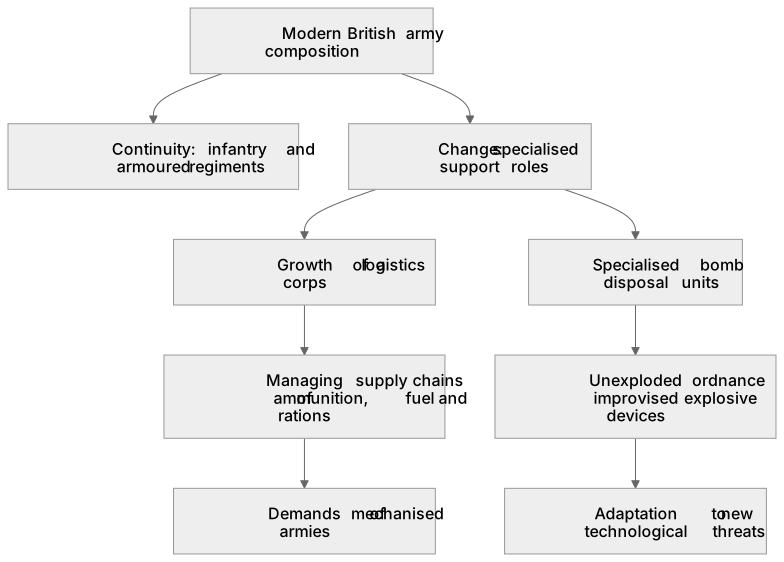
Key words
Say what each word means before you turn the card.
Bomb disposal units
Try answering aloud or in your head before turning the card.
Adaptation to new threats
Try answering aloud or in your head before turning the card.
Continuity
Try answering aloud or in your head before turning the card.
See every definition
- Bomb disposal units
- Specialised units created because of the increasing threat of unexploded ordnance and improvised explosive devices.
- Adaptation to new threats
- The army's response to new technological threats, shown by specialised bomb disposal units and a shift to advanced technical and logistical expertise.
- Continuity
- The ongoing reliance on infantry regiments, which remained central even as modern warfare necessitated a shift towards specialised support roles.
Label the diagram
Some boxes have lost their names. Pick the right name for each number.
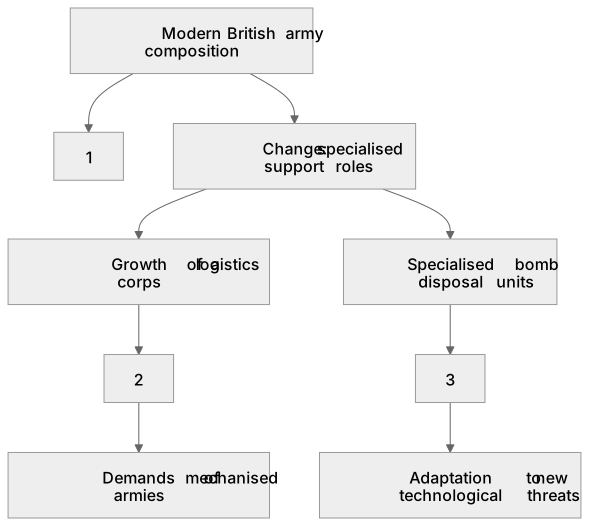
1Box 1
2Box 2
3Box 3
There is more to this lesson
The full lesson goes on to check your understanding and help you earn the marks. Create a free account to carry on, with your progress saved.
A week of Premium from your first lesson · Then the free plan continues · No card, no charge
Test your understanding of Option 12: c1900–present: Warfare and British society in the modern era: Continuity and change in the composition of the army, including the growth of a logistics corps and specialised bomb disposal units.
Active recall beats re-reading. Take an instant quiz now to test what you’ve learned and lock it into long-term memory.
A week of Premium from your first lesson · Then the free plan continues · No card, no charge