Pearson Edexcel · GCSE · History
Course version: 1HI0 · Version from Sept 2016
C1700–c1900: Migration in eighteenth- and nineteenth-century Britain - 1…
Full specification wording
Option 13: c1700–c1900: Migration in eighteenth- and nineteenth-century Britain - 1 The context for migration: The changing context of British society: changing social structures; the Industrial Revolution; urbanisation; transatlantic slavery; the growth of the British Empire; civil liberties.
Between 1700 and 1900, British society transformed, driving migration.
Checked against the Pearson Edexcel 1HI0 specification (opens in a new tab) on .
- Point 2 of 2
- 4 key terms
Study notes
From the checked teaching notes for this specification point.
The idea
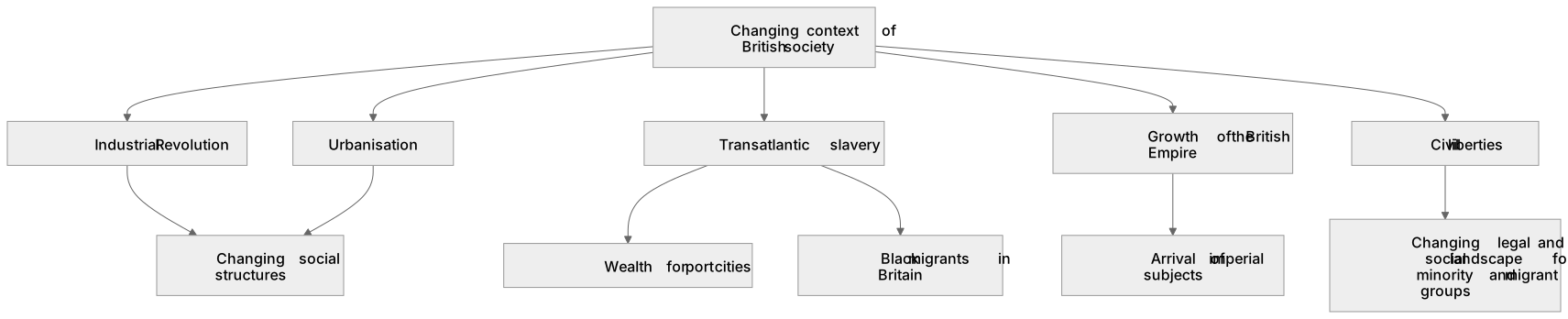
Between 1700 and 1900, British society transformed, driving migration. The Industrial Revolution and urbanisation shifted the population from rural areas to booming industrial cities, altering social structures by creating a large working class and a powerful middle class. Transatlantic slavery generated immense wealth for ports like Bristol, funding industrial growth and bringing Black migrants to Britain. The growth of the British Empire expanded global trade networks, resulting in the arrival of imperial subjects like lascars. Concurrently, evolving ideas about civil liberties, including the abolition movement and Catholic emancipation, slowly changed the legal and social landscape for minority and migrant groups within Britain.
What earns the marks
- Explain how the Industrial Revolution and urbanisation created new employment opportunities that acted as pull factors for migrants.
- Describe the changes in social structures, particularly the emergence of the industrial working class and the urban middle class.
- Analyse the impact of transatlantic slavery on British wealth, port city development, and the presence of Black communities in Britain.
- Discuss how the expansion of the British Empire facilitated the migration of imperial subjects to Britain.
- Evaluate the role of changing civil liberties, such as the abolition of slavery and religious emancipation, in shaping the migrant experience.
Common mistakes and how to put them right
Treating these contextual factors in isolation.
Put it right: Explain how they are interconnected, such as how imperial growth fuelled the Industrial Revolution.
Forgetting to link the context back to migration.
Put it right: Explain how factors like urbanisation or transatlantic slavery directly influenced who migrated and where they settled.
Overlooking the concept of civil liberties.
Put it right: Ensure you discuss how changing laws and attitudes towards rights affected different groups, including migrants.
Exam tips
- Use this contextual knowledge to explain the 'push' and 'pull' factors in any essay question about migration in this period.
- When discussing transatlantic slavery, mention its economic impact on specific British cities like Liverpool or Bristol to ground your answer.
- Think of 'civil liberties' in terms of specific historical events, such as the 1833 Slavery Abolition Act or the 1829 Catholic Relief Act.
Try the lesson
The start of the Option 13: c1700–c1900: Migration in eighteenth- and nineteenth-century Britain - 1 The context for migration: The changing context of British society: changing social structures; the Industrial Revolution; urbanisation; transatlantic slavery; the growth of the British Empire; civil liberties. lesson, made from checked teaching notes for this specification point.
Have a go first
How did the Industrial Revolution primarily alter the context for migration within and to Britain during the eighteenth and nineteenth centuries?
Listen
Between 1700 and 1900, British society transformed, driving migration. The Industrial Revolution and urbanisation shifted the population from rural areas to booming industrial cities, altering social structures by creating a large working class and a powerful middle class. Transatlantic slavery generated immense wealth for ports like Bristol, funding industrial growth and bringing Black migrants to Britain. The growth of the British Empire expanded global trade networks, resulting in the arrival of imperial subjects like lascars. Concurrently, evolving ideas about civil liberties, including the abolition movement and Catholic emancipation, slowly changed the legal and social landscape for minority and migrant groups within Britain. A strong answer earns marks for these points. Explain how the Industrial Revolution and urbanisation created new employment opportunities that acted as pull factors for migrants. Describe the changes in social structures, particularly the emergence of the industrial working class and the urban middle class. Analyse the impact of transatlantic slavery on British wealth, port city development, and the presence of Black communities in Britain. Discuss how the expansion of the British Empire facilitated the migration of imperial subjects to Britain. A common slip: Treating these contextual factors in isolation. Instead, explain how they are interconnected, such as how imperial growth fuelled the Industrial Revolution. Exam tip: Use this contextual knowledge to explain the 'push' and 'pull' factors in any essay question about migration in this period.
See it
Key words
Say what each word means before you turn the card.
Industrialisation and urbanisation
Try answering aloud or in your head before turning the card.
Imperialism and global trade
Try answering aloud or in your head before turning the card.
Social class and structure
Try answering aloud or in your head before turning the card.
Rights and liberties
Try answering aloud or in your head before turning the card.
See every definition
- Industrialisation and urbanisation
- The Industrial Revolution and urbanisation shifted the population from rural areas to booming industrial cities.
- Imperialism and global trade
- The growth of the British Empire expanded global trade networks, resulting in the arrival of imperial subjects like lascars.
- Social class and structure
- Social structures altered by creating a large working class and a powerful middle class.
- Rights and liberties
- Evolving ideas about civil liberties, including the abolition movement and Catholic emancipation, slowly changed the legal and social landscape for minority and migrant groups.
Label the diagram
Some boxes have lost their names. Pick the right name for each number.
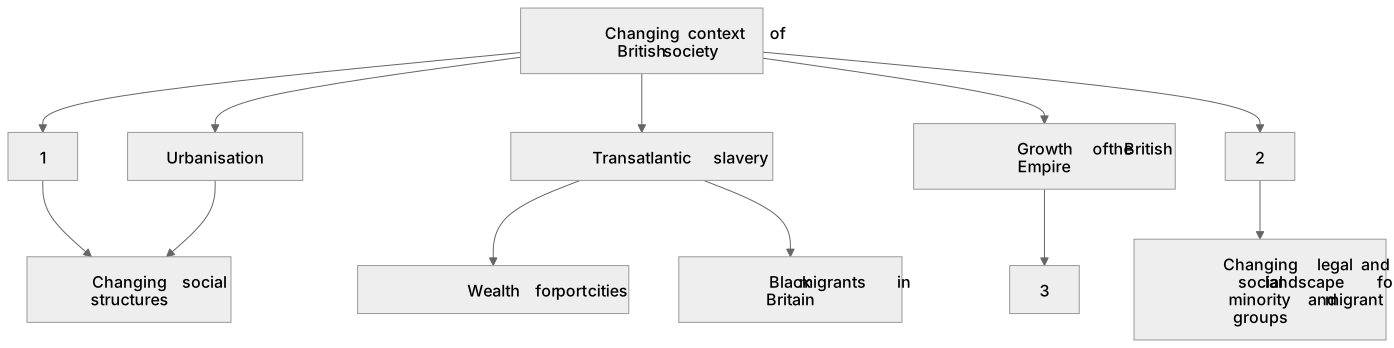
1Box 1
2Box 2
3Box 3
There is more to this lesson
The full lesson goes on to check your understanding and help you earn the marks. Create a free account to carry on, with your progress saved.
A week of Premium from your first lesson · Then the free plan continues · No card, no charge
Test your understanding of Option 13: c1700–c1900: Migration in eighteenth- and nineteenth-century Britain - 1 The context for migration: The changing context of British society: changing social structures; the Industrial Revolution; urbanisation; transatlantic slavery; the growth of the British Empire; civil liberties.
Active recall beats re-reading. Take an instant quiz now to test what you’ve learned and lock it into long-term memory.
A week of Premium from your first lesson · Then the free plan continues · No card, no charge