Pearson Edexcel · GCSE · History
Course version: 1HI0 · Version from Sept 2016
C1700–c1900: Migration in eighteenth- and nineteenth-century Britain - 3…
Full specification wording
Option 13: c1700–c1900: Migration in eighteenth- and nineteenth-century Britain - 3 Case studies ● Liverpool in the nineteenth century: its role in migration and the experiences of migrants, including Irish migrants.: The experience of Jewish migrants in the East End of London in late nineteenth century.
In the late 19th century, while Liverpool was a hub for Irish migrants, London's East End became the primary destination for Eastern European Jews escaping pogroms.
Checked against the Pearson Edexcel 1HI0 specification (opens in a new tab) on .
- 4 key terms
Study notes
From the checked teaching notes for this specification point.
The idea
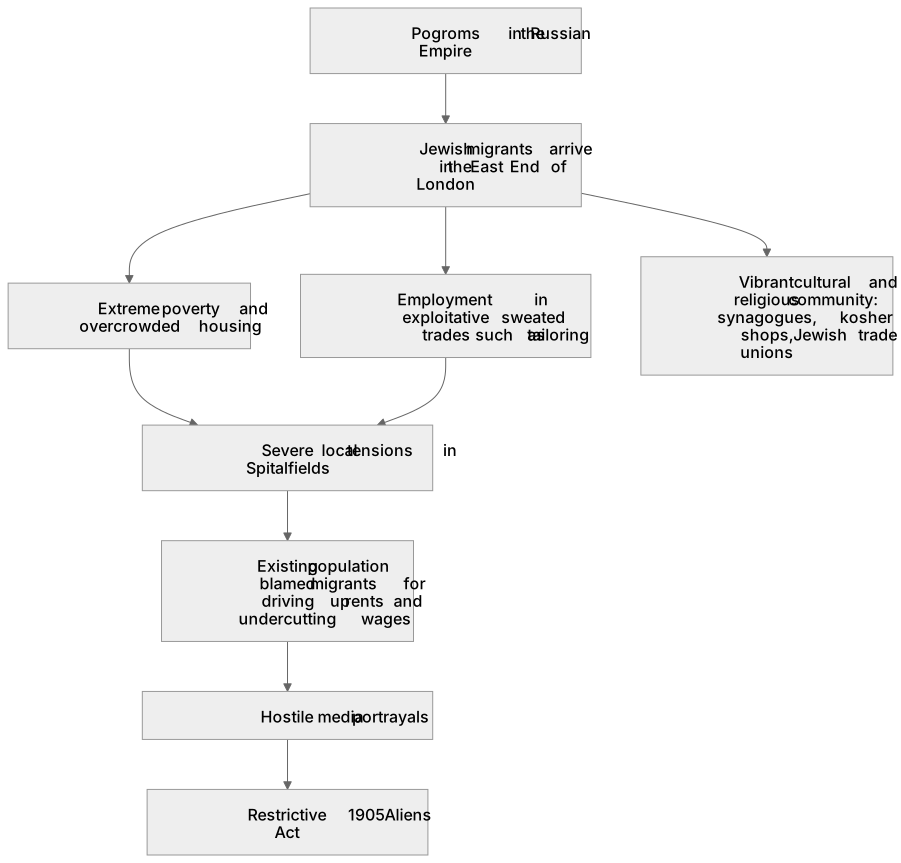
In the late 19th century, while Liverpool was a hub for Irish migrants, London's East End became the primary destination for Eastern European Jews escaping pogroms. Their experience featured extreme poverty, overcrowded housing, and employment in exploitative 'sweated trades' like tailoring. Despite these hardships, they built a vibrant cultural and religious community, establishing synagogues, kosher shops, and Jewish trade unions to fight for better conditions. However, their concentration in Spitalfields led to severe local tensions. The existing population blamed them for driving up rents and undercutting wages, exacerbated by hostile media portrayals, culminating in the restrictive 1905 Aliens Act.
What earns the marks
- Identify the push factors bringing Jewish migrants to London, specifically escaping pogroms in the Russian Empire.
- Describe the living and working conditions in the East End, focusing on overcrowding and the 'sweatshop' system.
- Explain how Jewish migrants maintained their culture and religion through synagogues, Yiddish newspapers, and kosher businesses.
- Analyse the causes of anti-alien sentiment among the local population, including economic competition and housing shortages.
- Compare the experiences of Jewish migrants in London with other groups, such as Irish migrants in Liverpool.
Common mistakes and how to put them right
Confusing late 19th-century Eastern European Jewish migrants with the earlier, more established middle-class Jewish community.
Put it right by distinguishing the poverty and distinct culture of the new arrivals.
Stating that Jewish migrants took all the local jobs.
Put it right by explaining they largely created their own employment in specific trades like tailoring.
Ignoring the community's agency.
Put it right by mentioning Jewish trade unions and strikes against sweatshop conditions.
Confusing the case studies of migration.
Put it right by ensuring Irish migration is linked to Liverpool and Jewish migration to the East End of London.
Exam tips
- Use specific terminology like 'pogroms', 'sweated trades', and 'Yiddish' to demonstrate precise historical knowledge.
- When discussing local hostility, explicitly link it to the economic context of the East End, such as the shortage of affordable housing.
- Contrast the initial reception of Jewish refugees with the later political backlash that led to the 1905 Aliens Act.
Try the lesson
The start of the Option 13: c1700–c1900: Migration in eighteenth- and nineteenth-century Britain - 3 Case studies ● Liverpool in the nineteenth century: its role in migration and the experiences of migrants, including Irish migrants.: The experience of Jewish migrants in the East End of London in late nineteenth century. lesson, made from checked teaching notes for this specification point.
Have a go first
Which type of employment was most commonly associated with Jewish migrants in the East End of London during the late nineteenth century?
Listen
In the late 19th century, while Liverpool was a hub for Irish migrants, London's East End became the primary destination for Eastern European Jews escaping pogroms. Their experience featured extreme poverty, overcrowded housing, and employment in exploitative 'sweated trades' like tailoring. Despite these hardships, they built a vibrant cultural and religious community, establishing synagogues, kosher shops, and Jewish trade unions to fight for better conditions. However, their concentration in Spitalfields led to severe local tensions. The existing population blamed them for driving up rents and undercutting wages, exacerbated by hostile media portrayals, culminating in the restrictive 1905 Aliens Act. A strong answer earns marks for these points. Identify the push factors bringing Jewish migrants to London, specifically escaping pogroms in the Russian Empire. Describe the living and working conditions in the East End, focusing on overcrowding and the 'sweatshop' system. Explain how Jewish migrants maintained their culture and religion through synagogues, Yiddish newspapers, and kosher businesses. Analyse the causes of anti-alien sentiment among the local population, including economic competition and housing shortages. A common slip: Confusing late 19th-century Eastern European Jewish migrants with the earlier, more established middle-class Jewish community. Instead, distinguishing the poverty and distinct culture of the new arrivals. Exam tip: Use specific terminology like 'pogroms', 'sweated trades', and 'Yiddish' to demonstrate precise historical knowledge.
See it
Key words
Say what each word means before you turn the card.
Religious persecution
Try answering aloud or in your head before turning the card.
Sweated labour
Try answering aloud or in your head before turning the card.
Community building
Try answering aloud or in your head before turning the card.
Anti-alien sentiment
Try answering aloud or in your head before turning the card.
See every definition
- Religious persecution
- The note links this to pogroms in the Russian Empire, which Eastern European Jews were escaping when they came to London's East End.
- Sweated labour
- Exploitative 'sweated trades' such as tailoring were the work Jewish migrants found in the East End.
- Community building
- Despite hardships, Jewish migrants built a vibrant cultural and religious community, establishing synagogues, kosher shops and Jewish trade unions.
- Anti-alien sentiment
- Hostility among the existing population, who blamed Jewish migrants for driving up rents and undercutting wages, was exacerbated by hostile media portrayals and culminated in the restrictive 1905 Aliens Act.
Label the diagram
Some boxes have lost their names. Pick the right name for each number.
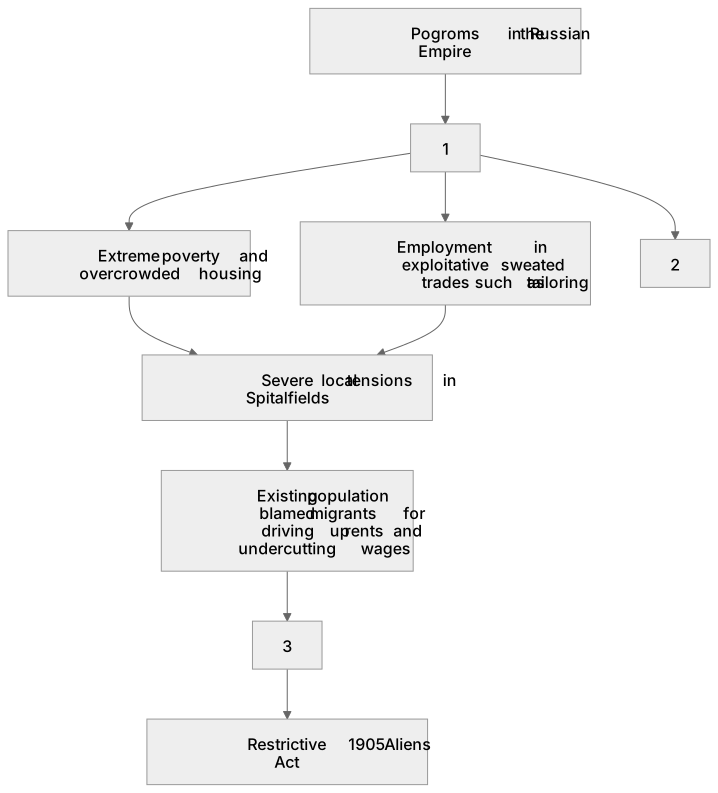
1Box 1
2Box 2
3Box 3
There is more to this lesson
The full lesson goes on to check your understanding and help you earn the marks. Create a free account to carry on, with your progress saved.
A week of Premium from your first lesson · Then the free plan continues · No card, no charge
Test your understanding of Option 13: c1700–c1900: Migration in eighteenth- and nineteenth-century Britain - 3 Case studies ● Liverpool in the nineteenth century: its role in migration and the experiences of migrants, including Irish migrants.: The experience of Jewish migrants in the East End of London in late nineteenth century.
Active recall beats re-reading. Take an instant quiz now to test what you’ve learned and lock it into long-term memory.
A week of Premium from your first lesson · Then the free plan continues · No card, no charge