Pearson Edexcel · GCSE · History
Course version: 1HI0 · Version from Sept 2016
C1900–present: Migration in modern Britain - 1 The context for migration:…
Full specification wording
Option 13: c1900–present: Migration in modern Britain - 1 The context for migration: Change and continuity in reasons for migration and patterns of settlement, including migrants from Ireland, Europe, the British Empire and the Commonwealth; refugees and asylum seekers.
Throughout the twentieth and twenty-first centuries, Britain experienced significant change and continuity in migration reasons and settlement patterns.
Checked against the Pearson Edexcel 1HI0 specification (opens in a new tab) on .
- Point 1 of 2
- 4 key terms
Study notes
From the checked teaching notes for this specification point.
The idea
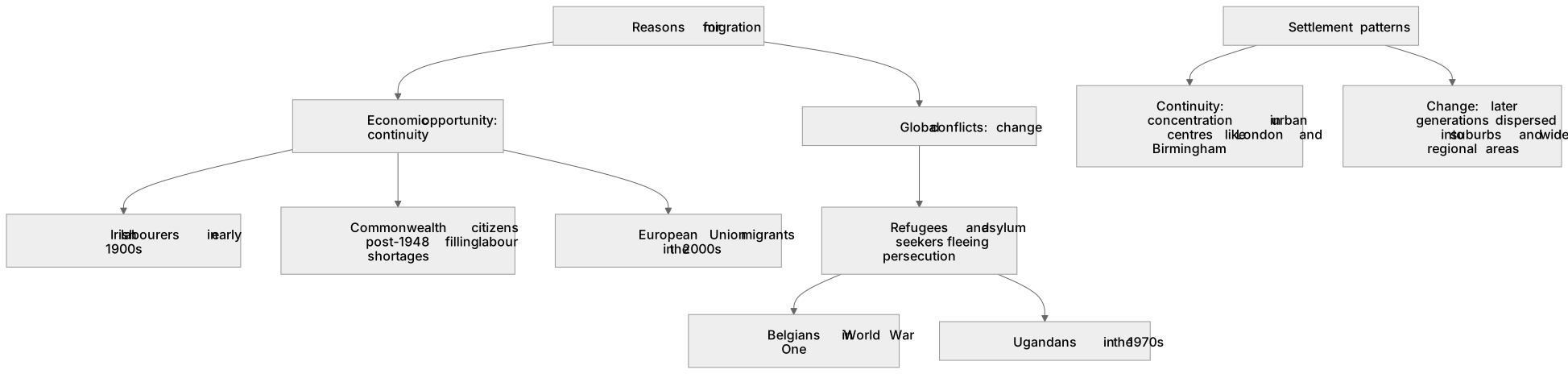
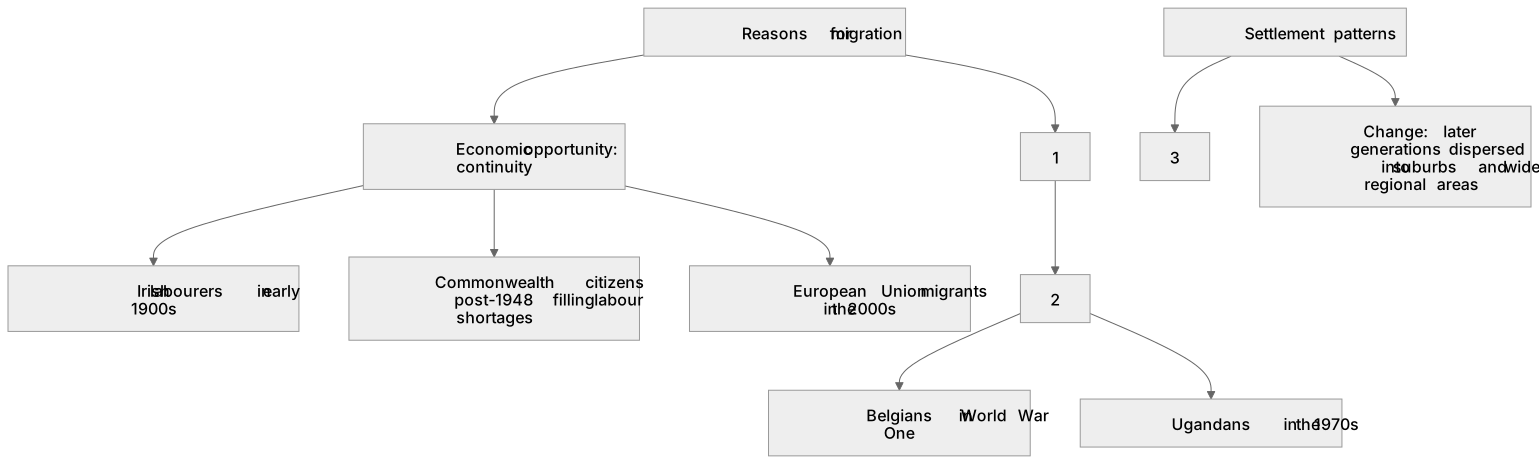
Throughout the twentieth and twenty-first centuries, Britain experienced significant change and continuity in migration reasons and settlement patterns. Economic opportunity remained a continuous pull factor, drawing Irish labourers in the early 1900s, Commonwealth citizens post-1948 to fill labour shortages, and European Union migrants in the 2000s. However, reasons for migration changed with the rise of global conflicts, increasing the number of refugees and asylum seekers fleeing persecution, such as Belgians in World War One or Ugandans in the 1970s. Settlement patterns showed continuity as migrants consistently gravitated towards urban centres like London and Birmingham for employment, yet changed as later generations dispersed into suburbs and wider regional areas.
What earns the marks
- Identify economic pull factors as a key continuity, linking labour shortages to migration from Ireland, the Commonwealth, and Europe.
- Explain how geopolitical crises caused changes in migration, driving distinct waves of refugees and asylum seekers to Britain.
- Analyse continuity in settlement patterns, noting the consistent initial concentration of migrants in major industrial and urban centres.
- Evaluate changes in settlement over time, such as the gradual suburbanisation of established migrant communities compared to new arrivals.
Common mistakes and how to put them right
Treating all Commonwealth migration as identical.
Put it right by distinguishing between different periods and reasons, such as the Windrush generation versus later East African Asian refugees.
Failing to address both change and continuity.
Put it right: Explicitly using these concepts to structure the answer, rather than just listing migrant groups.
Confusing economic migrants with asylum seekers.
Put it right: Clearly defining the different legal and push/pull factors driving each group.
Exam tips
- Structure your answer chronologically or thematically, but always explicitly use the words 'change' and 'continuity' in your topic sentences.
- Provide specific examples for each category mentioned in the specification (Ireland, Europe, Empire/Commonwealth, refugees) to ensure full coverage.
- Link settlement patterns directly to the availability of employment and existing community networks to explain why migrants settled where they did.
Try the lesson
The start of the Option 13: c1900–present: Migration in modern Britain - 1 The context for migration: Change and continuity in reasons for migration and patterns of settlement, including migrants from Ireland, Europe, the British Empire and the Commonwealth; refugees and asylum seekers. lesson, made from checked teaching notes for this specification point.
Have a go first
What was a primary reason why many migrants from the Commonwealth came to Britain in the years immediately following the Second World War?
Listen
Throughout the twentieth and twenty-first centuries, Britain experienced significant change and continuity in migration reasons and settlement patterns. Economic opportunity remained a continuous pull factor, drawing Irish labourers in the early 1900s, Commonwealth citizens post-1948 to fill labour shortages, and European Union migrants in the 2000s. However, reasons for migration changed with the rise of global conflicts, increasing the number of refugees and asylum seekers fleeing persecution, such as Belgians in World War One or Ugandans in the 1970s. Settlement patterns showed continuity as migrants consistently gravitated towards urban centres like London and Birmingham for employment, yet changed as later generations dispersed into suburbs and wider regional areas. A strong answer earns marks for these points. Identify economic pull factors as a key continuity, linking labour shortages to migration from Ireland, the Commonwealth, and Europe. Explain how geopolitical crises caused changes in migration, driving distinct waves of refugees and asylum seekers to Britain. Analyse continuity in settlement patterns, noting the consistent initial concentration of migrants in major industrial and urban centres. Evaluate changes in settlement over time, such as the gradual suburbanisation of established migrant communities compared to new arrivals. A common slip: Treating all Commonwealth migration as identical. Instead, distinguishing between different periods and reasons, such as the Windrush generation versus later East African Asian refugees. Exam tip: Structure your answer chronologically or thematically, but always explicitly use the words 'change' and 'continuity' in your topic sentences.
See it
Key words
Say what each word means before you turn the card.
Change and continuity
Try answering aloud or in your head before turning the card.
Economic migration
Try answering aloud or in your head before turning the card.
Forced displacement
Try answering aloud or in your head before turning the card.
Urban settlement
Try answering aloud or in your head before turning the card.
See every definition
- Change and continuity
- The idea that migration reasons and settlement patterns both altered and stayed the same across the twentieth and twenty-first centuries.
- Economic migration
- Movement driven by economic opportunity, a continuous pull factor drawing Irish labourers, Commonwealth citizens and European Union migrants to Britain.
- Forced displacement
- Migration caused by global conflicts, increasing the number of refugees and asylum seekers fleeing persecution, such as Belgians or Ugandans.
- Urban settlement
- The pattern of migrants gravitating towards urban centres like London and Birmingham for employment, later dispersing into suburbs and wider regional areas.
Label the diagram
Some boxes have lost their names. Pick the right name for each number.
1Box 1
2Box 2
3Box 3
There is more to this lesson
The full lesson goes on to check your understanding and help you earn the marks. Create a free account to carry on, with your progress saved.
A week of Premium from your first lesson · Then the free plan continues · No card, no charge
Test your understanding of Option 13: c1900–present: Migration in modern Britain - 1 The context for migration: Change and continuity in reasons for migration and patterns of settlement, including migrants from Ireland, Europe, the British Empire and the Commonwealth; refugees and asylum seekers.
Active recall beats re-reading. Take an instant quiz now to test what you’ve learned and lock it into long-term memory.
A week of Premium from your first lesson · Then the free plan continues · No card, no charge