Pearson Edexcel · GCSE · History
Course version: 1HI0 · Version from Sept 2016
C1900–present: Migration in modern Britain - 2 The experience and impact…
Full specification wording
Option 13: c1900–present: Migration in modern Britain - 2 The experience and impact of migrants: The experience of migrants in Britain: their relations with the authorities and the existing population, including anti-immigration and equal rights movements. The Race Relations Act (1965). The role of the media.
Migrants in modern Britain faced complex experiences, characterised by tension with authorities and the existing population.
Checked against the Pearson Edexcel 1HI0 specification (opens in a new tab) on .
- Point 1 of 2
- 4 key terms
Study notes
From the checked teaching notes for this specification point.
The idea
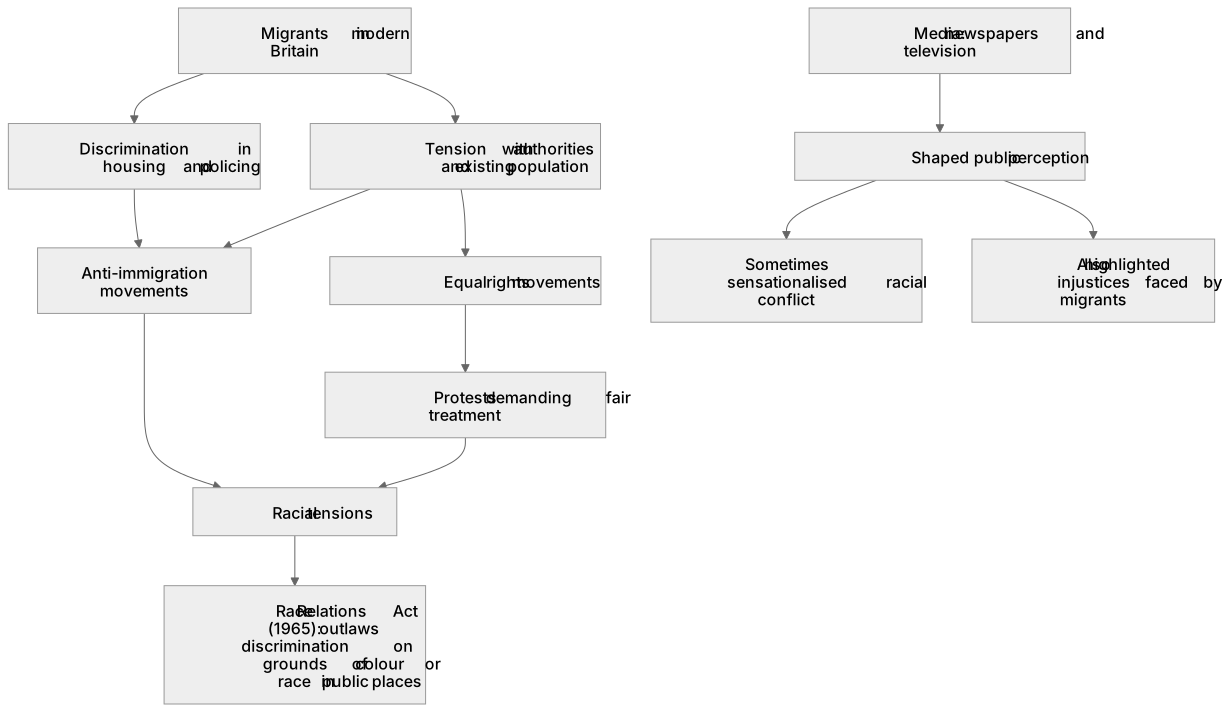
Migrants in modern Britain faced complex experiences, characterised by tension with authorities and the existing population. They frequently encountered discrimination in housing and policing. This friction fuelled anti-immigration movements, which campaigned against migrant communities. Conversely, equal rights movements emerged, with activists organising protests to demand fair treatment. In response to racial tensions, the government passed the Race Relations Act (1965), the first law to outlaw discrimination on the grounds of colour or race in public places. The media played a pivotal role; newspapers and television shaped public perception, sometimes sensationalising racial conflict while also highlighting the injustices faced by migrants.
What earns the marks
- Describe the nature of relations between migrants, the police, and local authorities.
- Explain the aims and actions of anti-immigration movements in post-war Britain.
- Detail the methods used by equal rights movements to challenge discrimination.
- Assess the significance and limitations of the Race Relations Act (1965).
- Analyse how the media influenced public attitudes towards migrants, both positively and negatively.
Common mistakes and how to put them right
Stating that the Race Relations Act (1965) ended all discrimination.
Put it right: It only applied to public places and did not cover housing or employment, which required later legislation.
Assuming the media only portrayed migrants negatively.
Put it right: While sensationalism existed, some media outlets also exposed discrimination and supported equal rights.
Believing that anti-immigration sentiment was only present among extremist groups.
Put it right: Mainstream political discourse and local populations also frequently exhibited hostility.
Exam tips
- Use specific examples of equal rights campaigns, such as the Bristol Bus Boycott, to illustrate resistance to discrimination.
- When discussing the Race Relations Act (1965), be sure to mention its specific scope (public places) to demonstrate precise knowledge.
- Evaluate the dual role of the media as both a reflector and a shaper of public opinion regarding immigration.
Try the lesson
The start of the Option 13: c1900–present: Migration in modern Britain - 2 The experience and impact of migrants: The experience of migrants in Britain: their relations with the authorities and the existing population, including anti-immigration and equal rights movements. The Race Relations Act (1965). The role of the media. lesson, made from checked teaching notes for this specification point.
Have a go first
What was the primary purpose of the Race Relations Act introduced by the British government in 1965?
Listen
Migrants in modern Britain faced complex experiences, characterised by tension with authorities and the existing population. They frequently encountered discrimination in housing and policing. This friction fuelled anti-immigration movements, which campaigned against migrant communities. Conversely, equal rights movements emerged, with activists organising protests to demand fair treatment. In response to racial tensions, the government passed the Race Relations Act (1965), the first law to outlaw discrimination on the grounds of colour or race in public places. The media played a pivotal role; newspapers and television shaped public perception, sometimes sensationalising racial conflict while also highlighting the injustices faced by migrants. A strong answer earns marks for these points. Describe the nature of relations between migrants, the police, and local authorities. Explain the aims and actions of anti-immigration movements in post-war Britain. Detail the methods used by equal rights movements to challenge discrimination. Assess the significance and limitations of the Race Relations Act (1965). Exam tip: Use specific examples of equal rights campaigns, such as the Bristol Bus Boycott, to illustrate resistance to discrimination.
See it
Key words
Say what each word means before you turn the card.
Discrimination and prejudice
Try answering aloud or in your head before turning the card.
Civil rights and activism
Try answering aloud or in your head before turning the card.
Government intervention
Try answering aloud or in your head before turning the card.
Media and public perception
Try answering aloud or in your head before turning the card.
See every definition
- Discrimination and prejudice
- Migrants frequently encountered discrimination in housing and policing, and the Race Relations Act (1965) was the first law to outlaw discrimination on the grounds of colour or race in public places.
- Civil rights and activism
- Equal rights movements emerged, with activists organising protests to demand fair treatment for migrant communities.
- Government intervention
- In response to racial tensions, the government passed the Race Relations Act (1965), the first law to outlaw discrimination on the grounds of colour or race in public places.
- Media and public perception
- Newspapers and television shaped public perception, sometimes sensationalising racial conflict while also highlighting the injustices faced by migrants.
Label the diagram
Some boxes have lost their names. Pick the right name for each number.
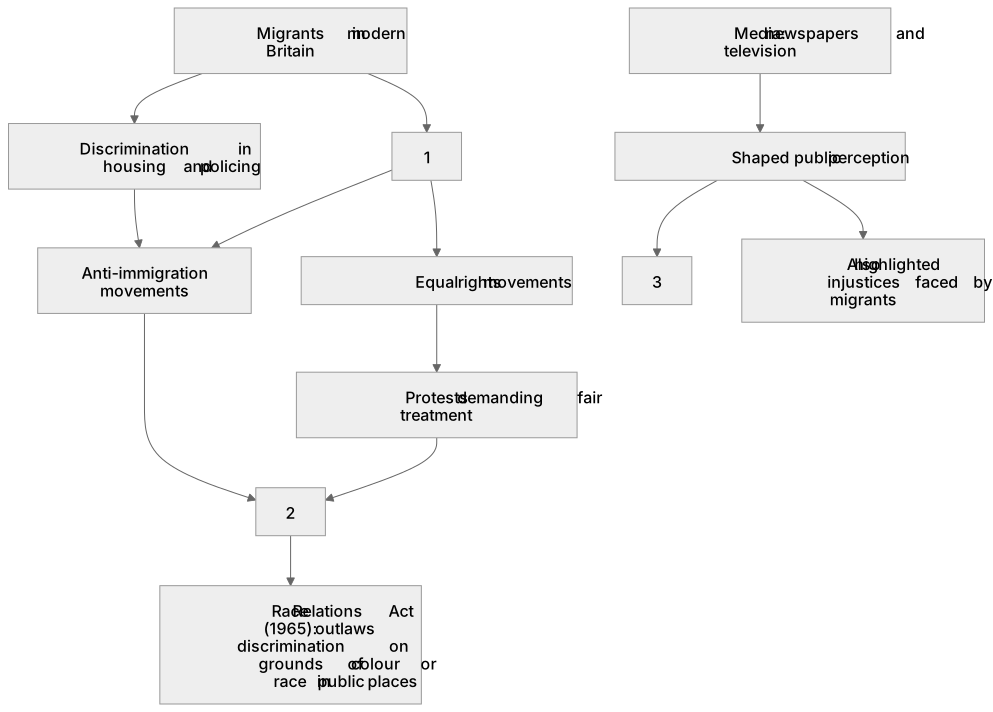
1Box 1
2Box 2
3Box 3
There is more to this lesson
The full lesson goes on to check your understanding and help you earn the marks. Create a free account to carry on, with your progress saved.
A week of Premium from your first lesson · Then the free plan continues · No card, no charge
Test your understanding of Option 13: c1900–present: Migration in modern Britain - 2 The experience and impact of migrants: The experience of migrants in Britain: their relations with the authorities and the existing population, including anti-immigration and equal rights movements. The Race Relations Act (1965). The role of the media.
Active recall beats re-reading. Take an instant quiz now to test what you’ve learned and lock it into long-term memory.
A week of Premium from your first lesson · Then the free plan continues · No card, no charge