Pearson Edexcel · GCSE · History
Course version: 1HI0 · Version from Sept 2016
C1900–present: Migration in modern Britain - 3 Case studies ● Bristol in…
Full specification wording
Option 13: c1900–present: Migration in modern Britain - 3 Case studies ● Bristol in the mid-twentieth century: the experiences of migrants and their impact on society.: The experience of Asian migrants in Leicester from 1945.
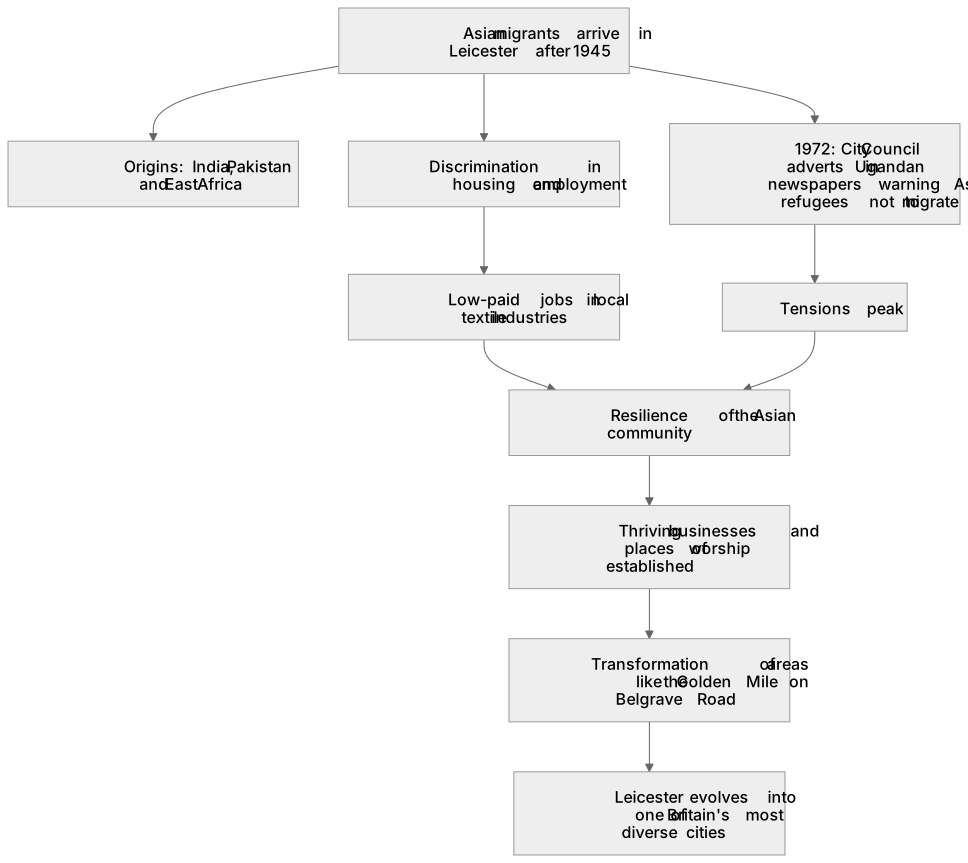
After 1945, Leicester became a key destination for Asian migrants from India, Pakistan, and East Africa.
Checked against the Pearson Edexcel 1HI0 specification (opens in a new tab) on .
- 4 key terms
Study notes
From the checked teaching notes for this specification point.
The idea
After 1945, Leicester became a key destination for Asian migrants from India, Pakistan, and East Africa. Initially, they faced discrimination in housing and employment, taking low-paid jobs in local textile industries. Tensions peaked in 1972 when the City Council placed adverts in Ugandan newspapers warning Asian refugees not to migrate there due to limited resources. Despite this hostility, the Asian community showed remarkable resilience. They established thriving businesses and places of worship, transforming areas like the Golden Mile on Belgrave Road. Leicester evolved into one of Britain's most diverse cities, showcasing the profound economic and cultural impact of Asian migration, contrasting with other case studies such as Bristol.
What earns the marks
- Describe the origins of Asian migrants arriving in Leicester after 1945, including those from East Africa.
- Explain the initial economic and social challenges faced by these migrants, such as employment in the hosiery industry.
- Analyse the significance of the 1972 Leicester City Council advertisements in Ugandan newspapers.
- Evaluate how the Asian community transformed Leicester culturally and economically, referencing the Golden Mile.
- Assess the long-term impact of Asian migration on Leicester's development into a diverse and cohesive city.
Common mistakes and how to put them right
Assuming all Asian migrants to Leicester came directly from the Indian subcontinent.
Put it right: Many arrived as refugees from East Africa, particularly Uganda in 1972.
Believing that Leicester welcomed all migrants with open arms initially.
Put it right: The City Council actively tried to deter Ugandan Asians from settling there.
Overlooking the economic contribution of Asian migrants, focusing only on cultural aspects rather than their role in revitalising local industries and establishing businesses.
Confusing the Leicester case study with Bristol.
Put it right by ensuring specific details like the 1972 Ugandan newspaper adverts are applied to Leicester, while events like the Bus Boycott apply to Bristol.
Exam tips
- Use the 1972 Ugandan newspaper advertisements as a specific piece of evidence to demonstrate the initial hostility faced by migrants.
- Mention the 'Golden Mile' on Belgrave Road as a concrete example of the cultural and economic transformation brought by Asian migrants.
- Contrast the initial challenges faced by the migrants with the long-term success and diversity of modern Leicester.
Try the lesson
The start of the Option 13: c1900–present: Migration in modern Britain - 3 Case studies ● Bristol in the mid-twentieth century: the experiences of migrants and their impact on society.: The experience of Asian migrants in Leicester from 1945. lesson, made from checked teaching notes for this specification point.
Have a go first
In 1972, a significant number of Asian migrants arrived in Leicester after being expelled from which country?
Listen
After 1945, Leicester became a key destination for Asian migrants from India, Pakistan, and East Africa. Initially, they faced discrimination in housing and employment, taking low-paid jobs in local textile industries. Tensions peaked in 1972 when the City Council placed adverts in Ugandan newspapers warning Asian refugees not to migrate there due to limited resources. Despite this hostility, the Asian community showed remarkable resilience. They established thriving businesses and places of worship, transforming areas like the Golden Mile on Belgrave Road. Leicester evolved into one of Britain's most diverse cities, showcasing the profound economic and cultural impact of Asian migration, contrasting with other case studies such as Bristol. A strong answer earns marks for these points. Describe the origins of Asian migrants arriving in Leicester after 1945, including those from East Africa. Explain the initial economic and social challenges faced by these migrants, such as employment in the hosiery industry. Analyse the significance of the 1972 Leicester City Council advertisements in Ugandan newspapers. Evaluate how the Asian community transformed Leicester culturally and economically, referencing the Golden Mile. A common slip: Confusing the Leicester case study with Bristol. Instead, ensuring specific details like the 1972 Ugandan newspaper adverts are applied to Leicester, while events like the Bus Boycott apply to Bristol. Exam tip: Use the 1972 Ugandan newspaper advertisements as a specific piece of evidence to demonstrate the initial hostility faced by migrants.
See it
Key words
Say what each word means before you turn the card.
Community resilience
Try answering aloud or in your head before turning the card.
Economic revitalisation
Try answering aloud or in your head before turning the card.
Cultural transformation
Try answering aloud or in your head before turning the card.
Local government response
Try answering aloud or in your head before turning the card.
See every definition
- Community resilience
- The remarkable strength shown by the Asian community in Leicester in establishing thriving businesses and places of worship despite hostility.
- Economic revitalisation
- The profound economic impact of Asian migration, with the community establishing thriving businesses and transforming areas of Leicester.
- Cultural transformation
- The profound cultural impact of Asian migration, with the community establishing places of worship and transforming areas like the Golden Mile on Belgrave Road.
- Local government response
- The 1972 action by Leicester City Council, which placed adverts in Ugandan newspapers warning Asian refugees not to migrate there due to limited resources.
Label the diagram
Some boxes have lost their names. Pick the right name for each number.
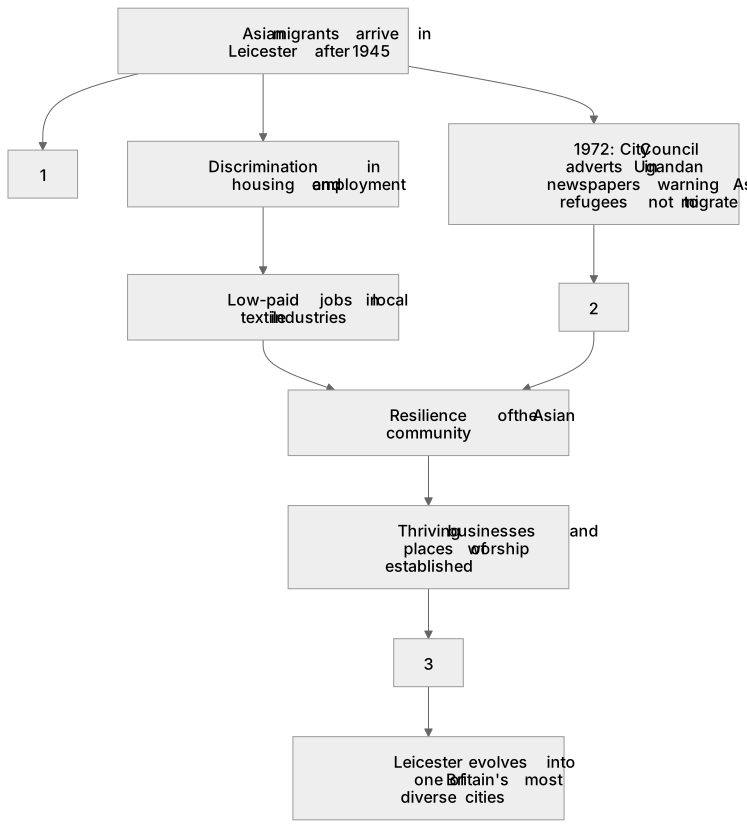
1Box 1
2Box 2
3Box 3
There is more to this lesson
The full lesson goes on to check your understanding and help you earn the marks. Create a free account to carry on, with your progress saved.
A week of Premium from your first lesson · Then the free plan continues · No card, no charge
Test your understanding of Option 13: c1900–present: Migration in modern Britain - 3 Case studies ● Bristol in the mid-twentieth century: the experiences of migrants and their impact on society.: The experience of Asian migrants in Leicester from 1945.
Active recall beats re-reading. Take an instant quiz now to test what you’ve learned and lock it into long-term memory.
A week of Premium from your first lesson · Then the free plan continues · No card, no charge