Pearson Edexcel · GCSE · History
Course version: 1HI0 · Version from Sept 2016
C800–c1500: Migration in medieval England - 1 The context for migration:…
Full specification wording
Option 13: c800–c1500: Migration in medieval England - 1 The context for migration: Reasons for migration and patterns of settlement, including Vikings, Normans, Jews and other European traders and craftsmen.
Medieval migration to England was driven by diverse push and pull factors, resulting in distinct settlement patterns.
Checked against the Pearson Edexcel 1HI0 specification (opens in a new tab) on .
- Point 1 of 2
Study notes
From the checked teaching notes for this specification point.
The idea
Medieval migration to England was driven by diverse push and pull factors, resulting in distinct settlement patterns. Vikings initially raided but later settled in the Danelaw for agricultural land. Normans migrated post-1066 as a conquering elite, settling in castles and urban centres to exert control. Jews were invited by William I for their financial expertise, settling primarily in major towns like London and York where royal protection was strongest. Other European traders and craftsmen, such as Flemish weavers, migrated for economic opportunities, settling in eastern ports and textile towns. Understanding these varied reasons and locations is essential.
What earns the marks
- Explain the economic and agricultural reasons for Viking settlement in the Danelaw.
- Describe the political and military motivations for Norman migration and their elite settlement patterns.
- Analyse the economic role of Jewish migrants and their urban settlement under royal protection.
- Evaluate the pull factors for European traders and craftsmen, such as Flemish weavers, and their settlement in commercial hubs.
Common mistakes and how to put them right
Treating all medieval migrants as having the same motivations (Correction.
Put it right: Distinguish between the military conquest of Normans, the economic invitations to Jews, and the agricultural/trade focus of Vikings and craftsmen).
Assuming Jewish migrants settled randomly across England (Correction.
Put it right: Specify that Jewish communities settled in major towns and cities where they could access royal protection and conduct financial business).
Confusing the timing of these migrations (Correction.
Put it right: Ensure chronological clarity, noting Vikings pre-date Normans, while Jewish migration began with the Norman conquest).
Exam tips
- Use specific examples of settlement locations, such as the Danelaw for Vikings or Norwich for Flemish weavers, to support your points.
- Categorise reasons for migration into economic, political, religious, or social factors to structure your answers.
- Always link the reason for migration to the specific pattern of settlement chosen by that group.
Try the lesson
The start of the Option 13: c800–c1500: Migration in medieval England - 1 The context for migration: Reasons for migration and patterns of settlement, including Vikings, Normans, Jews and other European traders and craftsmen. lesson, made from checked teaching notes for this specification point.
Have a go first
What was a primary reason for the initial migration of Jewish people to England following the Norman Conquest in 1066?
Listen
Medieval migration to England was driven by diverse push and pull factors, resulting in distinct settlement patterns. Vikings initially raided but later settled in the Danelaw for agricultural land. Normans migrated post-1066 as a conquering elite, settling in castles and urban centres to exert control. Jews were invited by William I for their financial expertise, settling primarily in major towns like London and York where royal protection was strongest. Other European traders and craftsmen, such as Flemish weavers, migrated for economic opportunities, settling in eastern ports and textile towns. Understanding these varied reasons and locations is essential. A strong answer earns marks for these points. Explain the economic and agricultural reasons for Viking settlement in the Danelaw. Describe the political and military motivations for Norman migration and their elite settlement patterns. Analyse the economic role of Jewish migrants and their urban settlement under royal protection. Evaluate the pull factors for European traders and craftsmen, such as Flemish weavers, and their settlement in commercial hubs. Exam tip: Use specific examples of settlement locations, such as the Danelaw for Vikings or Norwich for Flemish weavers, to support your points.
See it
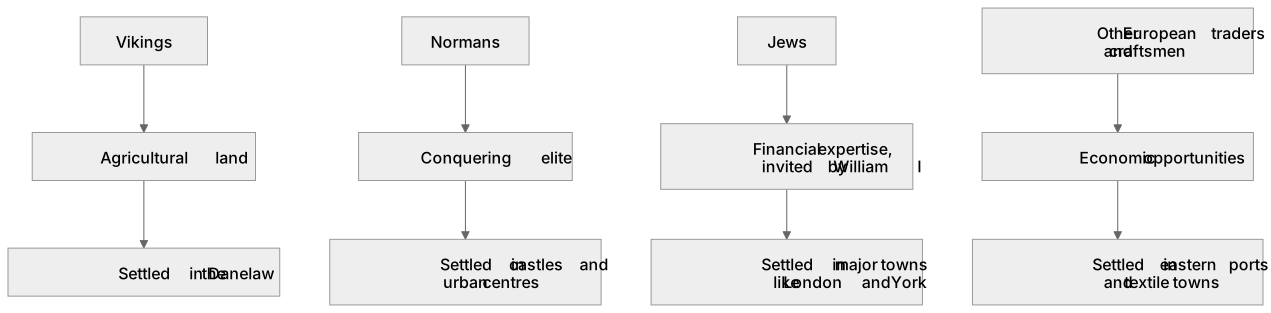
Label the diagram
Some boxes have lost their names. Pick the right name for each number.
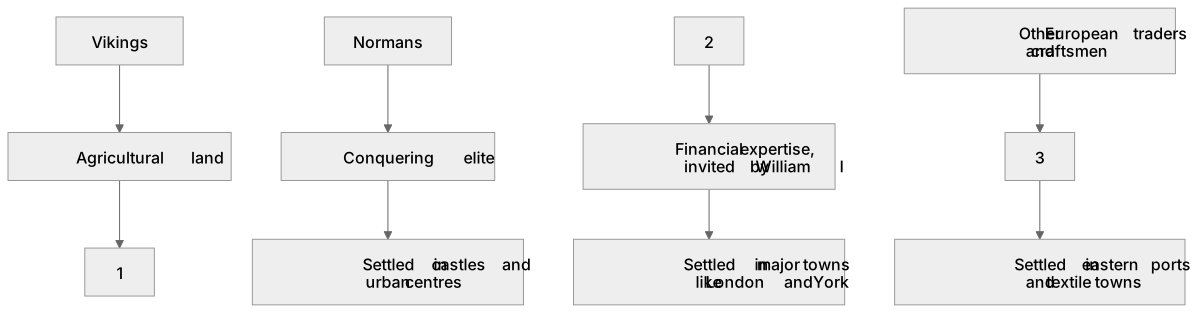
1Box 1
2Box 2
3Box 3
There is more to this lesson
The full lesson goes on to check your understanding and help you earn the marks. Create a free account to carry on, with your progress saved.
A week of Premium from your first lesson · Then the free plan continues · No card, no charge
Test your understanding of Option 13: c800–c1500: Migration in medieval England - 1 The context for migration: Reasons for migration and patterns of settlement, including Vikings, Normans, Jews and other European traders and craftsmen.
Active recall beats re-reading. Take an instant quiz now to test what you’ve learned and lock it into long-term memory.
A week of Premium from your first lesson · Then the free plan continues · No card, no charge