Pearson Edexcel · GCSE · History
Course version: 1HI0 · Version from Sept 2016
C800–c1500: Migration in medieval England - 2 The experience and impact of…
Full specification wording
Option 13: c800–c1500: Migration in medieval England - 2 The experience and impact of migrants: The impact of migrants in England, including the Danelaw, culture, trade and the built environment.
Migrants in medieval England profoundly shaped the nation's development.
Checked against the Pearson Edexcel 1HI0 specification (opens in a new tab) on .
- Point 2 of 2
- 4 key terms
Study notes
From the checked teaching notes for this specification point.
The idea
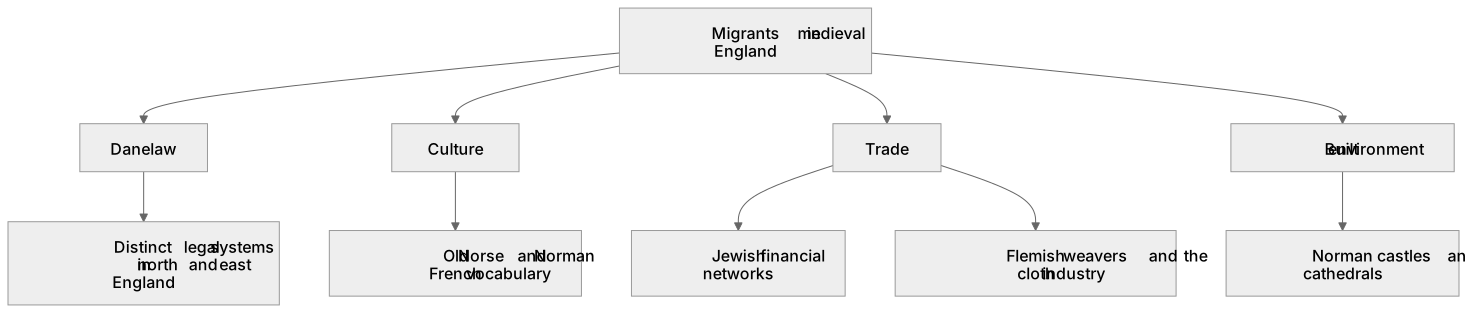
Migrants in medieval England profoundly shaped the nation's development. The establishment of the Danelaw by Viking settlers introduced distinct legal systems to northern and eastern England, leaving a lasting legacy on local governance. Culturally, migrants enriched the English language with Old Norse and Norman French vocabulary, while influencing customs. In trade, groups like the Jewish community and Flemish weavers stimulated economic growth by establishing financial networks and advancing the cloth industry. The built environment was transformed through Norman castles, cathedrals, and new architectural styles, physically demonstrating the enduring impact of these diverse migrant groups on the English landscape.
What earns the marks
- Explain how the Danelaw introduced new laws, customs, and administrative divisions to parts of England.
- Describe the cultural impact of migrants, such as linguistic changes including Old Norse and Norman French vocabulary.
- Analyse the economic contributions of migrants to trade, including Jewish financiers and Flemish weavers boosting the cloth trade.
- Evaluate changes to the built environment, such as the construction of motte-and-bailey castles and Romanesque cathedrals by the Normans.
Common mistakes and how to put them right
Assuming the Danelaw covered all of England.
Put it right by specifying it applied primarily to the north and east.
Confusing the economic roles of different migrant groups.
Put it right by associating Jewish migrants with finance and Flemish migrants with the cloth trade.
Believing the built environment only changed in London.
Put it right by noting that Norman castles and cathedrals were built across the entire country to project power.
Exam tips
- Use specific examples of vocabulary or place names to illustrate cultural impact.
- Link the construction of castles directly to the Norman strategy of controlling the existing population.
- When discussing trade, explain how migrant skills filled gaps in the domestic economy, such as advanced weaving techniques.
Try the lesson
The start of the Option 13: c800–c1500: Migration in medieval England - 2 The experience and impact of migrants: The impact of migrants in England, including the Danelaw, culture, trade and the built environment. lesson, made from checked teaching notes for this specification point.
Have a go first
What was the Danelaw in medieval England?
Listen
Migrants in medieval England profoundly shaped the nation's development. The establishment of the Danelaw by Viking settlers introduced distinct legal systems to northern and eastern England, leaving a lasting legacy on local governance. Culturally, migrants enriched the English language with Old Norse and Norman French vocabulary, while influencing customs. In trade, groups like the Jewish community and Flemish weavers stimulated economic growth by establishing financial networks and advancing the cloth industry. The built environment was transformed through Norman castles, cathedrals, and new architectural styles, physically demonstrating the enduring impact of these diverse migrant groups on the English landscape. A strong answer earns marks for these points. Explain how the Danelaw introduced new laws, customs, and administrative divisions to parts of England. Describe the cultural impact of migrants, such as linguistic changes including Old Norse and Norman French vocabulary. Analyse the economic contributions of migrants to trade, including Jewish financiers and Flemish weavers boosting the cloth trade. Evaluate changes to the built environment, such as the construction of motte-and-bailey castles and Romanesque cathedrals by the Normans. A common slip: Assuming the Danelaw covered all of England. Instead, specifying it applied primarily to the north and east. Exam tip: Use specific examples of vocabulary or place names to illustrate cultural impact.
See it
Key words
Say what each word means before you turn the card.
Danelaw
Try answering aloud or in your head before turning the card.
Cultural impact
Try answering aloud or in your head before turning the card.
Economic contributions
Try answering aloud or in your head before turning the card.
Built environment
Try answering aloud or in your head before turning the card.
See every definition
- Danelaw
- An area of northern and eastern England where Viking settlers established distinct legal systems and administrative divisions.
- Cultural impact
- Changes such as Old Norse and Norman French vocabulary enriching the English language and influences on customs.
- Economic contributions
- Growth stimulated by groups such as Jewish financiers establishing financial networks and Flemish weavers advancing the cloth trade.
- Built environment
- The English landscape transformed through Norman castles, cathedrals and new architectural styles.
Label the diagram
Some boxes have lost their names. Pick the right name for each number.
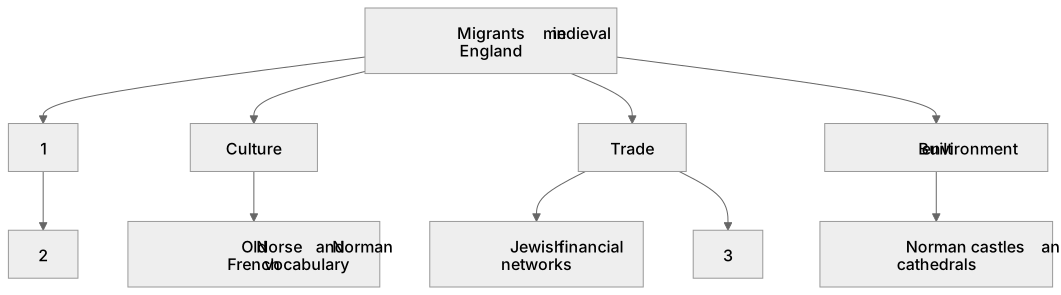
1Box 1
2Box 2
3Box 3
There is more to this lesson
The full lesson goes on to check your understanding and help you earn the marks. Create a free account to carry on, with your progress saved.
A week of Premium from your first lesson · Then the free plan continues · No card, no charge
Test your understanding of Option 13: c800–c1500: Migration in medieval England - 2 The experience and impact of migrants: The impact of migrants in England, including the Danelaw, culture, trade and the built environment.
Active recall beats re-reading. Take an instant quiz now to test what you’ve learned and lock it into long-term memory.
A week of Premium from your first lesson · Then the free plan continues · No card, no charge