Pearson Edexcel · GCSE · History
Course version: 1HI0 · Version from Sept 2016
The historic environment - 1 Notting Hill, c1948–c1970: The national and…
Full specification wording
Option 13: The historic environment - 1 Notting Hill, c1948–c1970: The national and regional context: Britain after the Second World War, reconstruction and demand for labour; the connection to the British Empire and Commonwealth. The ‘Swinging Sixties’. Poverty in London. Policing in London.
Post-WWII Britain faced massive reconstruction, creating a severe labour shortage.
Checked against the Pearson Edexcel 1HI0 specification (opens in a new tab) on .
- Point 5 of 5
- 4 key terms
Study notes
From the checked teaching notes for this specification point.
The idea
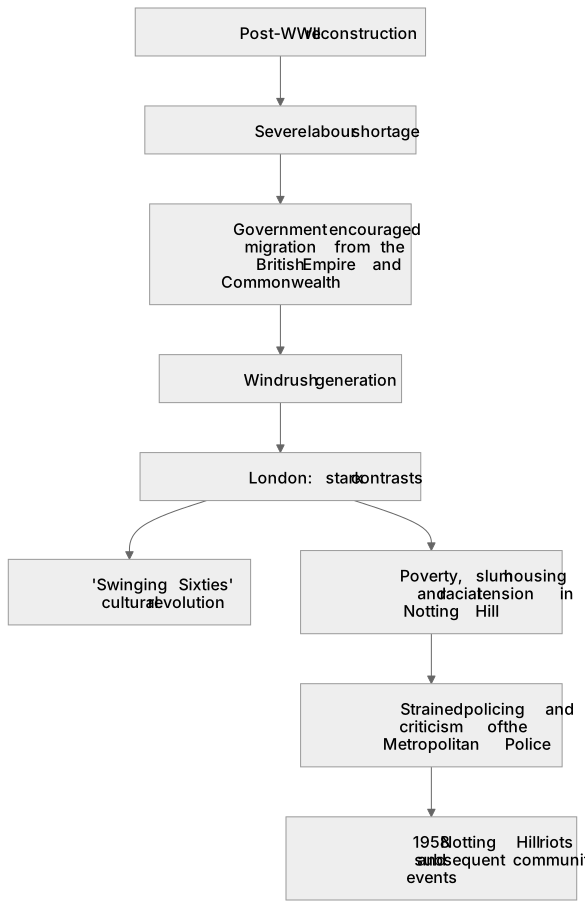
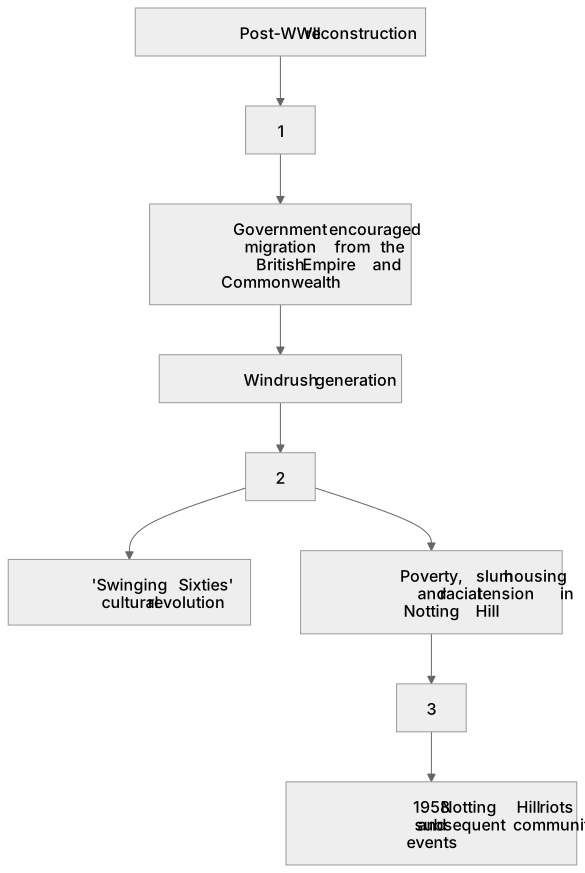
Post-WWII Britain faced massive reconstruction, creating a severe labour shortage. To meet this demand, the government encouraged migration from the British Empire and Commonwealth, notably the Caribbean, leading to the Windrush generation. Regionally, London experienced stark contrasts; while the 'Swinging Sixties' brought cultural revolution, fashion, and music to areas like Chelsea, parts of London like Notting Hill suffered severe poverty, slum housing, and racial tension. Policing in London during this period was often strained, with the Metropolitan Police facing criticism for their handling of race relations and community tensions, particularly during the 1958 Notting Hill riots and subsequent community events.
What earns the marks
- Explain the link between post-war reconstruction and the demand for labour from the Commonwealth.
- Describe the cultural shifts of the 'Swinging Sixties' and how they contrasted with the reality of poverty in London.
- Identify the specific housing and economic challenges faced by residents in impoverished areas like Notting Hill.
- Analyse the relationship between the Metropolitan Police and the local communities, highlighting tensions and specific incidents.
Common mistakes and how to put them right
Assuming the 'Swinging Sixties' meant prosperity for everyone.
Put it right: Acknowledge the stark contrast between cultural booms and persistent poverty in areas like Notting Hill.
Confusing the British Empire with the Commonwealth.
Put it right: Understand that the period saw a transition from Empire to Commonwealth, with migrants holding British citizenship under the 1948 Act.
Viewing policing as universally supportive.
Put it right: Recognise the documented tensions and mistrust between the Metropolitan Police and the Caribbean community.
Exam tips
- Use the 1948 British Nationality Act as a concrete example of the connection to the Commonwealth.
- Contrast the media image of the 'Swinging Sixties' with the lived experience of poverty in Notting Hill to show nuanced understanding.
- When discussing policing, refer to specific events like the 1958 riots to illustrate community relations.
Try the lesson
The start of the Option 13: The historic environment - 1 Notting Hill, c1948–c1970: The national and regional context: Britain after the Second World War, reconstruction and demand for labour; the connection to the British Empire and Commonwealth. The ‘Swinging Sixties’. Poverty in London. Policing in London. lesson, made from checked teaching notes for this specification point.
Have a go first
Which of the following best describes the primary economic reason for migration from the British Empire and Commonwealth to Britain immediately after the Second World War?
Listen
Post-WWII Britain faced massive reconstruction, creating a severe labour shortage. To meet this demand, the government encouraged migration from the British Empire and Commonwealth, notably the Caribbean, leading to the Windrush generation. Regionally, London experienced stark contrasts; while the 'Swinging Sixties' brought cultural revolution, fashion, and music to areas like Chelsea, parts of London like Notting Hill suffered severe poverty, slum housing, and racial tension. Policing in London during this period was often strained, with the Metropolitan Police facing criticism for their handling of race relations and community tensions, particularly during the 1958 Notting Hill riots and subsequent community events. A strong answer earns marks for these points. Explain the link between post-war reconstruction and the demand for labour from the Commonwealth. Describe the cultural shifts of the 'Swinging Sixties' and how they contrasted with the reality of poverty in London. Identify the specific housing and economic challenges faced by residents in impoverished areas like Notting Hill. Analyse the relationship between the Metropolitan Police and the local communities, highlighting tensions and specific incidents. A common slip: Assuming the 'Swinging Sixties' meant prosperity for everyone. Instead, acknowledge the stark contrast between cultural booms and persistent poverty in areas like Notting Hill. Exam tip: Use the 1948 British Nationality Act as a concrete example of the connection to the Commonwealth.
See it
Key words
Say what each word means before you turn the card.
Post-war reconstruction
Try answering aloud or in your head before turning the card.
Migration and Empire
Try answering aloud or in your head before turning the card.
Swinging Sixties
Try answering aloud or in your head before turning the card.
Policing in London
Try answering aloud or in your head before turning the card.
See every definition
- Post-war reconstruction
- The massive rebuilding of Britain after the Second World War, which created a severe labour shortage.
- Migration and Empire
- The government's encouragement of migration from the British Empire and Commonwealth, notably the Caribbean, to meet the demand for labour.
- Swinging Sixties
- A cultural revolution bringing fashion and music to areas like Chelsea, which contrasted with poverty elsewhere in London.
- Policing in London
- The work of the Metropolitan Police, which faced criticism for its handling of race relations and community tensions.
Label the diagram
Some boxes have lost their names. Pick the right name for each number.
1Box 1
2Box 2
3Box 3
There is more to this lesson
The full lesson goes on to check your understanding and help you earn the marks. Create a free account to carry on, with your progress saved.
A week of Premium from your first lesson · Then the free plan continues · No card, no charge
Test your understanding of Option 13: The historic environment - 1 Notting Hill, c1948–c1970: The national and regional context: Britain after the Second World War, reconstruction and demand for labour; the connection to the British Empire and Commonwealth. The ‘Swinging Sixties’. Poverty in London. Policing in London.
Active recall beats re-reading. Take an instant quiz now to test what you’ve learned and lock it into long-term memory.
A week of Premium from your first lesson · Then the free plan continues · No card, no charge