Pearson Edexcel · GCSE · History
Course version: 1HI0 · Version from Sept 2016
The historic environment - 2 Knowledge, selection and use of sources for…
Full specification wording
Option 13: The historic environment - 2 Knowledge, selection and use of sources for historical enquiries: Knowledge of national sources relevant to the period and issue, e.g. national newspapers, photographs, government records, census data, opinion polls, television reports, memoirs.
To understand the broader context of Notting Hill, historians utilise national sources reflecting country-wide attitudes.
Checked against the Pearson Edexcel 1HI0 specification (opens in a new tab) on .
- Point 2 of 5
- 4 key terms
Study notes
From the checked teaching notes for this specification point.
The idea
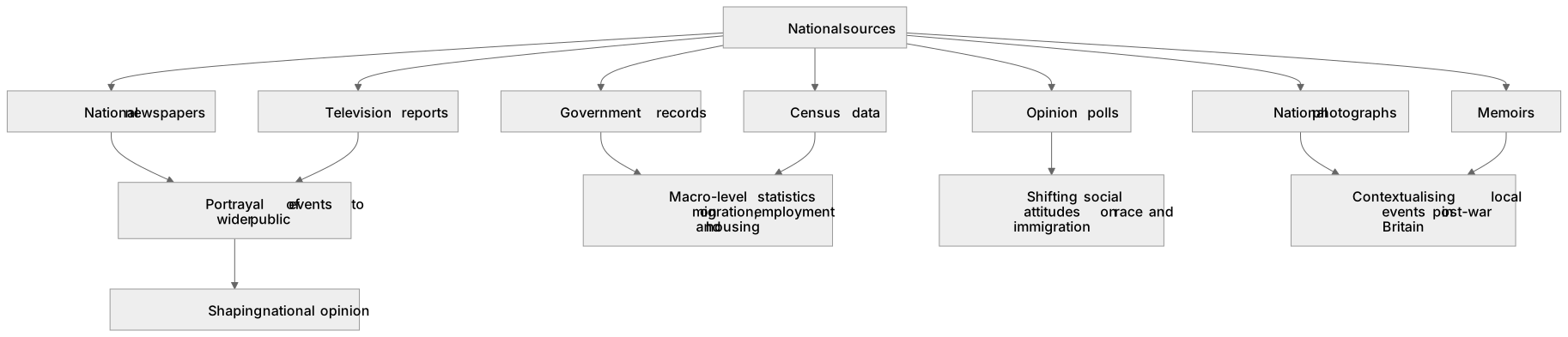
To understand the broader context of Notting Hill, historians utilise national sources reflecting country-wide attitudes. National newspapers and television reports show how events like the 1958 riots were portrayed to the wider public, shaping national opinion. Government records and census data offer objective, macro-level statistics on migration, employment, and housing across the UK. Opinion polls reveal shifting social attitudes regarding race and immigration. Additionally, national photographs and memoirs help contextualise local events within the broader narrative of post-war Britain, highlighting the intersection of national policy and local reality.
What earns the marks
- Identify various national sources, including government records, census data, and opinion polls.
- Explain how national newspapers and television reports shaped public perception of local events.
- Assess the utility of census data and government records for providing statistical evidence on migration and housing.
- Evaluate how national opinion polls and memoirs reflect the broader social and political climate of post-war Britain.
Common mistakes and how to put them right
Confusing national and local newspapers.
Put it right: Clearly distinguish between national press (broad context/audience) and local press (specific community focus).
Assuming census data provides the complete picture.
Put it right: Acknowledge that while census data gives statistical facts, it lacks the personal experiences found in memoirs.
Taking opinion polls as absolute fact.
Put it right: Recognise that polls reflect a sample of public mood at a specific time and can be influenced by the questions asked.
Exam tips
- Contrast a national newspaper report with a local source to demonstrate an understanding of different perspectives.
- Use census data to support arguments about the scale of migration and demographic changes.
- Consider the audience and purpose of television reports when evaluating their usefulness for an enquiry.
Try the lesson
The start of the Option 13: The historic environment - 2 Knowledge, selection and use of sources for historical enquiries: Knowledge of national sources relevant to the period and issue, e.g. national newspapers, photographs, government records, census data, opinion polls, television reports, memoirs. lesson, made from checked teaching notes for this specification point.
Have a go first
Which of the following is an example of a national source that could be used to investigate attitudes towards immigration in Britain during the 1960s?
Listen
To understand the broader context of Notting Hill, historians utilise national sources reflecting country-wide attitudes. National newspapers and television reports show how events like the 1958 riots were portrayed to the wider public, shaping national opinion. Government records and census data offer objective, macro-level statistics on migration, employment, and housing across the UK. Opinion polls reveal shifting social attitudes regarding race and immigration. Additionally, national photographs and memoirs help contextualise local events within the broader narrative of post-war Britain, highlighting the intersection of national policy and local reality. A strong answer earns marks for these points. Identify various national sources, including government records, census data, and opinion polls. Explain how national newspapers and television reports shaped public perception of local events. Assess the utility of census data and government records for providing statistical evidence on migration and housing. Evaluate how national opinion polls and memoirs reflect the broader social and political climate of post-war Britain. A common slip: Confusing national and local newspapers. Instead, clearly distinguish between national press (broad context/audience) and local press (specific community focus). Exam tip: Contrast a national newspaper report with a local source to demonstrate an understanding of different perspectives.
See it
Key words
Say what each word means before you turn the card.
National context
Try answering aloud or in your head before turning the card.
Statistical evidence
Try answering aloud or in your head before turning the card.
Media representation
Try answering aloud or in your head before turning the card.
Public opinion
Try answering aloud or in your head before turning the card.
See every definition
- National context
- The broader context of Notting Hill that historians understand by utilising national sources reflecting country-wide attitudes.
- Statistical evidence
- Objective, macro-level statistics on migration, employment and housing across the UK offered by government records and census data.
- Media representation
- How events like the 1958 riots were portrayed to the wider public through national newspapers and television reports.
- Public opinion
- Shifting social attitudes regarding race and immigration revealed by opinion polls.
Label the diagram
Some boxes have lost their names. Pick the right name for each number.
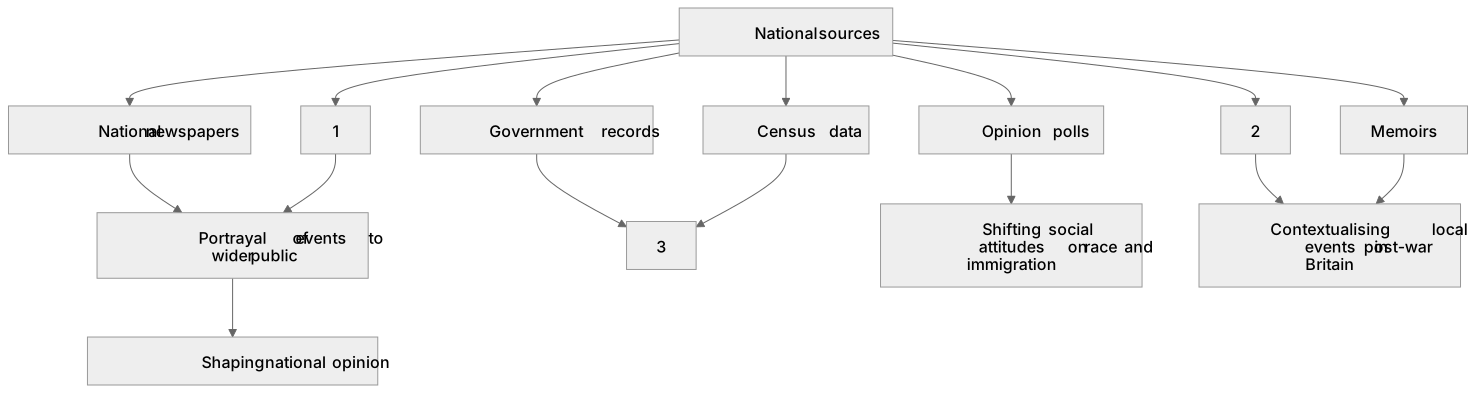
1Box 1
2Box 2
3Box 3
There is more to this lesson
The full lesson goes on to check your understanding and help you earn the marks. Create a free account to carry on, with your progress saved.
A week of Premium from your first lesson · Then the free plan continues · No card, no charge
Test your understanding of Option 13: The historic environment - 2 Knowledge, selection and use of sources for historical enquiries: Knowledge of national sources relevant to the period and issue, e.g. national newspapers, photographs, government records, census data, opinion polls, television reports, memoirs.
Active recall beats re-reading. Take an instant quiz now to test what you’ve learned and lock it into long-term memory.
A week of Premium from your first lesson · Then the free plan continues · No card, no charge