Pearson Edexcel · GCSE · History
Course version: 1HI0 · Version from Sept 2016
Key topic 1: The revolutions of 1917 - 2 The February Revolution: The…
Full specification wording
Option 30: Key topic 1: The revolutions of 1917 - 2 The February Revolution: The immediate reasons for the February Revolution: events in Petrograd in February 1917, including strikes and the mutiny in the army. The Tsar’s absence and abdication.
The February Revolution was triggered by immediate crises in Petrograd.
Checked against the Pearson Edexcel 1HI0 specification (opens in a new tab) on .
- 4 key terms
Study notes
From the checked teaching notes for this specification point.
The idea
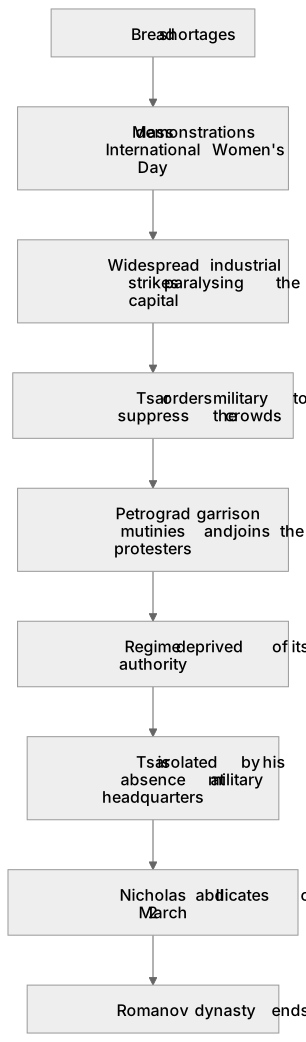
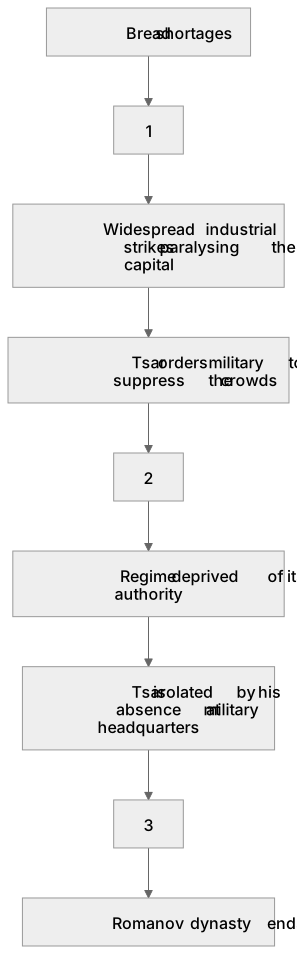
The February Revolution was triggered by immediate crises in Petrograd. In late February 1917, severe bread shortages sparked mass demonstrations, beginning on International Women's Day. These protests rapidly escalated into widespread industrial strikes, paralysing the capital. The crucial turning point occurred when the Tsar ordered the military to suppress the crowds; instead, soldiers of the Petrograd garrison mutinied, refusing to fire on civilians and joining the protesters, depriving the regime of its authority. Crucially, the Tsar's absence at military headquarters left him isolated and out of touch. Realising he had lost the support of the army and the Duma, Nicholas II abdicated on 2 March, ending the Romanov dynasty.
What earns the marks
- Identify the trigger events in Petrograd, such as bread rationing and the International Women's Day protests.
- Explain the escalation of protests into general strikes that brought the city to a standstill.
- Analyse the significance of the army mutiny, explaining how it removed the Tsar's ability to enforce order.
- Describe the circumstances of the Tsar's abdication, including his isolation at headquarters and loss of elite support.
Common mistakes and how to put them right
Confusing the February and October Revolutions.
Put it right: Ensure details like the army mutiny and the Tsar's abdication are strictly attributed to February.
Stating the Tsar abdicated voluntarily.
Put it right: Clarify that he was forced to abdicate by his generals and Duma members who saw no other way to restore order.
Ignoring the role of women.
Put it right: Explicitly mention that the initial protests were led by women demanding bread.
Exam tips
- Emphasise the spontaneous nature of the February Revolution compared to the planned October Revolution.
- Use the army mutiny as the definitive moment the Tsar lost control of Petrograd.
- Clearly link the Tsar's absence at the front to his inability to grasp the severity of the situation in the capital.
Try the lesson
The start of the Option 30: Key topic 1: The revolutions of 1917 - 2 The February Revolution: The immediate reasons for the February Revolution: events in Petrograd in February 1917, including strikes and the mutiny in the army. The Tsar’s absence and abdication. lesson, made from checked teaching notes for this specification point.
Have a go first
Which event on 23 February 1917 helped to trigger the mass protests of the February Revolution in Petrograd?
Listen
The February Revolution was triggered by immediate crises in Petrograd. In late February 1917, severe bread shortages sparked mass demonstrations, beginning on International Women's Day. These protests rapidly escalated into widespread industrial strikes, paralysing the capital. The crucial turning point occurred when the Tsar ordered the military to suppress the crowds; instead, soldiers of the Petrograd garrison mutinied, refusing to fire on civilians and joining the protesters, depriving the regime of its authority. Crucially, the Tsar's absence at military headquarters left him isolated and out of touch. Realising he had lost the support of the army and the Duma, Nicholas II abdicated on 2 March, ending the Romanov dynasty. A strong answer earns marks for these points. Identify the trigger events in Petrograd, such as bread rationing and the International Women's Day protests. Explain the escalation of protests into general strikes that brought the city to a standstill. Analyse the significance of the army mutiny, explaining how it removed the Tsar's ability to enforce order. Describe the circumstances of the Tsar's abdication, including his isolation at headquarters and loss of elite support. A common slip: Confusing the February and October Revolutions. Instead, ensure details like the army mutiny and the Tsar's abdication are strictly attributed to February. Exam tip: Emphasise the spontaneous nature of the February Revolution compared to the planned October Revolution.
See it
Key words
Say what each word means before you turn the card.
Spontaneous revolution
Try answering aloud or in your head before turning the card.
Army mutiny
Try answering aloud or in your head before turning the card.
Abdication
Try answering aloud or in your head before turning the card.
Tsar's absence
Try answering aloud or in your head before turning the card.
See every definition
- Spontaneous revolution
- The February Revolution is emphasised as spontaneous in nature compared to the planned October Revolution.
- Army mutiny
- Soldiers of the Petrograd garrison refused to fire on civilians and joined the protesters, depriving the regime of its authority.
- Abdication
- Forced by his generals and Duma members who saw no other way to restore order, the Tsar gave up the throne on 2 March, ending the Romanov dynasty.
- Tsar's absence
- Being at military headquarters left him isolated and out of touch, unable to grasp the severity of the situation in the capital.
Label the diagram
Some boxes have lost their names. Pick the right name for each number.
1Box 1
2Box 2
3Box 3
There is more to this lesson
The full lesson goes on to check your understanding and help you earn the marks. Create a free account to carry on, with your progress saved.
A week of Premium from your first lesson · Then the free plan continues · No card, no charge
Test your understanding of Option 30: Key topic 1: The revolutions of 1917 - 2 The February Revolution: The immediate reasons for the February Revolution: events in Petrograd in February 1917, including strikes and the mutiny in the army. The Tsar’s absence and abdication.
Active recall beats re-reading. Take an instant quiz now to test what you’ve learned and lock it into long-term memory.
A week of Premium from your first lesson · Then the free plan continues · No card, no charge