Pearson Edexcel · GCSE · History
Course version: 1HI0 · Version from Sept 2016
Key topic 1: The revolutions of 1917 - 3 The Provisional Government: The…
Full specification wording
Option 30: Key topic 1: The revolutions of 1917 - 3 The Provisional Government: The significance of the Kornilov Revolt.
The Kornilov Revolt of August 1917 was a highly significant turning point that fatally weakened the Provisional Government and revived Bolshevik fortunes.
Checked against the Pearson Edexcel 1HI0 specification (opens in a new tab) on .
- Point 3 of 3
- 4 key terms
Study notes
From the checked teaching notes for this specification point.
The idea
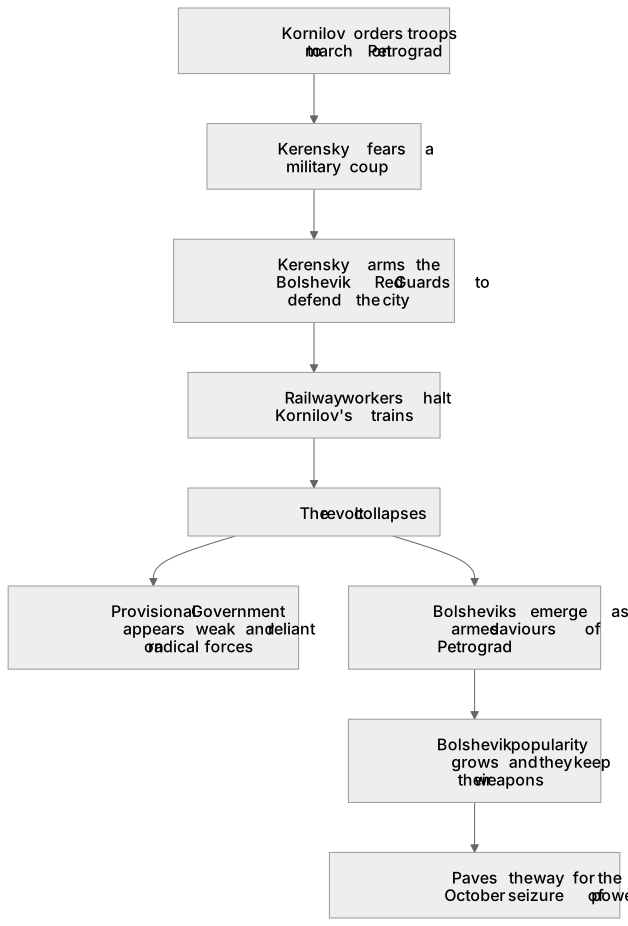
The Kornilov Revolt of August 1917 was a highly significant turning point that fatally weakened the Provisional Government and revived Bolshevik fortunes. General Kornilov ordered troops to march on Petrograd, ostensibly to restore order and crush the Soviet. Prime Minister Kerensky, fearing a military coup, panicked and armed the Bolshevik Red Guards to defend the city. The revolt collapsed when railway workers halted Kornilov's trains, but the consequences were profound. The Provisional Government appeared weak and reliant on radical forces for survival. Conversely, the Bolsheviks emerged as the armed saviours of Petrograd, significantly boosting their popularity, securing weapons, and paving the way for their October seizure of power.
What earns the marks
- Explain Kerensky's decision to arm the Bolshevik Red Guards to defend Petrograd against Kornilov's advancing troops.
- Analyse how the revolt exposed the military weakness and political vulnerability of the Provisional Government.
- Describe the transformation of the Bolsheviks' reputation from traitors to the armed defenders of the revolution.
- Evaluate the long-term significance of the Bolsheviks retaining the weapons provided by Kerensky, which were later used in the October Revolution.
Common mistakes and how to put them right
Claiming Kornilov successfully overthrew the government.
Put it right by stating his advance was halted by railway workers and Bolshevik agitators before reaching Petrograd.
Confusing Kornilov with a Bolshevik leader.
Put it right by identifying him as a right-wing general seeking to establish military discipline.
Stating the Bolsheviks started the revolt.
Put it right by explaining they were the ones armed by Kerensky to stop Kornilov's attempted coup.
Exam tips
- Focus on the consequences of the revolt rather than just the narrative of what happened.
- Highlight the contrast between the Provisional Government's loss of authority and the Bolsheviks' surge in popularity.
- Use the Kornilov Revolt as a key factor when explaining why the Bolsheviks were able to seize power in October.
Try the lesson
The start of the Option 30: Key topic 1: The revolutions of 1917 - 3 The Provisional Government: The significance of the Kornilov Revolt. lesson, made from checked teaching notes for this specification point.
Have a go first
What was the main outcome of the Kornilov Revolt in August 1917?
Listen
The Kornilov Revolt of August 1917 was a highly significant turning point that fatally weakened the Provisional Government and revived Bolshevik fortunes. General Kornilov ordered troops to march on Petrograd, ostensibly to restore order and crush the Soviet. Prime Minister Kerensky, fearing a military coup, panicked and armed the Bolshevik Red Guards to defend the city. The revolt collapsed when railway workers halted Kornilov's trains, but the consequences were profound. The Provisional Government appeared weak and reliant on radical forces for survival. Conversely, the Bolsheviks emerged as the armed saviours of Petrograd, significantly boosting their popularity, securing weapons, and paving the way for their October seizure of power. A strong answer earns marks for these points. Explain Kerensky's decision to arm the Bolshevik Red Guards to defend Petrograd against Kornilov's advancing troops. Analyse how the revolt exposed the military weakness and political vulnerability of the Provisional Government. Describe the transformation of the Bolsheviks' reputation from traitors to the armed defenders of the revolution. Evaluate the long-term significance of the Bolsheviks retaining the weapons provided by Kerensky, which were later used in the October Revolution. A common slip: Claiming Kornilov successfully overthrew the government. Instead, stating his advance was halted by railway workers and Bolshevik agitators before reaching Petrograd. Exam tip: Focus on the consequences of the revolt rather than just the narrative of what happened.
See it
Key words
Say what each word means before you turn the card.
Military intervention
Try answering aloud or in your head before turning the card.
Political instability
Try answering aloud or in your head before turning the card.
Rise of radicalism
Try answering aloud or in your head before turning the card.
Shifting power dynamics
Try answering aloud or in your head before turning the card.
See every definition
- Military intervention
- Kornilov ordered troops to march on Petrograd, ostensibly to restore order and crush the Soviet.
- Political instability
- The Provisional Government appeared weak and reliant on radical forces for survival after the revolt collapsed.
- Rise of radicalism
- The Bolsheviks emerged as the armed saviours of Petrograd, significantly boosting their popularity and securing weapons.
- Shifting power dynamics
- The revolt fatally weakened the Provisional Government and revived Bolshevik fortunes, paving the way for their October seizure of power.
Label the diagram
Some boxes have lost their names. Pick the right name for each number.
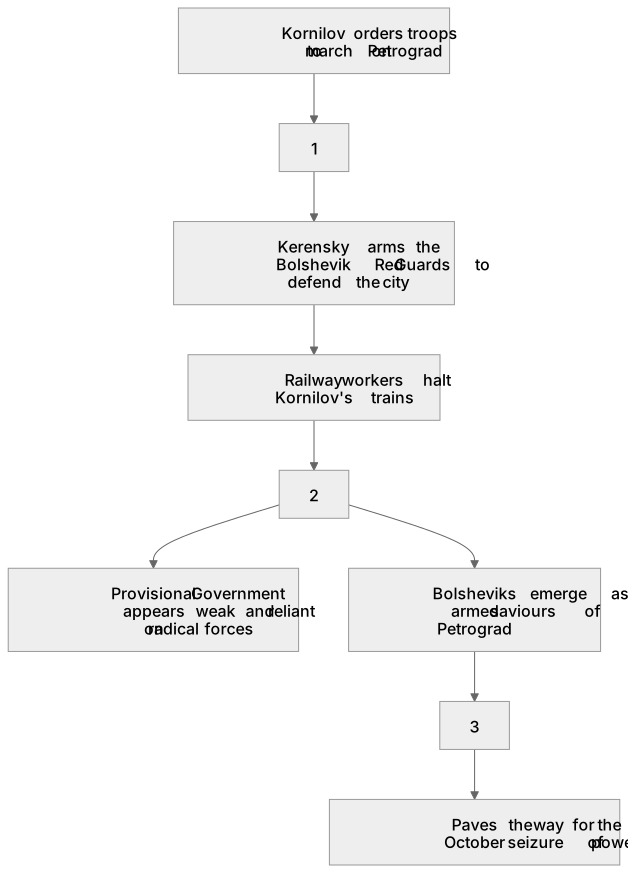
1Box 1
2Box 2
3Box 3
There is more to this lesson
The full lesson goes on to check your understanding and help you earn the marks. Create a free account to carry on, with your progress saved.
A week of Premium from your first lesson · Then the free plan continues · No card, no charge
Test your understanding of Option 30: Key topic 1: The revolutions of 1917 - 3 The Provisional Government: The significance of the Kornilov Revolt.
Active recall beats re-reading. Take an instant quiz now to test what you’ve learned and lock it into long-term memory.
A week of Premium from your first lesson · Then the free plan continues · No card, no charge