Pearson Edexcel · GCSE · History
Course version: 1HI0 · Version from Sept 2016
Key topic 1: The revolutions of 1917 - 4 The Bolshevik Revolution: Lenin’s…
Full specification wording
Option 30: Key topic 1: The revolutions of 1917 - 4 The Bolshevik Revolution: Lenin’s return and activities, including the April Theses and the growth in support for the Bolshevik Party. The ‘July Days’.
Lenin’s return to Petrograd in April 1917 transformed Bolshevik strategy.
Checked against the Pearson Edexcel 1HI0 specification (opens in a new tab) on .
- Point 1 of 2
- 4 key terms
Study notes
From the checked teaching notes for this specification point.
The idea
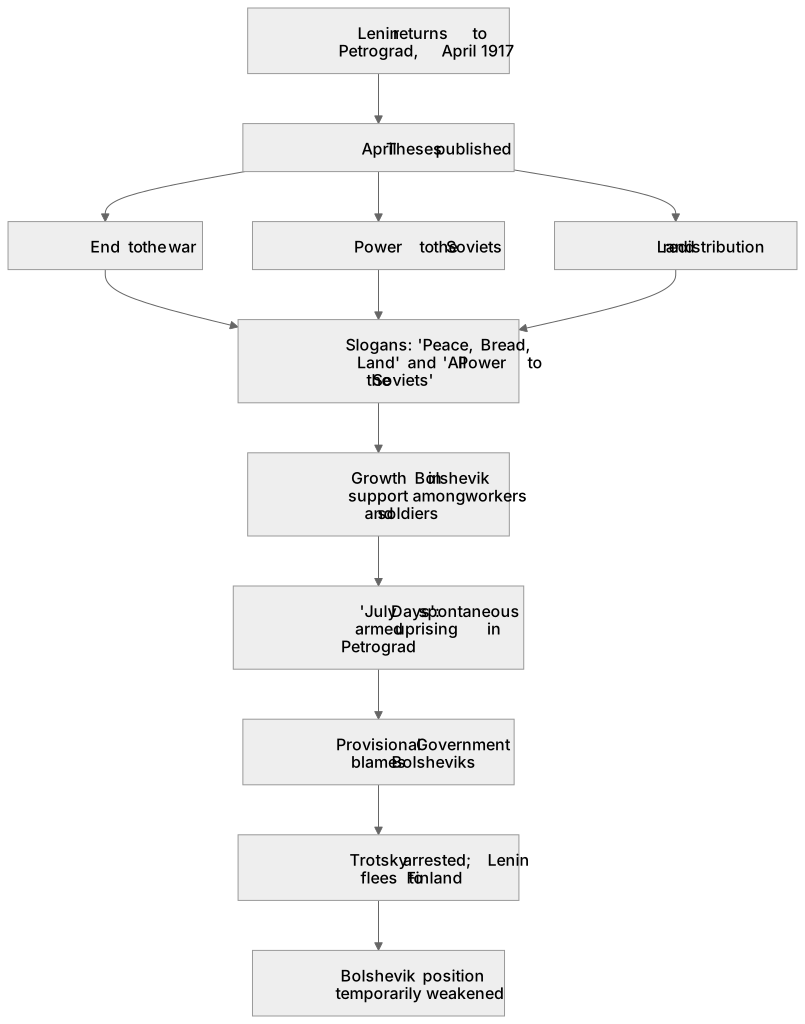
Lenin’s return to Petrograd in April 1917 transformed Bolshevik strategy. He published the April Theses, demanding an end to the war, the transfer of power to the Soviets, and land redistribution, encapsulated in the slogans 'Peace, Bread, Land' and 'All Power to the Soviets'. These activities provided a radical alternative to the Provisional Government, driving a significant growth in Bolshevik support among workers and soldiers. However, this momentum was halted by the 'July Days', a spontaneous armed uprising in Petrograd. The Provisional Government blamed the Bolsheviks, leading to the arrest of key leaders like Trotsky and forcing Lenin to flee to Finland, temporarily weakening the party's position before their later resurgence.
What earns the marks
- Detail the core demands of Lenin's April Theses, specifically 'Peace, Bread, Land' and 'All Power to the Soviets'.
- Explain how Lenin's clear policies capitalised on the Provisional Government's failures to increase Bolshevik support.
- Describe the events of the July Days as a premature, spontaneous uprising that lacked clear leadership.
- Analyse the consequences of the July Days, including the suppression of the Bolsheviks, Trotsky's arrest, and Lenin's exile.
Common mistakes and how to put them right
Stating that Lenin organised the July Days uprising.
Put it right by explaining it was a spontaneous revolt by soldiers and sailors that the Bolsheviks reluctantly supported.
Believing the April Theses immediately gave the Bolsheviks a majority in the Soviet.
Put it right by noting that support grew gradually over the following months.
Confusing the July Days with the October Revolution.
Put it right by identifying the July Days as a failed uprising that temporarily crushed the Bolsheviks.
Exam tips
- Memorise the slogans 'Peace, Bread, Land' and 'All Power to the Soviets' as direct evidence of Lenin's appeal to different social groups.
- Contrast the Bolsheviks' fortunes before and after the July Days to demonstrate an understanding of the fluctuating political situation.
- Link Lenin's activities directly to the growing dissatisfaction with the Provisional Government's continuation of the war.
Try the lesson
The start of the Option 30: Key topic 1: The revolutions of 1917 - 4 The Bolshevik Revolution: Lenin’s return and activities, including the April Theses and the growth in support for the Bolshevik Party. The ‘July Days’. lesson, made from checked teaching notes for this specification point.
Have a go first
What were the two main slogans used by Lenin in his April Theses to gain support for the Bolshevik Party in 1917?
Listen
Lenin’s return to Petrograd in April 1917 transformed Bolshevik strategy. He published the April Theses, demanding an end to the war, the transfer of power to the Soviets, and land redistribution, encapsulated in the slogans 'Peace, Bread, Land' and 'All Power to the Soviets'. These activities provided a radical alternative to the Provisional Government, driving a significant growth in Bolshevik support among workers and soldiers. However, this momentum was halted by the 'July Days', a spontaneous armed uprising in Petrograd. The Provisional Government blamed the Bolsheviks, leading to the arrest of key leaders like Trotsky and forcing Lenin to flee to Finland, temporarily weakening the party's position before their later resurgence. A strong answer earns marks for these points. Detail the core demands of Lenin's April Theses, specifically 'Peace, Bread, Land' and 'All Power to the Soviets'. Explain how Lenin's clear policies capitalised on the Provisional Government's failures to increase Bolshevik support. Describe the events of the July Days as a premature, spontaneous uprising that lacked clear leadership. Analyse the consequences of the July Days, including the suppression of the Bolsheviks, Trotsky's arrest, and Lenin's exile. A common slip: Stating that Lenin organised the July Days uprising. Instead, explaining it was a spontaneous revolt by soldiers and sailors that the Bolsheviks reluctantly supported. Exam tip: Memorise the slogans 'Peace, Bread, Land' and 'All Power to the Soviets' as direct evidence of Lenin's appeal to different social groups.
See it
Key words
Say what each word means before you turn the card.
April Theses
Try answering aloud or in your head before turning the card.
July Days
Try answering aloud or in your head before turning the card.
Bolshevik support
Try answering aloud or in your head before turning the card.
Provisional Government
Try answering aloud or in your head before turning the card.
See every definition
- April Theses
- Lenin's demands for an end to the war, the transfer of power to the Soviets, and land redistribution, encapsulated in the slogans 'Peace, Bread, Land' and 'All Power to the Soviets'.
- July Days
- A spontaneous armed uprising in Petrograd that the Bolsheviks reluctantly supported, after which the Provisional Government blamed the Bolsheviks and arrested key leaders like Trotsky.
- Bolshevik support
- Support that grew significantly among workers and soldiers as Lenin's activities provided a radical alternative to the Provisional Government.
- Provisional Government
- The body whose failures Lenin's clear policies capitalised on, and which blamed the Bolsheviks for the July Days.
Label the diagram
Some boxes have lost their names. Pick the right name for each number.
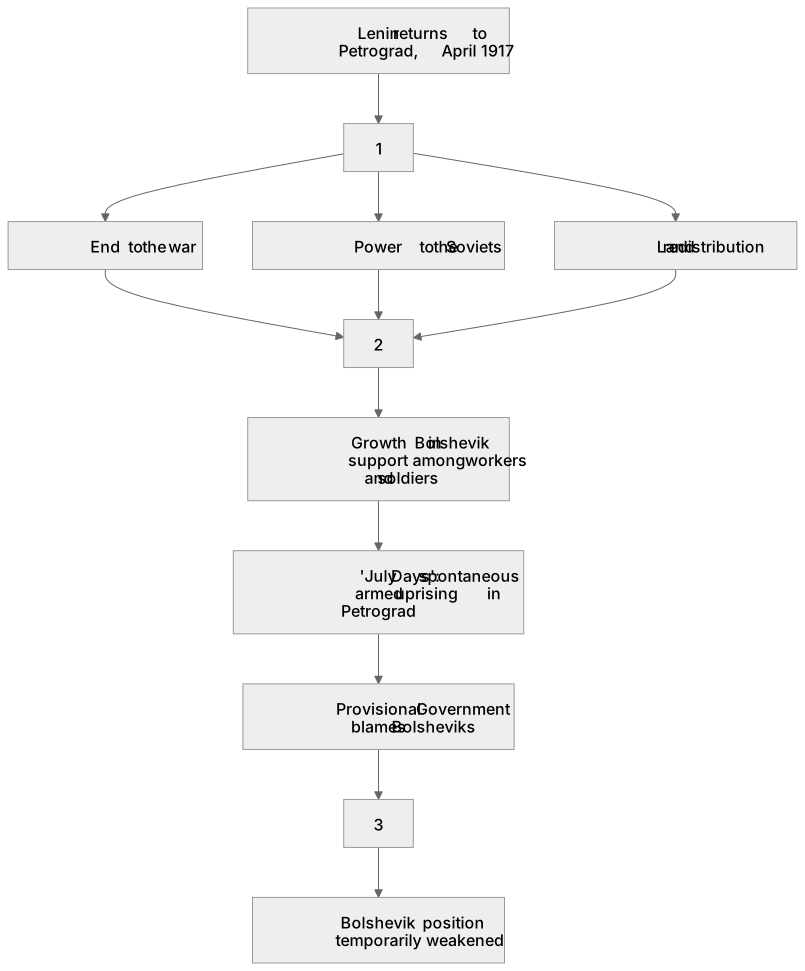
1Box 1
2Box 2
3Box 3
There is more to this lesson
The full lesson goes on to check your understanding and help you earn the marks. Create a free account to carry on, with your progress saved.
A week of Premium from your first lesson · Then the free plan continues · No card, no charge
Test your understanding of Option 30: Key topic 1: The revolutions of 1917 - 4 The Bolshevik Revolution: Lenin’s return and activities, including the April Theses and the growth in support for the Bolshevik Party. The ‘July Days’.
Active recall beats re-reading. Take an instant quiz now to test what you’ve learned and lock it into long-term memory.
A week of Premium from your first lesson · Then the free plan continues · No card, no charge