Pearson Edexcel · GCSE · History
Course version: 1HI0 · Version from Sept 2016
Key topic 2: The Bolsheviks in power, 1917–24 - 3 Moves towards…
Full specification wording
Option 30: Key topic 2: The Bolsheviks in power, 1917–24 - 3 Moves towards totalitarianism: Bolshevik centralisation, including the role of Lenin and the Politburo. Setting up of the USSR.
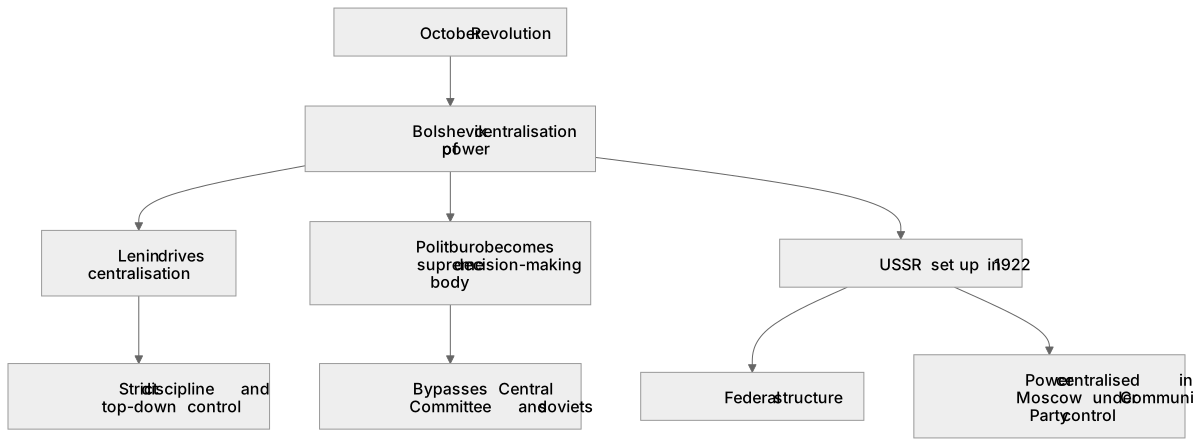
Following the October Revolution, the Bolsheviks rapidly centralised power to establish a one-party state.
Checked against the Pearson Edexcel 1HI0 specification (opens in a new tab) on .
- Point 2 of 2
- 4 key terms
Study notes
From the checked teaching notes for this specification point.
The idea
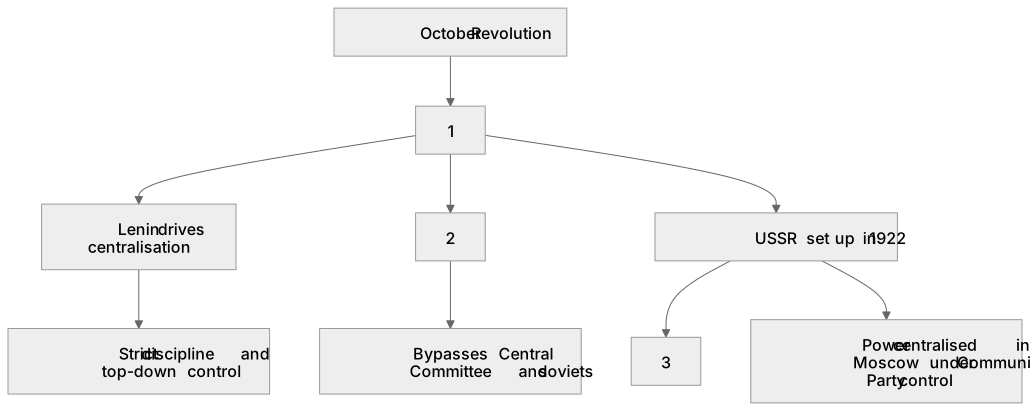
Following the October Revolution, the Bolsheviks rapidly centralised power to establish a one-party state. Lenin drove this centralisation, arguing that strict discipline and top-down control were essential. The Politburo, a small inner cabinet of senior Bolsheviks including Lenin and Trotsky, became the supreme decision-making body, bypassing the larger Central Committee and the soviets. This concentration of power ensured swift action but stifled debate. In 1922, this control was formalised geographically with the setting up of the Union of Soviet Socialist Republics (USSR). The USSR united Russia with other Soviet republics under a federal structure, though in reality, power remained firmly centralised in Moscow under Communist Party control.
What earns the marks
- Explain how the Bolsheviks dismantled democratic structures, such as the Constituent Assembly, to centralise power.
- Describe the role of the Politburo as the primary decision-making body, superseding the authority of the broader government and soviets.
- Analyse Lenin's justification for centralisation, focusing on the perceived necessity of strict discipline to win the Civil War and secure the revolution.
- Outline the creation of the USSR in 1922, explaining how it established a federal structure that masked the reality of centralised control from Moscow.
Common mistakes and how to put them right
Confusing the Politburo with the Sovnarkom.
Put it right: Distinguish between the Politburo (the highest policy-making authority within the Communist Party) and the Sovnarkom (the formal government cabinet).
Assuming the creation of the USSR gave genuine independence to the republics.
Put it right: Explain that while the USSR was nominally a federation, real power was tightly controlled by the central Communist Party in Moscow.
Stating that centralisation only began after Lenin's death.
Put it right: Emphasise that Lenin was the primary architect of centralisation and the one-party state during his time in power.
Exam tips
- Use the term 'democratic centralism' to describe the Bolshevik principle where decisions made at the top were binding on all lower levels.
- When discussing the Politburo, mention key figures like Lenin, Trotsky, and Stalin to demonstrate specific knowledge of its composition.
- Contrast the theoretical structure of the USSR with the practical reality of centralised Communist Party rule.
Try the lesson
The start of the Option 30: Key topic 2: The Bolsheviks in power, 1917–24 - 3 Moves towards totalitarianism: Bolshevik centralisation, including the role of Lenin and the Politburo. Setting up of the USSR. lesson, made from checked teaching notes for this specification point.
Have a go first
Which body became the supreme policy-making committee of the Communist Party, centralising power away from the larger Central Committee?
Listen
Following the October Revolution, the Bolsheviks rapidly centralised power to establish a one-party state. Lenin drove this centralisation, arguing that strict discipline and top-down control were essential. The Politburo, a small inner cabinet of senior Bolsheviks including Lenin and Trotsky, became the supreme decision-making body, bypassing the larger Central Committee and the soviets. This concentration of power ensured swift action but stifled debate. In 1922, this control was formalised geographically with the setting up of the Union of Soviet Socialist Republics (USSR). The USSR united Russia with other Soviet republics under a federal structure, though in reality, power remained firmly centralised in Moscow under Communist Party control. A strong answer earns marks for these points. Explain how the Bolsheviks dismantled democratic structures, such as the Constituent Assembly, to centralise power. Describe the role of the Politburo as the primary decision-making body, superseding the authority of the broader government and soviets. Analyse Lenin's justification for centralisation, focusing on the perceived necessity of strict discipline to win the Civil War and secure the revolution. Outline the creation of the USSR in 1922, explaining how it established a federal structure that masked the reality of centralised control from Moscow. A common slip: Confusing the Politburo with the Sovnarkom. Instead, Distinguish between the Politburo (the highest policy-making authority within the Communist Party) and the Sovnarkom (the formal government cabinet). Exam tip: Use the term 'democratic centralism' to describe the Bolshevik principle where decisions made at the top were binding on all lower levels.
See it
Key words
Say what each word means before you turn the card.
Political centralisation
Try answering aloud or in your head before turning the card.
One-party state
Try answering aloud or in your head before turning the card.
Politburo
Try answering aloud or in your head before turning the card.
USSR
Try answering aloud or in your head before turning the card.
See every definition
- Political centralisation
- The process by which the Bolsheviks rapidly concentrated power after the October Revolution, with Lenin arguing that strict discipline and top-down control were essential.
- One-party state
- A system the Bolsheviks established by rapidly centralising power after the October Revolution.
- Politburo
- A small inner cabinet of senior Bolsheviks including Lenin and Trotsky that became the supreme decision-making body, bypassing the larger Central Committee and the soviets.
- USSR
- The Union of Soviet Socialist Republics, set up in 1922, which united Russia with other Soviet republics under a federal structure while power remained centralised in Moscow under Communist Party control.
Label the diagram
Some boxes have lost their names. Pick the right name for each number.
1Box 1
2Box 2
3Box 3
There is more to this lesson
The full lesson goes on to check your understanding and help you earn the marks. Create a free account to carry on, with your progress saved.
A week of Premium from your first lesson · Then the free plan continues · No card, no charge
Test your understanding of Option 30: Key topic 2: The Bolsheviks in power, 1917–24 - 3 Moves towards totalitarianism: Bolshevik centralisation, including the role of Lenin and the Politburo. Setting up of the USSR.
Active recall beats re-reading. Take an instant quiz now to test what you’ve learned and lock it into long-term memory.
A week of Premium from your first lesson · Then the free plan continues · No card, no charge