Pearson Edexcel · GCSE · History
Course version: 1HI0 · Version from Sept 2016
Key topic 3: Stalin’s rise to power and dictatorship, 1924–41 - 3…
Full specification wording
Option 30: Key topic 3: Stalin’s rise to power and dictatorship, 1924–41 - 3 Propaganda and censorship: Official culture, socialist realism, control of education and religion. Media censorship.
Stalin established an official culture to indoctrinate the population, heavily promoting 'socialist realism' in art and literature.
Checked against the Pearson Edexcel 1HI0 specification (opens in a new tab) on .
- Point 1 of 2
Study notes
From the checked teaching notes for this specification point.
The idea
Stalin established an official culture to indoctrinate the population, heavily promoting 'socialist realism' in art and literature. This style required artists to depict Soviet life in an idealised, optimistic way, glorifying workers and Stalin himself. Control of education was tightened; schools focused on strict discipline, Russian history, and technical skills, ensuring children were raised as loyal communists. Religion was fiercely suppressed, with churches closed and clerics persecuted, as the state promoted atheism to replace religious devotion with loyalty to Stalin. Media censorship was absolute; the state controlled all newspapers, radio, and cinema, ensuring only pro-Stalin propaganda was published and dissenting voices were silenced.
What earns the marks
- Define socialist realism as the mandated artistic style that glorified Soviet achievements and Stalin.
- Explain how education was controlled to enforce discipline, promote communist ideology, and rewrite history to favour Stalin.
- Describe the suppression of religion, including the closure of places of worship and the promotion of state atheism.
- Detail the mechanisms of media censorship, noting that the state controlled all information to prevent criticism and spread propaganda.
Common mistakes and how to put them right
Assuming socialist realism reflected actual Soviet life.
Put it right: Explain that it was an idealised, utopian representation designed for propaganda, not reality.
Stating that religion was completely eradicated.
Put it right: Note that while heavily persecuted and driven underground, religious belief survived among many citizens.
Confusing 1920s progressive education with 1930s Stalinist education.
Put it right: Highlight that Stalin reversed progressive policies in favour of strict discipline and traditional subjects.
Exam tips
- Use the term 'socialist realism' explicitly when discussing art, literature, or culture under Stalin.
- Connect the control of education to the creation of the 'New Soviet Man'—a citizen entirely devoted to the state.
- When discussing censorship, mention that photographs were often doctored to remove purged individuals, demonstrating the extent of state control over truth.
Try the lesson
The start of the Option 30: Key topic 3: Stalin’s rise to power and dictatorship, 1924–41 - 3 Propaganda and censorship: Official culture, socialist realism, control of education and religion. Media censorship. lesson, made from checked teaching notes for this specification point.
Have a go first
What was the main characteristic of 'socialist realism' in Soviet art and literature?
Listen
Stalin established an official culture to indoctrinate the population, heavily promoting 'socialist realism' in art and literature. This style required artists to depict Soviet life in an idealised, optimistic way, glorifying workers and Stalin himself. Control of education was tightened; schools focused on strict discipline, Russian history, and technical skills, ensuring children were raised as loyal communists. Religion was fiercely suppressed, with churches closed and clerics persecuted, as the state promoted atheism to replace religious devotion with loyalty to Stalin. Media censorship was absolute; the state controlled all newspapers, radio, and cinema, ensuring only pro-Stalin propaganda was published and dissenting voices were silenced. A strong answer earns marks for these points. Define socialist realism as the mandated artistic style that glorified Soviet achievements and Stalin. Explain how education was controlled to enforce discipline, promote communist ideology, and rewrite history to favour Stalin. Describe the suppression of religion, including the closure of places of worship and the promotion of state atheism. Detail the mechanisms of media censorship, noting that the state controlled all information to prevent criticism and spread propaganda. A common slip: Assuming socialist realism reflected actual Soviet life. Instead, explain that it was an idealised, utopian representation designed for propaganda, not reality. Exam tip: Use the term 'socialist realism' explicitly when discussing art, literature, or culture under Stalin.
See it
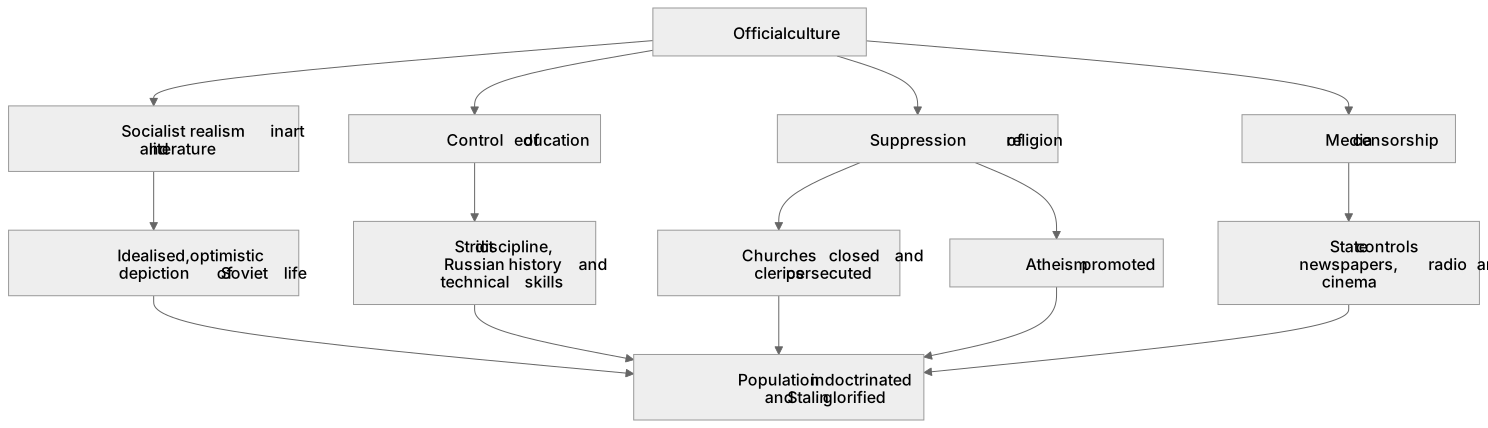
Label the diagram
Some boxes have lost their names. Pick the right name for each number.
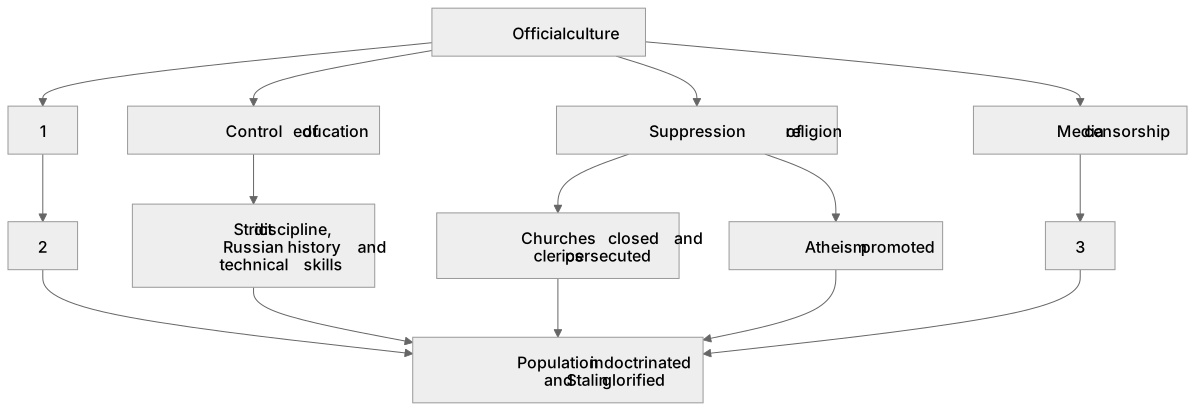
1Box 1
2Box 2
3Box 3
There is more to this lesson
The full lesson goes on to check your understanding and help you earn the marks. Create a free account to carry on, with your progress saved.
A week of Premium from your first lesson · Then the free plan continues · No card, no charge
Test your understanding of Option 30: Key topic 3: Stalin’s rise to power and dictatorship, 1924–41 - 3 Propaganda and censorship: Official culture, socialist realism, control of education and religion. Media censorship.
Active recall beats re-reading. Take an instant quiz now to test what you’ve learned and lock it into long-term memory.
A week of Premium from your first lesson · Then the free plan continues · No card, no charge