Pearson Edexcel · GCSE · History
Course version: 1HI0 · Version from Sept 2016
Key topic 4: Economic and social changes, 1924–41 - 1 Agriculture and…
Full specification wording
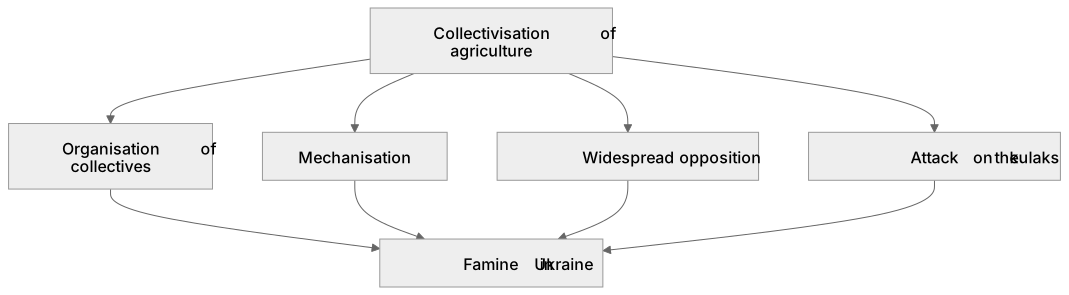
Option 30: Key topic 4: Economic and social changes, 1924–41 - 1 Agriculture and collectivisation: The organisation of collectives, mechanisation, widespread opposition and the attack on the kulaks. Famine in Ukraine.
Collectivisation transformed Soviet agriculture by merging individual farms into state-controlled collectives (kolkhozes).
Checked against the Pearson Edexcel 1HI0 specification (opens in a new tab) on .
- Point 2 of 3
- 4 key terms
Study notes
From the checked teaching notes for this specification point.
The idea
Collectivisation transformed Soviet agriculture by merging individual farms into state-controlled collectives (kolkhozes). To modernise farming, Machine Tractor Stations (MTS) provided mechanised equipment like tractors, though these were often poorly maintained. This policy faced widespread opposition from peasants who slaughtered livestock and burned crops rather than surrender them. Stalin responded with 'dekulakisation', a brutal attack on wealthier peasants (kulaks) involving mass deportations and executions to eliminate resistance. The resulting disruption and state grain requisitions caused a devastating man-made famine in Ukraine (the Holodomor) between 1932 and 1933, killing millions.
What earns the marks
- Describe the structure of a kolkhoz, where peasants pooled land and resources while meeting strict state grain quotas.
- Explain the role of Machine Tractor Stations (MTS) in providing mechanisation and acting as political control centres in rural areas.
- Detail peasant opposition tactics, such as destroying crops and slaughtering livestock, which severely damaged agricultural output.
- Outline the process of dekulakisation, including the categorisation of kulaks and their subsequent deportation to gulags or execution.
- Explain the causes of the Ukrainian famine (Holodomor), focusing on excessive state grain requisitioning despite widespread crop failures.
Common mistakes and how to put them right
Confusing kolkhozes (collective farms) with sovkhozes (state farms).
Put it right by specifying that kolkhozes involved pooled peasant land while sovkhozes were entirely state-owned with wage-earning workers.
Assuming mechanisation was universally successful.
Put it right by noting that MTS often lacked skilled mechanics and machinery was frequently broken.
Believing kulaks were a genuine, distinct social class.
Put it right by explaining that 'kulak' became a political label applied to any peasant opposing collectivisation.
Exam tips
- When discussing opposition, use specific examples of peasant resistance, such as the mass slaughter of horses and cattle, to demonstrate the scale of defiance.
- Link the attack on the kulaks directly to Stalin's need to eliminate political opposition and force compliance with collectivisation.
- Use the term 'Holodomor' when discussing the famine in Ukraine to show precise historical knowledge of the targeted nature of the starvation.
Try the lesson
The start of the Option 30: Key topic 4: Economic and social changes, 1924–41 - 1 Agriculture and collectivisation: The organisation of collectives, mechanisation, widespread opposition and the attack on the kulaks. Famine in Ukraine. lesson, made from checked teaching notes for this specification point.
Have a go first
What was the primary purpose of the Soviet government's attack on the kulaks during the collectivisation process?
Listen
Collectivisation transformed Soviet agriculture by merging individual farms into state-controlled collectives (kolkhozes). To modernise farming, Machine Tractor Stations (MTS) provided mechanised equipment like tractors, though these were often poorly maintained. This policy faced widespread opposition from peasants who slaughtered livestock and burned crops rather than surrender them. Stalin responded with 'dekulakisation', a brutal attack on wealthier peasants (kulaks) involving mass deportations and executions to eliminate resistance. The resulting disruption and state grain requisitions caused a devastating man-made famine in Ukraine (the Holodomor) between 1932 and 1933, killing millions. A strong answer earns marks for these points. Describe the structure of a kolkhoz, where peasants pooled land and resources while meeting strict state grain quotas. Explain the role of Machine Tractor Stations (MTS) in providing mechanisation and acting as political control centres in rural areas. Detail peasant opposition tactics, such as destroying crops and slaughtering livestock, which severely damaged agricultural output. Outline the process of dekulakisation, including the categorisation of kulaks and their subsequent deportation to gulags or execution. A common slip: Confusing kolkhozes (collective farms) with sovkhozes (state farms). Instead, specifying that kolkhozes involved pooled peasant land while sovkhozes were entirely state-owned with wage-earning workers. Exam tip: When discussing opposition, use specific examples of peasant resistance, such as the mass slaughter of horses and cattle, to demonstrate the scale of defiance.
See it
Key words
Say what each word means before you turn the card.
Collectives
Try answering aloud or in your head before turning the card.
Mechanisation
Try answering aloud or in your head before turning the card.
Kulaks
Try answering aloud or in your head before turning the card.
Holodomor
Try answering aloud or in your head before turning the card.
See every definition
- Collectives
- Farms formed by merging individual farms into state-controlled units.
- Mechanisation
- The provision of mechanised equipment like tractors through Machine Tractor Stations (MTS).
- Kulaks
- Wealthier peasants targeted in a brutal attack involving mass deportations and executions.
- Holodomor
- A devastating man-made famine in Ukraine between 1932 and 1933, killing millions.
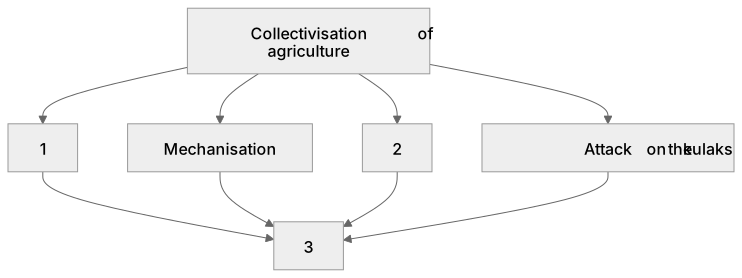
Label the diagram
Some boxes have lost their names. Pick the right name for each number.
1Box 1
2Box 2
3Box 3
There is more to this lesson
The full lesson goes on to check your understanding and help you earn the marks. Create a free account to carry on, with your progress saved.
A week of Premium from your first lesson · Then the free plan continues · No card, no charge
Test your understanding of Option 30: Key topic 4: Economic and social changes, 1924–41 - 1 Agriculture and collectivisation: The organisation of collectives, mechanisation, widespread opposition and the attack on the kulaks. Famine in Ukraine.
Active recall beats re-reading. Take an instant quiz now to test what you’ve learned and lock it into long-term memory.
A week of Premium from your first lesson · Then the free plan continues · No card, no charge