Pearson Edexcel · GCSE · History
Course version: 1HI0 · Version from Sept 2016
Key topic 4: Economic and social changes, 1924–41 - 2 Changes in industry:…
Full specification wording
Option 30: Key topic 4: Economic and social changes, 1924–41 - 2 Changes in industry: The successes and failures of industrialisation.
Stalin's Five-Year Plans transformed the Soviet Union into an industrial power, but at a severe human cost.
Checked against the Pearson Edexcel 1HI0 specification (opens in a new tab) on .
- Point 3 of 3
Study notes
From the checked teaching notes for this specification point.
The idea
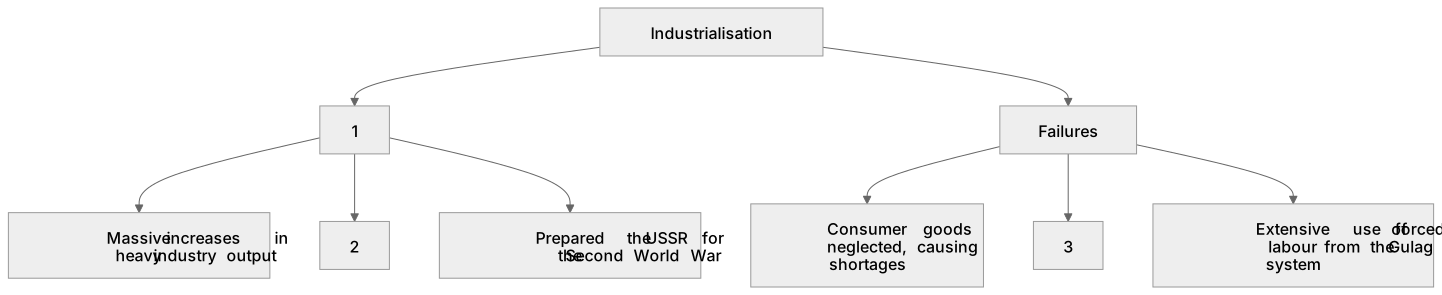
Stalin's Five-Year Plans transformed the Soviet Union into an industrial power, but at a severe human cost. Successes included massive increases in heavy industry output, such as coal and steel, alongside colossal projects like the Magnitogorsk steelworks. These achievements prepared the USSR for the Second World War. However, failures were equally significant. The relentless focus on heavy industry meant consumer goods were neglected, causing widespread shortages. Furthermore, the rapid pace of industrialisation resulted in poor quality output, high accident rates, and the extensive use of forced labour from the Gulag system. This highlights the immense human suffering and inefficiency that underpinned the impressive economic statistics.
What earns the marks
- Identify specific successes of the Five-Year Plans, such as the exponential growth in coal, iron, and steel production.
- Explain the strategic importance of new industrial centres like Magnitogorsk in preparing the USSR for potential conflict.
- Detail the failures of industrialisation, particularly the chronic shortages of consumer goods like clothing and furniture.
- Evaluate the human cost of industrialisation, including poor working conditions, high accident rates, and reliance on Gulag labour.
Common mistakes and how to put them right
Claiming that industrialisation was a complete success.
Put it right: Acknowledge the severe failures, such as the lack of consumer goods and the immense human cost.
Confusing the outcomes of the First, Second, and Third Five-Year Plans.
Put it right: Ensure specific successes and failures are attributed to the correct period or general trend of the 1930s.
Ignoring the role of forced labour.
Put it right: Explicitly mention the use of Gulag prisoners in major construction projects like the White Sea Canal.
Exam tips
- Use specific statistics or named projects (like the Dnieper Dam) to support points about industrial success.
- When evaluating failures, balance economic inefficiencies (like poor quality goods) with social impacts (like harsh working conditions).
- Link the successes of industrialisation to the broader context of the USSR's ability to withstand the German invasion in 1941.
Try the lesson
The start of the Option 30: Key topic 4: Economic and social changes, 1924–41 - 2 Changes in industry: The successes and failures of industrialisation. lesson, made from checked teaching notes for this specification point.
Have a go first
Which of the following was a major success of the Five-Year Plans in the Soviet Union during the 1930s?
Listen
Stalin's Five-Year Plans transformed the Soviet Union into an industrial power, but at a severe human cost. Successes included massive increases in heavy industry output, such as coal and steel, alongside colossal projects like the Magnitogorsk steelworks. These achievements prepared the USSR for the Second World War. However, failures were equally significant. The relentless focus on heavy industry meant consumer goods were neglected, causing widespread shortages. Furthermore, the rapid pace of industrialisation resulted in poor quality output, high accident rates, and the extensive use of forced labour from the Gulag system. This highlights the immense human suffering and inefficiency that underpinned the impressive economic statistics. A strong answer earns marks for these points. Identify specific successes of the Five-Year Plans, such as the exponential growth in coal, iron, and steel production. Explain the strategic importance of new industrial centres like Magnitogorsk in preparing the USSR for potential conflict. Detail the failures of industrialisation, particularly the chronic shortages of consumer goods like clothing and furniture. Evaluate the human cost of industrialisation, including poor working conditions, high accident rates, and reliance on Gulag labour. A common slip: Claiming that industrialisation was a complete success. Instead, acknowledge the severe failures, such as the lack of consumer goods and the immense human cost. Exam tip: Use specific statistics or named projects (like the Dnieper Dam) to support points about industrial success.
See it

Label the diagram
Some boxes have lost their names. Pick the right name for each number.
1Box 1
2Box 2
3Box 3
There is more to this lesson
The full lesson goes on to check your understanding and help you earn the marks. Create a free account to carry on, with your progress saved.
A week of Premium from your first lesson · Then the free plan continues · No card, no charge
Test your understanding of Option 30: Key topic 4: Economic and social changes, 1924–41 - 2 Changes in industry: The successes and failures of industrialisation.
Active recall beats re-reading. Take an instant quiz now to test what you’ve learned and lock it into long-term memory.
A week of Premium from your first lesson · Then the free plan continues · No card, no charge