Pearson Edexcel · GCSE · History
Course version: 1HI0 · Version from Sept 2016
Key topic 4: Economic and social changes, 1924–41 - 4 The position of…
Full specification wording
Option 30: Key topic 4: Economic and social changes, 1924–41 - 4 The position of women and ethnic minorities: Changes in family life and employment and the political position of women.
The period 1924-1941 saw dramatic shifts in the lives of Soviet women.
Checked against the Pearson Edexcel 1HI0 specification (opens in a new tab) on .
- Point 1 of 2
- 4 key terms
Study notes
From the checked teaching notes for this specification point.
The idea
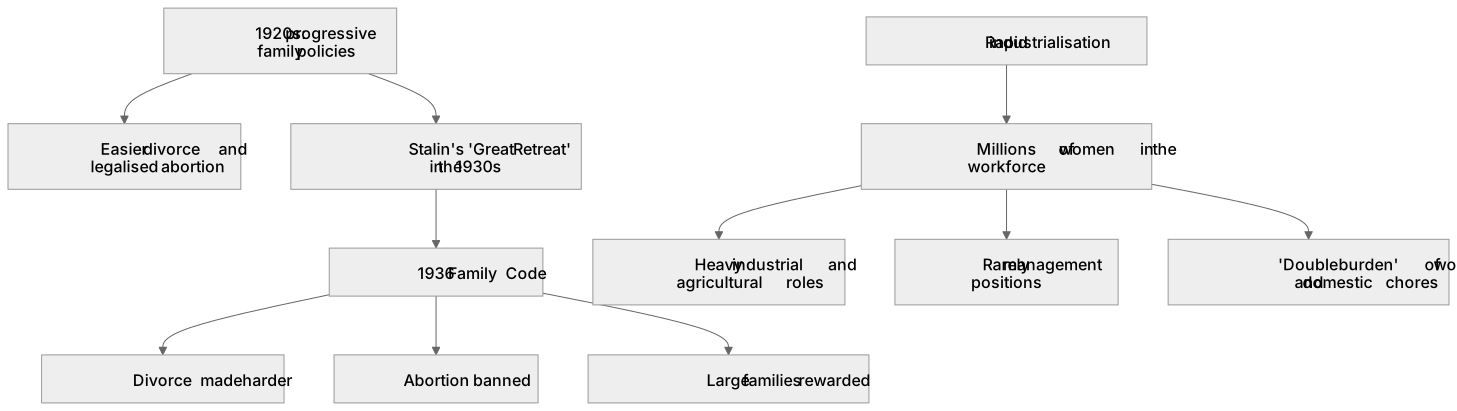
The period 1924-1941 saw dramatic shifts in the lives of Soviet women. Initially, the 1920s brought progressive changes, including easier divorce and legalised abortion. However, Stalin's 'Great Retreat' in the 1930s reversed this, promoting traditional family life to combat falling birth rates. The 1936 Family Code made divorce harder, banned abortion, and rewarded large families. In employment, rapid industrialisation forced millions of women into the workforce. Women took on heavy industrial jobs and agricultural roles, yet they rarely achieved management positions and still bore the 'double burden' of domestic chores. Politically, despite communist rhetoric of equality, women remained underrepresented in the higher echelons of the Communist Party, holding very few positions of real political power.
What earns the marks
- Explain the shift from the progressive family policies of the 1920s to Stalin's 'Great Retreat' and the 1936 Family Code.
- Describe the impact of the 1936 Family Code, including the banning of abortion and the introduction of financial incentives for large families.
- Detail the massive increase of women in the workforce due to the Five-Year Plans, including their roles in heavy industry and agriculture.
- Evaluate the political position of women, noting that despite theoretical equality, they were largely excluded from senior Party roles.
Common mistakes and how to put them right
Claiming women achieved full equality in employment.
Put it right: Note that while women worked in all sectors, they were paid less, rarely promoted, and faced the 'double burden' of work and home.
Confusing the policies of the 1920s with the 1930s.
Put it right: Clearly distinguish between the early Bolshevik liberalisation and Stalin's conservative 'Great Retreat'.
Overstating women's political power.
Put it right: Clarify that women were well-represented at local levels but almost entirely absent from the Politburo and senior leadership.
Exam tips
- Use the phrase 'The Great Retreat' to describe Stalin's reversal of early Bolshevik social policies regarding the family.
- Mention the 'double burden' when discussing employment to show an understanding of the reality of women's daily lives.
- Be prepared to contrast the theoretical rights of women under Soviet law with the practical realities of their employment and political status.
Try the lesson
The start of the Option 30: Key topic 4: Economic and social changes, 1924–41 - 4 The position of women and ethnic minorities: Changes in family life and employment and the political position of women. lesson, made from checked teaching notes for this specification point.
Have a go first
What was a major change in the employment of women in the Soviet Union during the 1930s?
Listen
The period 1924-1941 saw dramatic shifts in the lives of Soviet women. Initially, the 1920s brought progressive changes, including easier divorce and legalised abortion. However, Stalin's 'Great Retreat' in the 1930s reversed this, promoting traditional family life to combat falling birth rates. The 1936 Family Code made divorce harder, banned abortion, and rewarded large families. In employment, rapid industrialisation forced millions of women into the workforce. Women took on heavy industrial jobs and agricultural roles, yet they rarely achieved management positions and still bore the 'double burden' of domestic chores. Politically, despite communist rhetoric of equality, women remained underrepresented in the higher echelons of the Communist Party, holding very few positions of real political power. A strong answer earns marks for these points. Explain the shift from the progressive family policies of the 1920s to Stalin's 'Great Retreat' and the 1936 Family Code. Describe the impact of the 1936 Family Code, including the banning of abortion and the introduction of financial incentives for large families. Detail the massive increase of women in the workforce due to the Five-Year Plans, including their roles in heavy industry and agriculture. Evaluate the political position of women, noting that despite theoretical equality, they were largely excluded from senior Party roles. A common slip: Claiming women achieved full equality in employment. Instead, note that while women worked in all sectors, they were paid less, rarely promoted, and faced the 'double burden' of work and home. Exam tip: Use the phrase 'The Great Retreat' to describe Stalin's reversal of early Bolshevik social policies regarding the family.
See it
Key words
Say what each word means before you turn the card.
Social policy and the family
Try answering aloud or in your head before turning the card.
Women in the workforce
Try answering aloud or in your head before turning the card.
Political representation and equality
Try answering aloud or in your head before turning the card.
The 'Great Retreat'
Try answering aloud or in your head before turning the card.
See every definition
- Social policy and the family
- The changes in family life, including easier divorce and legalised abortion in the 1920s, reversed by Stalin's 'Great Retreat' in the 1930s, which promoted traditional family life to combat falling birth rates.
- Women in the workforce
- Rapid industrialisation forced millions of women into the workforce, taking on heavy industrial jobs and agricultural roles, yet they rarely achieved management positions and still bore the 'double burden' of domestic chores.
- Political representation and equality
- Despite communist rhetoric of equality, women remained underrepresented in the higher echelons of the Communist Party, holding very few positions of real political power.
- The 'Great Retreat'
- Stalin's reversal in the 1930s of the progressive family policies of the 1920s, promoting traditional family life to combat falling birth rates.
Label the diagram
Some boxes have lost their names. Pick the right name for each number.
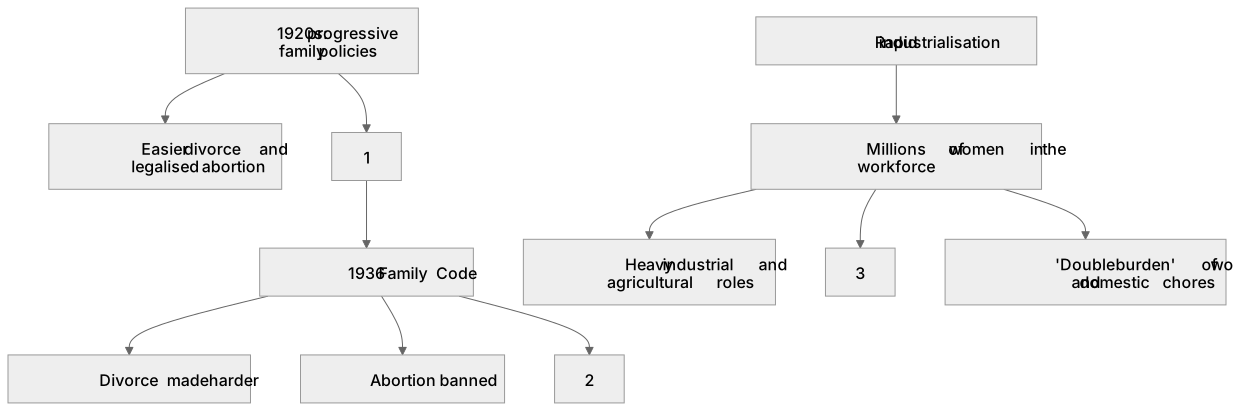
1Box 1
2Box 2
3Box 3
There is more to this lesson
The full lesson goes on to check your understanding and help you earn the marks. Create a free account to carry on, with your progress saved.
A week of Premium from your first lesson · Then the free plan continues · No card, no charge
Test your understanding of Option 30: Key topic 4: Economic and social changes, 1924–41 - 4 The position of women and ethnic minorities: Changes in family life and employment and the political position of women.
Active recall beats re-reading. Take an instant quiz now to test what you’ve learned and lock it into long-term memory.
A week of Premium from your first lesson · Then the free plan continues · No card, no charge