Pearson Edexcel · GCSE · History
Course version: 1HI0 · Version from Sept 2016
Key topic 1: The Weimar Republic 1918–29 - 4 Changes in society, 1924–29:…
Full specification wording
Option 31: Key topic 1: The Weimar Republic 1918–29 - 4 Changes in society, 1924–29: Changes in the standard of living.
Between 1924 and 1929, the Weimar Republic experienced significant changes in the standard of living, though these were not felt equally.
Checked against the Pearson Edexcel 1HI0 specification (opens in a new tab) on .
- Point 1 of 3
Study notes
From the checked teaching notes for this specification point.
The idea
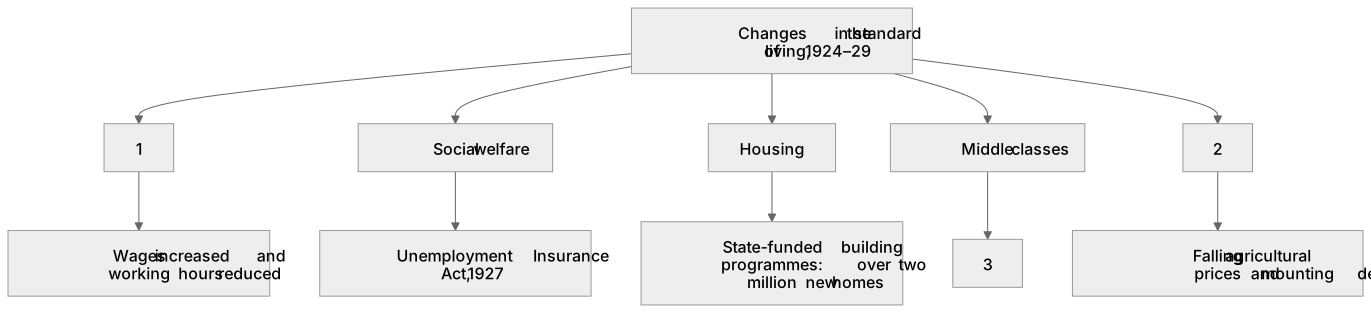
Between 1924 and 1929, the Weimar Republic experienced significant changes in the standard of living, though these were not felt equally. For many industrial workers, wages increased and working hours were reduced, improving their daily lives. The government also expanded social welfare, notably introducing the Unemployment Insurance Act in 1927, which provided a crucial safety net. To combat severe housing shortages, the state funded massive building programmes, resulting in the construction of over two million new homes. However, these improvements largely bypassed the middle classes, who had lost their savings during the 1923 hyperinflation, and farmers, who suffered from falling agricultural prices and mounting debt.
What earns the marks
- Identify improvements in wages and working hours for industrial workers during the period 1924-1929.
- Describe the introduction and impact of the 1927 Unemployment Insurance Act.
- Explain the government's response to housing shortages, including state-funded building projects.
- Recognise the limitations of these improvements, particularly the economic struggles of the middle classes and farmers.
Common mistakes and how to put them right
Assuming all Germans experienced a rise in living standards.
Put it right: Note that farmers and the middle classes often struggled economically during this period.
Confusing the 1924-1929 period with the hyperinflation crisis of 1923.
Put it right: Focus on the recovery period under Stresemann, not the crisis year.
Stating that unemployment was completely eradicated.
Put it right: Acknowledge that unemployment remained a persistent issue, which is why the 1927 insurance act was necessary.
Exam tips
- Use specific statistics, such as the number of homes built or the provisions of the 1927 Act, to support your points.
- When evaluating living standards, always contrast the experiences of different social groups, such as industrial workers versus farmers.
- Link changes in living standards to the broader economic policies and stability of the Stresemann era.
Try the lesson
The start of the Option 31: Key topic 1: The Weimar Republic 1918–29 - 4 Changes in society, 1924–29: Changes in the standard of living. lesson, made from checked teaching notes for this specification point.
Have a go first
Which of the following was a key improvement in the standard of living for many German workers between 1924 and 1929?
Listen
Between 1924 and 1929, the Weimar Republic experienced significant changes in the standard of living, though these were not felt equally. For many industrial workers, wages increased and working hours were reduced, improving their daily lives. The government also expanded social welfare, notably introducing the Unemployment Insurance Act in 1927, which provided a crucial safety net. To combat severe housing shortages, the state funded massive building programmes, resulting in the construction of over two million new homes. However, these improvements largely bypassed the middle classes, who had lost their savings during the 1923 hyperinflation, and farmers, who suffered from falling agricultural prices and mounting debt. A strong answer earns marks for these points. Identify improvements in wages and working hours for industrial workers during the period 1924-1929. Describe the introduction and impact of the 1927 Unemployment Insurance Act. Explain the government's response to housing shortages, including state-funded building projects. Recognise the limitations of these improvements, particularly the economic struggles of the middle classes and farmers. A common slip: Assuming all Germans experienced a rise in living standards. Instead, Note that farmers and the middle classes often struggled economically during this period. Exam tip: Use specific statistics, such as the number of homes built or the provisions of the 1927 Act, to support your points.
See it

Put the events in order
Put these events in the order they happened, earliest first.
- 1. Middle classes lost savings during hyperinflation
- 2. Unemployment Insurance Act introduced as social welfare safety net
- 3. Weimar Republic began period of significant changes in living standards
Label the diagram
Some boxes have lost their names. Pick the right name for each number.
1Box 1
2Box 2
3Box 3
There is more to this lesson
The full lesson goes on to check your understanding and help you earn the marks. Create a free account to carry on, with your progress saved.
A week of Premium from your first lesson · Then the free plan continues · No card, no charge
Test your understanding of Option 31: Key topic 1: The Weimar Republic 1918–29 - 4 Changes in society, 1924–29: Changes in the standard of living.
Active recall beats re-reading. Take an instant quiz now to test what you’ve learned and lock it into long-term memory.
A week of Premium from your first lesson · Then the free plan continues · No card, no charge