Pearson Edexcel · GCSE · History
Course version: 1HI0 · Version from Sept 2016
Key topic 1: The Weimar Republic 1918–29 - 4 Changes in society, 1924–29:…
Full specification wording
Option 31: Key topic 1: The Weimar Republic 1918–29 - 4 Changes in society, 1924–29: Cultural changes: developments in architecture, art and the cinema.
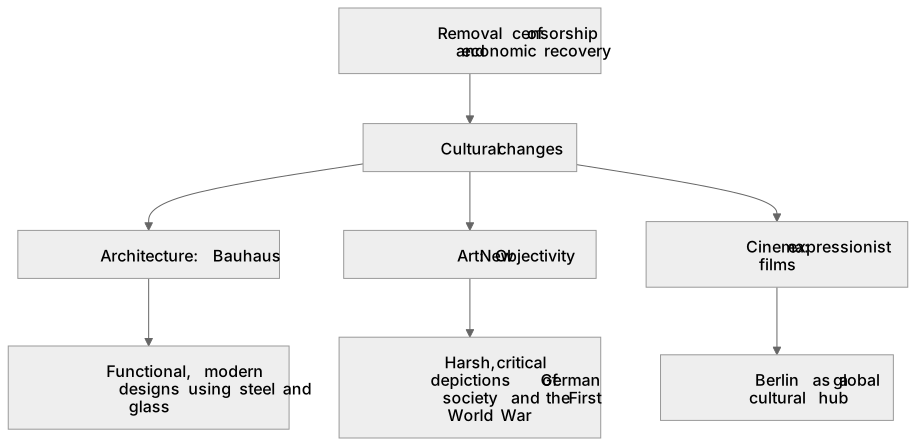
The Weimar Republic's 'Golden Age' witnessed radical cultural changes and developments in architecture, art, and the cinema, fuelled by the removal of censorship and economic recovery.
Checked against the Pearson Edexcel 1HI0 specification (opens in a new tab) on .
- Point 3 of 3
- 4 key terms
Study notes
From the checked teaching notes for this specification point.
The idea
The Weimar Republic's 'Golden Age' witnessed radical cultural changes and developments in architecture, art, and the cinema, fuelled by the removal of censorship and economic recovery. In architecture, Walter Gropius founded the Bauhaus movement, which rejected traditional ornamentation in favour of functional, modern designs using new materials like steel and glass. In art, the 'New Objectivity' movement emerged; artists such as Otto Dix and George Grosz painted harsh, critical depictions of German society and the brutal legacy of the First World War. Cinema also flourished, with Germany producing innovative expressionist films, such as Fritz Lang's sci-fi masterpiece 'Metropolis', establishing Berlin as a global cultural hub.
What earns the marks
- Describe the Bauhaus movement's impact on architecture and design, focusing on functionalism and modern materials.
- Explain the 'New Objectivity' movement in art, referencing artists like Otto Dix and George Grosz.
- Detail the growth of the German film industry, mentioning expressionist cinema and key films like 'Metropolis'.
- Explain how the removal of censorship and economic recovery facilitated this cultural boom.
Common mistakes and how to put them right
Describing Weimar culture without linking it to the political or economic context.
Put it right: Explain how the end of censorship and the trauma of the First World War influenced these cultural developments.
Confusing Bauhaus with traditional German architecture.
Put it right: Emphasise that Bauhaus was a radical, modern movement using new materials and rejecting traditional ornamentation.
Stating that everyone in Germany embraced these cultural changes.
Put it right: Note that many conservatives and rural populations viewed Weimar culture as decadent and un-German.
Exam tips
- Memorise specific examples for each category: Bauhaus for architecture, Otto Dix for art, and Fritz Lang for cinema.
- Discuss how artists used their work to critique Weimar society and the legacy of the First World War.
- Be prepared to explain why these cultural changes provoked a strong backlash from right-wing and traditionalist groups.
Try the lesson
The start of the Option 31: Key topic 1: The Weimar Republic 1918–29 - 4 Changes in society, 1924–29: Cultural changes: developments in architecture, art and the cinema. lesson, made from checked teaching notes for this specification point.
Have a go first
Which architectural and design movement became highly influential in the Weimar Republic during the 1920s?
Listen
The Weimar Republic's 'Golden Age' witnessed radical cultural changes and developments in architecture, art, and the cinema, fuelled by the removal of censorship and economic recovery. In architecture, Walter Gropius founded the Bauhaus movement, which rejected traditional ornamentation in favour of functional, modern designs using new materials like steel and glass. In art, the 'New Objectivity' movement emerged; artists such as Otto Dix and George Grosz painted harsh, critical depictions of German society and the brutal legacy of the First World War. Cinema also flourished, with Germany producing innovative expressionist films, such as Fritz Lang's sci-fi masterpiece 'Metropolis', establishing Berlin as a global cultural hub. A strong answer earns marks for these points. Describe the Bauhaus movement's impact on architecture and design, focusing on functionalism and modern materials. Explain the 'New Objectivity' movement in art, referencing artists like Otto Dix and George Grosz. Detail the growth of the German film industry, mentioning expressionist cinema and key films like 'Metropolis'. Explain how the removal of censorship and economic recovery facilitated this cultural boom. A common slip: Describing Weimar culture without linking it to the political or economic context. Instead, Explain how the end of censorship and the trauma of the First World War influenced these cultural developments. Exam tip: Memorise specific examples for each category: Bauhaus for architecture, Otto Dix for art, and Fritz Lang for cinema.
See it
Key words
Say what each word means before you turn the card.
Bauhaus
Try answering aloud or in your head before turning the card.
New Objectivity
Try answering aloud or in your head before turning the card.
Expressionist cinema
Try answering aloud or in your head before turning the card.
Removal of censorship
Try answering aloud or in your head before turning the card.
See every definition
- Bauhaus
- A movement founded by Walter Gropius that rejected traditional ornamentation in favour of functional, modern designs using new materials like steel and glass.
- New Objectivity
- An art movement in which artists such as Otto Dix and George Grosz painted harsh, critical depictions of German society and the brutal legacy of the First World War.
- Expressionist cinema
- Innovative films produced in Germany, such as Fritz Lang's sci-fi masterpiece 'Metropolis', which helped establish Berlin as a global cultural hub.
- Removal of censorship
- Alongside economic recovery, this fuelled the radical cultural changes and developments in architecture, art and the cinema.
Label the diagram
Some boxes have lost their names. Pick the right name for each number.
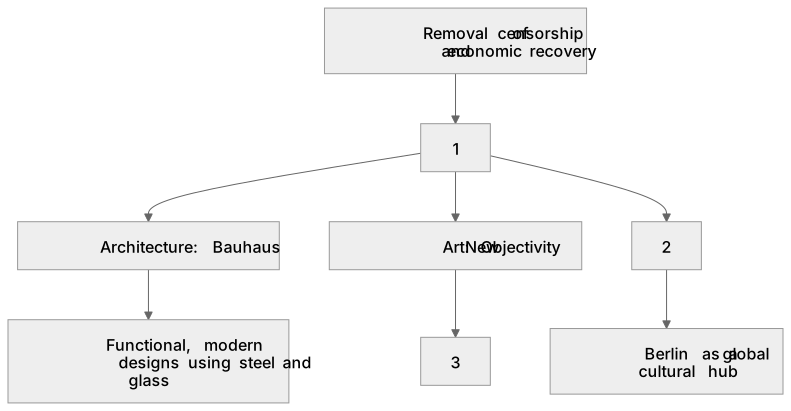
1Box 1
2Box 2
3Box 3
There is more to this lesson
The full lesson goes on to check your understanding and help you earn the marks. Create a free account to carry on, with your progress saved.
A week of Premium from your first lesson · Then the free plan continues · No card, no charge
Test your understanding of Option 31: Key topic 1: The Weimar Republic 1918–29 - 4 Changes in society, 1924–29: Cultural changes: developments in architecture, art and the cinema.
Active recall beats re-reading. Take an instant quiz now to test what you’ve learned and lock it into long-term memory.
A week of Premium from your first lesson · Then the free plan continues · No card, no charge