Pearson Edexcel · GCSE · History
Course version: 1HI0 · Version from Sept 2016
Key topic 2: Hitler’s rise to power, 1919–33 - 3 The growth in support for…
Full specification wording
Option 31: Key topic 2: Hitler’s rise to power, 1919–33 - 3 The growth in support for the Nazis, 1929–32: The growth of unemployment – its causes and impact. The growth of support for the Communist Party.
The 1929 Wall Street Crash devastated the German economy, as American banks recalled the short-term loans that had underpinned Weimar's recovery under the Dawes Plan.
Checked against the Pearson Edexcel 1HI0 specification (opens in a new tab) on .
- Point 1 of 2
Study notes
From the checked teaching notes for this specification point.
The idea
The 1929 Wall Street Crash devastated the German economy, as American banks recalled the short-term loans that had underpinned Weimar's recovery under the Dawes Plan. This caused a catastrophic collapse in German industry, leading to soaring unemployment that peaked at over six million by 1932. The impact was profound: widespread poverty, homelessness, and a collapse of faith in democratic institutions, exacerbated by Chancellor Brüning's unpopular deflationary policies and reliance on Article 48. This desperation fuelled a surge in support for the Communist Party (KPD), who promised a radical redistribution of wealth. The KPD's growing strength terrified the middle classes, driving them towards the Nazis as a bulwark against Bolshevism.
What earns the marks
- Identify the Wall Street Crash and the recall of US loans as the primary causes of the German economic collapse.
- Describe the social impact of mass unemployment, including poverty, homelessness, and reliance on inadequate state benefits.
- Explain how the Weimar government's failure to solve the crisis undermined faith in democracy.
- Analyse the reasons for the growth in KPD support among the unemployed and working classes.
- Evaluate how the fear of a Communist revolution pushed middle-class voters and wealthy industrialists to support the Nazi Party.
Common mistakes and how to put them right
Stating the Wall Street Crash directly caused Hitler to become Chancellor.
Put it right: Explain that the Crash caused the economic crisis and unemployment, which in turn created the desperate conditions that made extremist parties popular.
Ignoring the growth of the Communist Party when discussing this period.
Put it right: Include the KPD's rise, as the middle-class fear of Communism was a crucial factor in the Nazis' electoral success.
Blaming the hyperinflation of 1923 for the unemployment of 1929-32.
Put it right: Clearly distinguish between the 1923 hyperinflation crisis and the 1929 Great Depression; they are separate economic disasters with different causes.
Exam tips
- Use specific statistics, such as unemployment reaching six million by 1932, to substantiate your explanations of the economic crisis.
- When explaining the growth of Nazi support, explicitly link it to the fear generated by the simultaneous growth of the Communist Party.
- Discuss the psychological impact of unemployment, such as the loss of pride and hope, to explain why radical solutions became so appealing to ordinary Germans.
Try the lesson
The start of the Option 31: Key topic 2: Hitler’s rise to power, 1919–33 - 3 The growth in support for the Nazis, 1929–32: The growth of unemployment – its causes and impact. The growth of support for the Communist Party. lesson, made from checked teaching notes for this specification point.
Have a go first
What was the primary cause of the massive growth in unemployment in Germany starting in 1929?
Listen
The 1929 Wall Street Crash devastated the German economy, as American banks recalled the short-term loans that had underpinned Weimar's recovery under the Dawes Plan. This caused a catastrophic collapse in German industry, leading to soaring unemployment that peaked at over six million by 1932. The impact was profound: widespread poverty, homelessness, and a collapse of faith in democratic institutions, exacerbated by Chancellor Brüning's unpopular deflationary policies and reliance on Article 48. This desperation fuelled a surge in support for the Communist Party (KPD), who promised a radical redistribution of wealth. The KPD's growing strength terrified the middle classes, driving them towards the Nazis as a bulwark against Bolshevism. A strong answer earns marks for these points. Identify the Wall Street Crash and the recall of US loans as the primary causes of the German economic collapse. Describe the social impact of mass unemployment, including poverty, homelessness, and reliance on inadequate state benefits. Explain how the Weimar government's failure to solve the crisis undermined faith in democracy. Analyse the reasons for the growth in KPD support among the unemployed and working classes. A common slip: Stating the Wall Street Crash directly caused Hitler to become Chancellor. Instead, Explain that the Crash caused the economic crisis and unemployment, which in turn created the desperate conditions that made extremist parties popular. Exam tip: Use specific statistics, such as unemployment reaching six million by 1932, to substantiate your explanations of the economic crisis.
See it
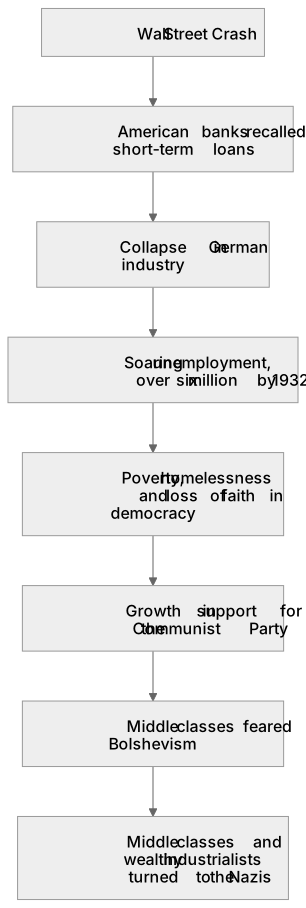
Put it in order
Put these steps in the order they happen.
- 1. Poverty, homelessness and loss of faith in democracy
- 2. Middle classes and wealthy industrialists turned to the Nazis
- 3. Growth in support for the Communist Party
- 4. Wall Street Crash
- 5. American banks recalled short-term loans
- 6. Middle classes feared Bolshevism
- 7. Collapse in German industry
- 8. Soaring unemployment, over six million by 1932
Label the diagram
Some boxes have lost their names. Pick the right name for each number.
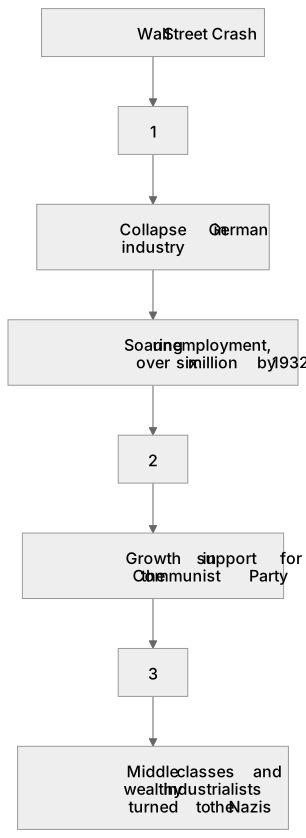
1Box 1
2Box 2
3Box 3
There is more to this lesson
The full lesson goes on to check your understanding and help you earn the marks. Create a free account to carry on, with your progress saved.
A week of Premium from your first lesson · Then the free plan continues · No card, no charge
Test your understanding of Option 31: Key topic 2: Hitler’s rise to power, 1919–33 - 3 The growth in support for the Nazis, 1929–32: The growth of unemployment – its causes and impact. The growth of support for the Communist Party.
Active recall beats re-reading. Take an instant quiz now to test what you’ve learned and lock it into long-term memory.
A week of Premium from your first lesson · Then the free plan continues · No card, no charge