Pearson Edexcel · GCSE · History
Course version: 1HI0 · Version from Sept 2016
Key topic 3: Nazi control and dictatorship, 1933–39 - 1 The creation of a…
Full specification wording
Option 31: Key topic 3: Nazi control and dictatorship, 1933–39 - 1 The creation of a dictatorship, 1933–34: The Reichstag Fire. The Enabling Act and the banning of other parties and trade unions.
The creation of the Nazi dictatorship began rapidly in 1933.
Checked against the Pearson Edexcel 1HI0 specification (opens in a new tab) on .
- Point 1 of 2
- 4 key terms
Study notes
From the checked teaching notes for this specification point.
The idea
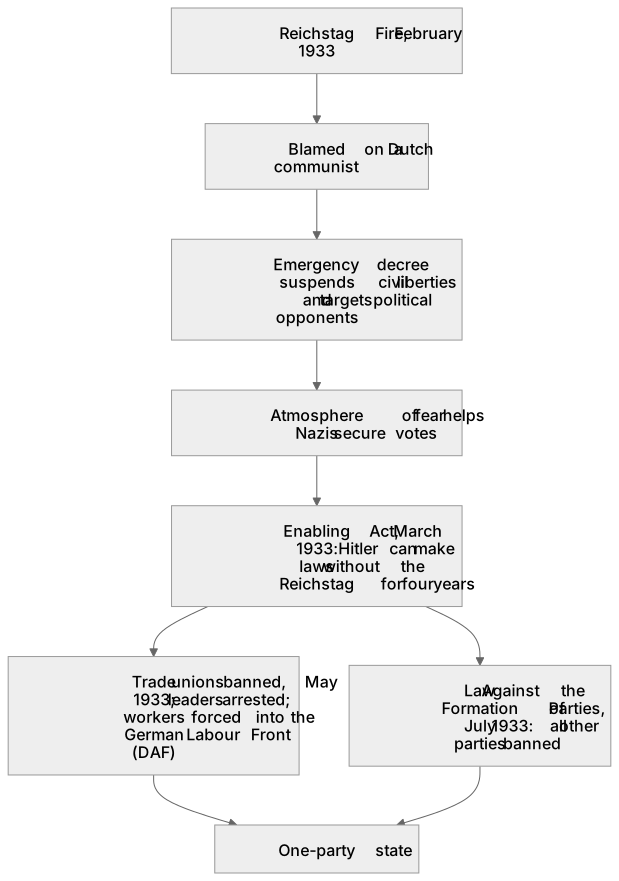
The creation of the Nazi dictatorship began rapidly in 1933. The Reichstag Fire in February 1933, blamed on a Dutch communist, allowed Hitler to persuade Hindenburg to pass an emergency decree suspending civil liberties and targeting political opponents. This atmosphere of fear helped the Nazis secure enough votes to pass the Enabling Act in March 1933, which gave Hitler the power to make laws without the Reichstag's approval for four years, effectively ending Weimar democracy. Hitler quickly used these dictatorial powers to eliminate opposition. In May 1933, trade unions were banned, their leaders arrested, and workers forced into the German Labour Front (DAF). By July 1933, the Law Against the Formation of Parties was passed, banning all other political parties and making Germany a one-party state.
What earns the marks
- Explain how the Reichstag Fire was used by Hitler to claim a communist uprising was imminent, leading to the Decree for the Protection of the People and the State.
- Describe the mechanics of the Enabling Act, which allowed the Chancellor to pass laws without the Reichstag, effectively dismantling the Weimar Constitution.
- Detail the process of banning trade unions in May 1933, replacing them with the German Labour Front (DAF) to remove a major source of working-class opposition.
- Outline the banning of other political parties by July 1933, culminating in the Law Against the Formation of Parties, establishing a one-party state.
Common mistakes and how to put them right
Confusing the Reichstag Fire Decree with the Enabling Act.
Put it right: Distinguish that the Decree suspended civil liberties, while the Enabling Act granted dictatorial law-making powers.
Stating that the Nazis banned all parties immediately after Hitler became Chancellor.
Put it right: Clarify that the banning of parties was a gradual process over several months, ending in July 1933.
Assuming the Enabling Act was passed illegally.
Put it right: Explain that the Act was passed using constitutional mechanisms, albeit in an atmosphere of severe SA intimidation.
Exam tips
- When discussing the Reichstag Fire, focus on its consequences rather than the debate over who actually started it.
- Link the banning of trade unions and political parties directly to Hitler's goal of removing all organised opposition to his rule.
- Use the Enabling Act as the key turning point where Germany transitioned from a democracy to a legal dictatorship.
Try the lesson
The start of the Option 31: Key topic 3: Nazi control and dictatorship, 1933–39 - 1 The creation of a dictatorship, 1933–34: The Reichstag Fire. The Enabling Act and the banning of other parties and trade unions. lesson, made from checked teaching notes for this specification point.
Have a go first
What immediate action did Hitler take following the Reichstag Fire in February 1933?
Listen
The creation of the Nazi dictatorship began rapidly in 1933. The Reichstag Fire in February 1933, blamed on a Dutch communist, allowed Hitler to persuade Hindenburg to pass an emergency decree suspending civil liberties and targeting political opponents. This atmosphere of fear helped the Nazis secure enough votes to pass the Enabling Act in March 1933, which gave Hitler the power to make laws without the Reichstag's approval for four years, effectively ending Weimar democracy. Hitler quickly used these dictatorial powers to eliminate opposition. In May 1933, trade unions were banned, their leaders arrested, and workers forced into the German Labour Front (DAF). By July 1933, the Law Against the Formation of Parties was passed, banning all other political parties and making Germany a one-party state. A strong answer earns marks for these points. Explain how the Reichstag Fire was used by Hitler to claim a communist uprising was imminent, leading to the Decree for the Protection of the People and the State. Describe the mechanics of the Enabling Act, which allowed the Chancellor to pass laws without the Reichstag, effectively dismantling the Weimar Constitution. Detail the process of banning trade unions in May 1933, replacing them with the German Labour Front (DAF) to remove a major source of working-class opposition. Outline the banning of other political parties by July 1933, culminating in the Law Against the Formation of Parties, establishing a one-party state. A common slip: Confusing the Reichstag Fire Decree with the Enabling Act. Instead, Distinguish that the Decree suspended civil liberties, while the Enabling Act granted dictatorial law-making powers. Exam tip: When discussing the Reichstag Fire, focus on its consequences rather than the debate over who actually started it.
See it
Key words
Say what each word means before you turn the card.
Enabling Act
Try answering aloud or in your head before turning the card.
Reichstag Fire
Try answering aloud or in your head before turning the card.
Elimination of opposition
Try answering aloud or in your head before turning the card.
Consolidation of power
Try answering aloud or in your head before turning the card.
See every definition
- Enabling Act
- Passed in March 1933, it gave Hitler the power to make laws without the Reichstag's approval for four years, effectively ending Weimar democracy.
- Reichstag Fire
- In February 1933, blamed on a Dutch communist, it allowed Hitler to persuade Hindenburg to pass an emergency decree suspending civil liberties and targeting political opponents.
- Elimination of opposition
- Hitler quickly used his dictatorial powers to remove organised opposition, banning trade unions in May 1933 and all other political parties by July 1933.
- Consolidation of power
- The rapid creation of the Nazi dictatorship in 1933 through the Reichstag Fire, the Enabling Act and the banning of other parties and trade unions.
Label the diagram
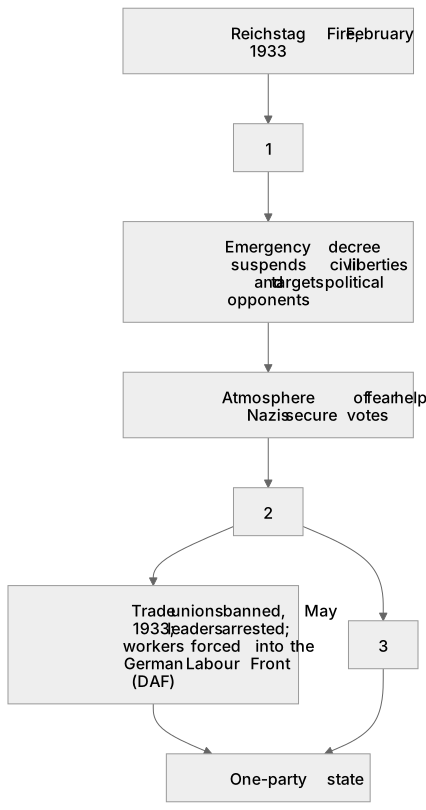
Some boxes have lost their names. Pick the right name for each number.
1Box 1
2Box 2
3Box 3
There is more to this lesson
The full lesson goes on to check your understanding and help you earn the marks. Create a free account to carry on, with your progress saved.
A week of Premium from your first lesson · Then the free plan continues · No card, no charge
Test your understanding of Option 31: Key topic 3: Nazi control and dictatorship, 1933–39 - 1 The creation of a dictatorship, 1933–34: The Reichstag Fire. The Enabling Act and the banning of other parties and trade unions.
Active recall beats re-reading. Take an instant quiz now to test what you’ve learned and lock it into long-term memory.
A week of Premium from your first lesson · Then the free plan continues · No card, no charge