Pearson Edexcel · GCSE · History
Course version: 1HI0 · Version from Sept 2016
Key topic 3: Nazi control and dictatorship, 1933–39 - 2 The police state:…
Full specification wording
Option 31: Key topic 3: Nazi control and dictatorship, 1933–39 - 2 The police state: The role of the Gestapo, the SS and concentration camps.
The Nazi police state relied on terror to eliminate opposition.
Checked against the Pearson Edexcel 1HI0 specification (opens in a new tab) on .
- Point 1 of 2
- 4 key terms
Study notes
From the checked teaching notes for this specification point.
The idea
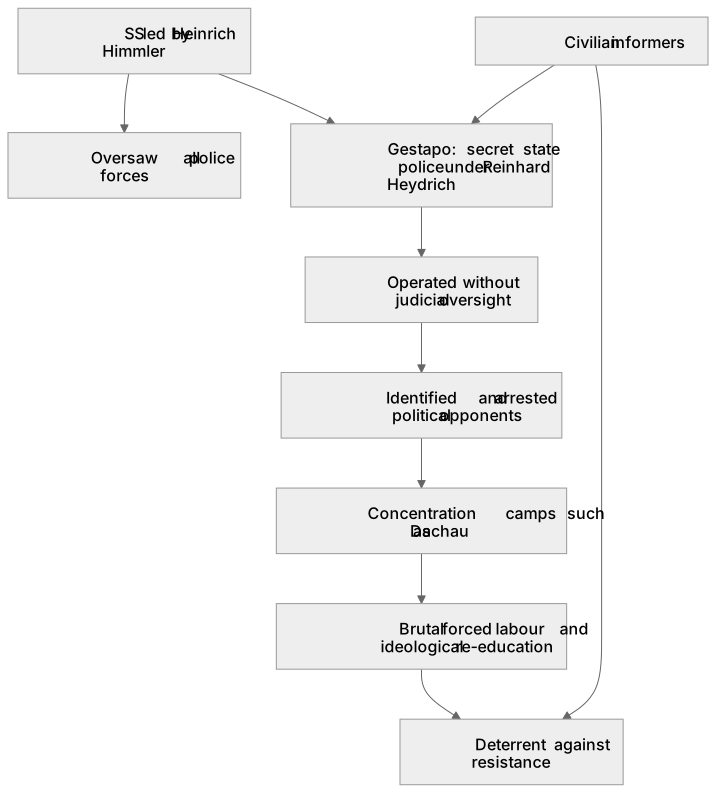
The Nazi police state relied on terror to eliminate opposition. The SS, led by Heinrich Himmler, grew from Hitler's bodyguard into the primary instrument of internal security, overseeing all police forces. The Gestapo, the secret state police under Reinhard Heydrich, operated without judicial oversight to identify and arrest political opponents. They relied heavily on civilian informers to create an atmosphere of pervasive fear. Those arrested were often sent to concentration camps, such as Dachau, which initially incarcerated political prisoners like communists. These camps subjected inmates to brutal forced labour and ideological 're-education', serving as a powerful deterrent against any resistance to the Nazi regime.
What earns the marks
- Identify the SS as the overarching security organisation led by Heinrich Himmler.
- Explain the Gestapo's role as a secret police force relying on civilian informers to root out opposition.
- Describe the purpose of early concentration camps as brutal prisons for political opponents and trade unionists.
- Analyse how the combined use of these organisations created a climate of fear and compliance across Germany.
Common mistakes and how to put them right
Confusing the SS and the SA.
Put it right: The SA was the original paramilitary wing purged in 1934, while the SS became the main security force.
Assuming concentration camps in 1933-39 were extermination camps.
Put it right: They were primarily for political prisoners and forced labour during this period.
Believing the Gestapo had millions of officers.
Put it right: They were actually a relatively small force that relied heavily on denunciations from ordinary citizens.
Exam tips
- Use specific examples, such as Dachau, to illustrate the early use and purpose of concentration camps.
- Emphasise the psychological impact of the Gestapo, noting that the fear of informers was as effective as the police themselves.
- Link the roles of the SS, Gestapo and camps together to explain how the 'police state' functioned as a cohesive system of control.
Try the lesson
The start of the Option 31: Key topic 3: Nazi control and dictatorship, 1933–39 - 2 The police state: The role of the Gestapo, the SS and concentration camps. lesson, made from checked teaching notes for this specification point.
Have a go first
What was the primary role of the Gestapo in Nazi Germany?
Listen
The Nazi police state relied on terror to eliminate opposition. The SS, led by Heinrich Himmler, grew from Hitler's bodyguard into the primary instrument of internal security, overseeing all police forces. The Gestapo, the secret state police under Reinhard Heydrich, operated without judicial oversight to identify and arrest political opponents. They relied heavily on civilian informers to create an atmosphere of pervasive fear. Those arrested were often sent to concentration camps, such as Dachau, which initially incarcerated political prisoners like communists. These camps subjected inmates to brutal forced labour and ideological 're-education', serving as a powerful deterrent against any resistance to the Nazi regime. A strong answer earns marks for these points. Identify the SS as the overarching security organisation led by Heinrich Himmler. Explain the Gestapo's role as a secret police force relying on civilian informers to root out opposition. Describe the purpose of early concentration camps as brutal prisons for political opponents and trade unionists. Analyse how the combined use of these organisations created a climate of fear and compliance across Germany. Exam tip: Use specific examples, such as Dachau, to illustrate the early use and purpose of concentration camps.
See it
Key words
Say what each word means before you turn the card.
The police state
Try answering aloud or in your head before turning the card.
The SS
Try answering aloud or in your head before turning the card.
The Gestapo
Try answering aloud or in your head before turning the card.
Concentration camps
Try answering aloud or in your head before turning the card.
See every definition
- The police state
- A system relying on terror to eliminate opposition, in which the SS oversaw all police forces and the Gestapo arrested political opponents without judicial oversight.
- The SS
- Led by Heinrich Himmler, it grew from Hitler's bodyguard into the primary instrument of internal security, overseeing all police forces.
- The Gestapo
- The secret state police under Reinhard Heydrich, which operated without judicial oversight to identify and arrest political opponents and relied heavily on civilian informers.
- Concentration camps
- Brutal prisons such as Dachau, which initially incarcerated political prisoners like communists and subjected inmates to forced labour and ideological 're-education' as a deterrent against resistance.
Label the diagram
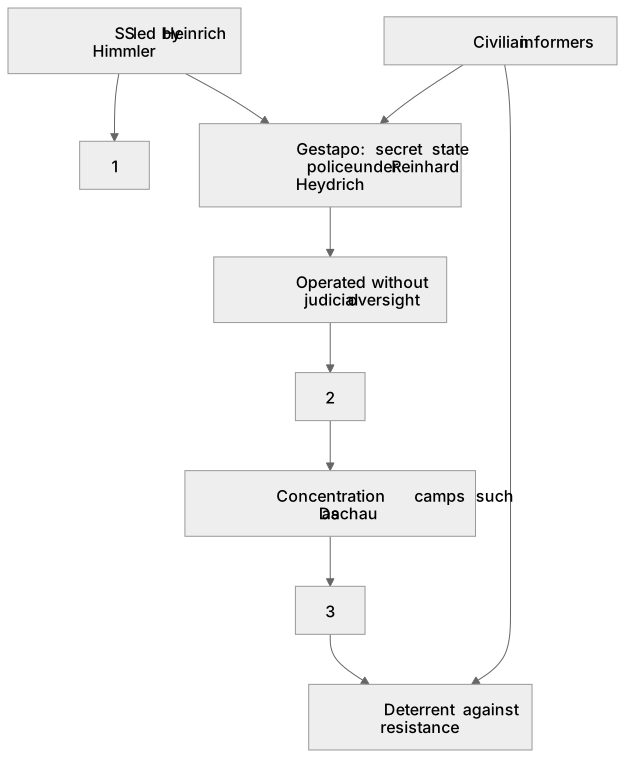
Some boxes have lost their names. Pick the right name for each number.
1Box 1
2Box 2
3Box 3
There is more to this lesson
The full lesson goes on to check your understanding and help you earn the marks. Create a free account to carry on, with your progress saved.
A week of Premium from your first lesson · Then the free plan continues · No card, no charge
Test your understanding of Option 31: Key topic 3: Nazi control and dictatorship, 1933–39 - 2 The police state: The role of the Gestapo, the SS and concentration camps.
Active recall beats re-reading. Take an instant quiz now to test what you’ve learned and lock it into long-term memory.
A week of Premium from your first lesson · Then the free plan continues · No card, no charge