Pearson Edexcel · GCSE · History
Course version: 1HI0 · Version from Sept 2016
Key topic 4: Life in Nazi Germany, 1933–39 - 1 Nazi policies towards…
Full specification wording
Option 31: Key topic 4: Life in Nazi Germany, 1933–39 - 1 Nazi policies towards women: Nazi views on women and the family.
The Nazis held highly traditional and biologically deterministic views on women and the family, encapsulated by the slogan 'Kinder, Küche, Kirche' (Children, Kitchen, Church).
Checked against the Pearson Edexcel 1HI0 specification (opens in a new tab) on .
- Point 1 of 2
- 3 key terms
Study notes
From the checked teaching notes for this specification point.
The idea
The Nazis held highly traditional and biologically deterministic views on women and the family, encapsulated by the slogan 'Kinder, Küche, Kirche' (Children, Kitchen, Church). They believed a woman's primary duty was to be a mother and raise a large number of racially pure Aryan children to secure the future of the Thousand Year Reich. The family was viewed as the foundational unit of the state, essential for breeding the next generation of soldiers and mothers. Consequently, women were actively discouraged from pursuing higher education, politics, or professional careers, which were deemed unnatural and detrimental to their biological function. Men were expected to be the providers and defenders, while women were strictly the nurturers.
What earns the marks
- Identify the core Nazi belief that women's primary role was domestic, summarised by the phrase 'Kinder, Küche, Kirche'.
- Explain the ideological importance of the family as the breeding ground for the Aryan race and the foundation of the state.
- Describe the Nazi view that men and women had distinct, biologically determined roles, with men as fighters and women as mothers.
- Note the Nazi opposition to Weimar-era female emancipation, viewing female professionals and politicians as unnatural.
Common mistakes and how to put them right
Stating that the Nazis hated women.
Put it right: The Nazis highly valued women, but strictly in their capacity as mothers and homemakers, not as independent professionals.
Claiming women had no role in the Nazi state.
Put it right: Women had a crucial role in securing the future of the Reich by raising the next generation of Aryan children.
Confusing Nazi views with general 1930s conservatism.
Put it right: While sharing some traditional views, Nazi ideology was uniquely driven by racial purity and the need to breed soldiers.
Exam tips
- Use the phrase 'Kinder, Küche, Kirche' to demonstrate specific knowledge of Nazi attitudes towards women.
- Link Nazi views on women directly to their broader goals of racial purity and military expansion.
- Contrast Nazi views with the progressive freedoms women enjoyed during the Weimar Republic to highlight the scale of the ideological shift.
Try the lesson
The start of the Option 31: Key topic 4: Life in Nazi Germany, 1933–39 - 1 Nazi policies towards women: Nazi views on women and the family. lesson, made from checked teaching notes for this specification point.
Have a go first
What were the three main roles expected of women according to traditional Nazi ideology?
Listen
The Nazis held highly traditional and biologically deterministic views on women and the family, encapsulated by the slogan 'Kinder, Küche, Kirche' (Children, Kitchen, Church). They believed a woman's primary duty was to be a mother and raise a large number of racially pure Aryan children to secure the future of the Thousand Year Reich. The family was viewed as the foundational unit of the state, essential for breeding the next generation of soldiers and mothers. Consequently, women were actively discouraged from pursuing higher education, politics, or professional careers, which were deemed unnatural and detrimental to their biological function. Men were expected to be the providers and defenders, while women were strictly the nurturers. A strong answer earns marks for these points. Identify the core Nazi belief that women's primary role was domestic, summarised by the phrase 'Kinder, Küche, Kirche'. Explain the ideological importance of the family as the breeding ground for the Aryan race and the foundation of the state. Describe the Nazi view that men and women had distinct, biologically determined roles, with men as fighters and women as mothers. Note the Nazi opposition to Weimar-era female emancipation, viewing female professionals and politicians as unnatural. A common slip: Stating that the Nazis hated women. Instead, The Nazis highly valued women, but strictly in their capacity as mothers and homemakers, not as independent professionals. Exam tip: Use the phrase 'Kinder, Küche, Kirche' to demonstrate specific knowledge of Nazi attitudes towards women.
See it

Key words
Say what each word means before you turn the card.
Kinder, Küche, Kirche
Try answering aloud or in your head before turning the card.
The family unit
Try answering aloud or in your head before turning the card.
Gender roles
Try answering aloud or in your head before turning the card.
See every definition
- Kinder, Küche, Kirche
- A slogan summarising the Nazi view that a woman's primary duty was to be a mother and raise a large number of racially pure Aryan children.
- The family unit
- The foundational unit of the state, viewed by the Nazis as essential for breeding the next generation of soldiers and mothers.
- Gender roles
- The Nazi view that men and women had distinct, biologically determined roles, with men as providers and defenders and women strictly as nurturers.
Label the diagram
Some boxes have lost their names. Pick the right name for each number.
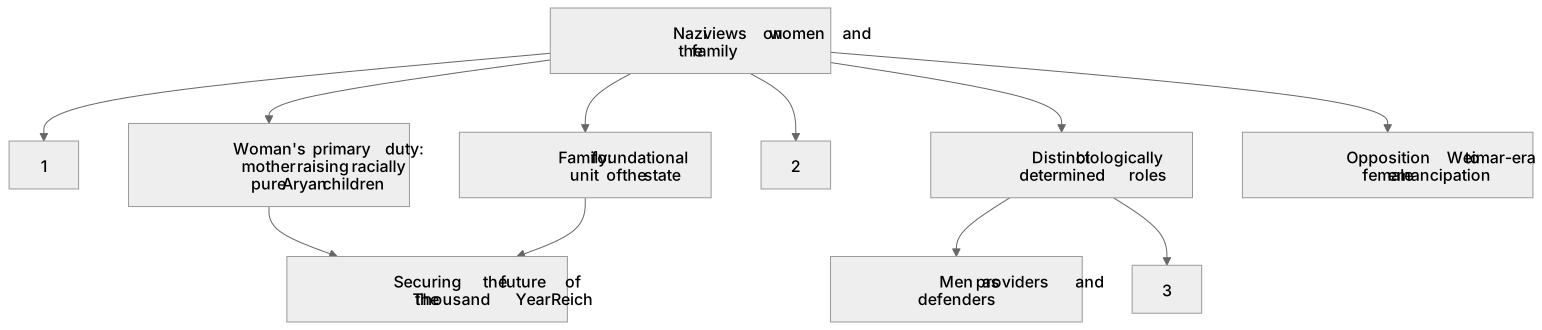
1Box 1
2Box 2
3Box 3
There is more to this lesson
The full lesson goes on to check your understanding and help you earn the marks. Create a free account to carry on, with your progress saved.
A week of Premium from your first lesson · Then the free plan continues · No card, no charge
Test your understanding of Option 31: Key topic 4: Life in Nazi Germany, 1933–39 - 1 Nazi policies towards women: Nazi views on women and the family.
Active recall beats re-reading. Take an instant quiz now to test what you’ve learned and lock it into long-term memory.
A week of Premium from your first lesson · Then the free plan continues · No card, no charge